Filing Chapter 7 in Florida can feel overwhelming when you’re drowning in debt. The process has strict rules, timelines, and requirements that trip up many people who try to navigate it alone.
We at Harnage Law, PLLC have helped countless Floridians understand what Chapter 7 actually means and how to protect their assets through the filing process. This guide walks you through each step so you know exactly what to expect.
What Chapter 7 Actually Does for You
Chapter 7 bankruptcy is a liquidation process, not a magic wand that erases your past. It targets people who genuinely cannot repay their debts. The trustee appointed to your case will sell any nonexempt assets you own and distribute the proceeds to creditors. Most importantly, Chapter 7 discharges qualifying debts entirely, meaning you no longer owe them after discharge.
The entire process typically completes within a few months, making it faster than Chapter 13, which stretches across three to five years of monthly payments. Chapter 7 stops creditor collection calls, wage garnishments, and lawsuits immediately through the automatic stay, which activates the moment you file. After discharge, your post-bankruptcy income belongs entirely to you and cannot be applied to discharged debts.
The Means Test Determines Your Eligibility
Chapter 7 is not available to everyone. You must pass the means test, a calculation that compares your current monthly income against the median income for your household size in Florida. If your income falls below the median, you likely qualify.
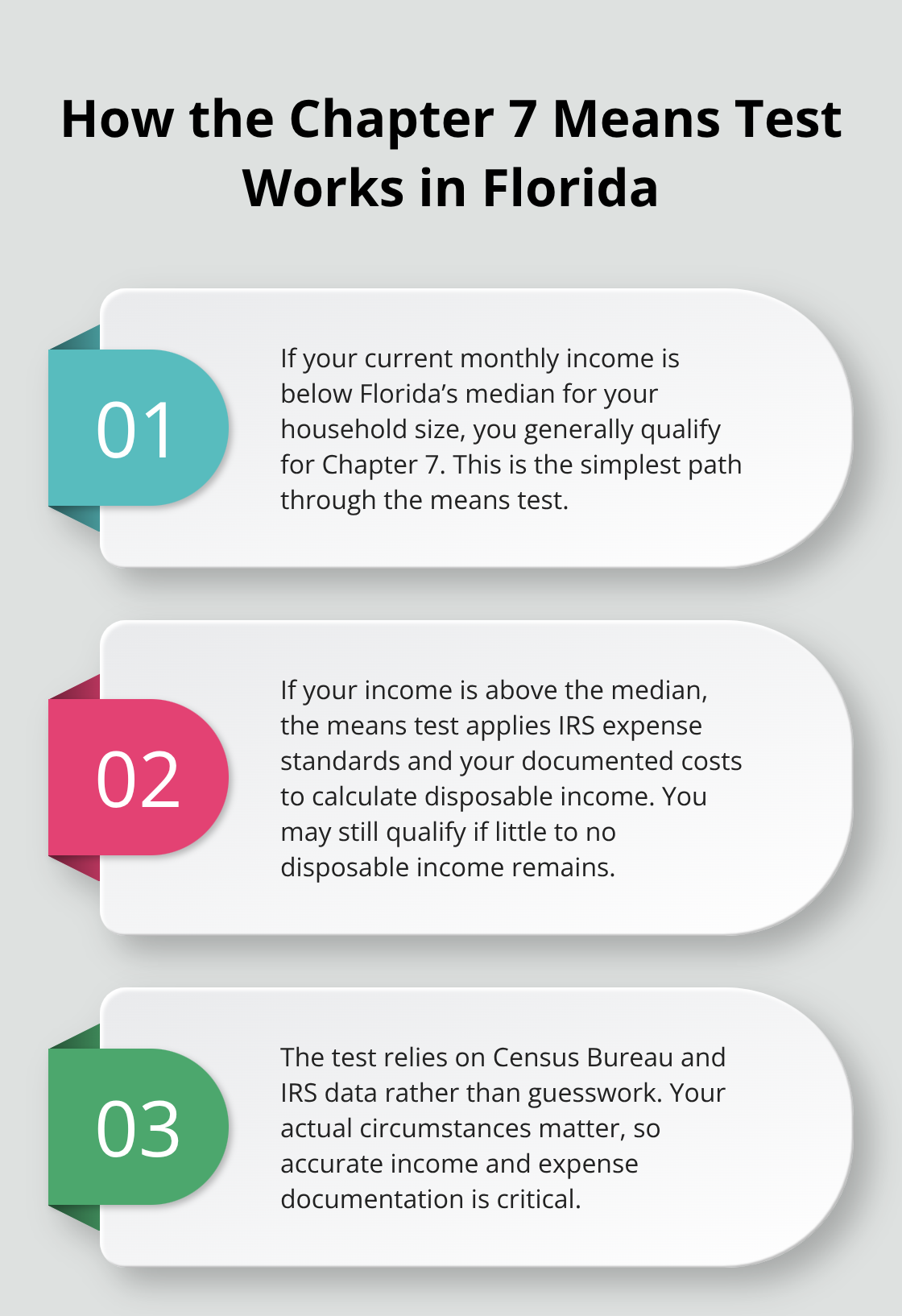
If it exceeds the median, the means test examines your actual monthly expenses using IRS standards to determine whether you have disposable income. The means test uses specific expense multipliers from the Census Bureau and IRS data, not arbitrary figures, so your actual situation matters significantly.
Chapter 13 Works Differently, and That Matters
Chapter 13 is fundamentally different from Chapter 7. Instead of liquidating assets, you propose a repayment plan lasting three to five years where you pay creditors through the trustee. Chapter 13 allows you to keep all your property, making it the better choice if you have substantial nonexempt assets or want to stop a foreclosure or repossession.
You can also pay attorney fees through the repayment plan in Chapter 13, whereas Chapter 7 requires paying fees upfront (typically between $1,500 and $2,500). The trade-off is clear: Chapter 13 preserves your property but commits you to years of payments. Chapter 7 offers a faster exit but requires surrendering nonexempt assets.
Filing Fees and Payment Requirements
The filing fee for Chapter 7 is $338, comprising a $245 filing fee, $78 administrative fee, and $15 trustee surcharge. You must pay this by money order or cashier’s check made payable to Clerk, US Bankruptcy Court. No personal checks, cash, or credit cards are accepted.
Many people filing in Florida choose Chapter 7 because they have few nonexempt assets and need immediate relief from debt. If you fail the means test in Chapter 7, Chapter 13 may still be available as your alternative path forward. Understanding which chapter fits your situation requires examining your income, assets, and financial goals-the next section walks you through the specific steps that begin your filing process.
Starting Your Chapter 7 Filing in Florida
Before you submit a single form to the bankruptcy court, Florida law requires you to complete credit counseling from an approved agency listed on the U.S. Trustee website. This is not optional and not a formality-you cannot file without the certificate of completion. The counseling typically takes two to three hours and covers budgeting, debt management alternatives, and what bankruptcy actually does. Most agencies charge between $50 and $200 for the course, though fee waivers exist if you cannot afford it.
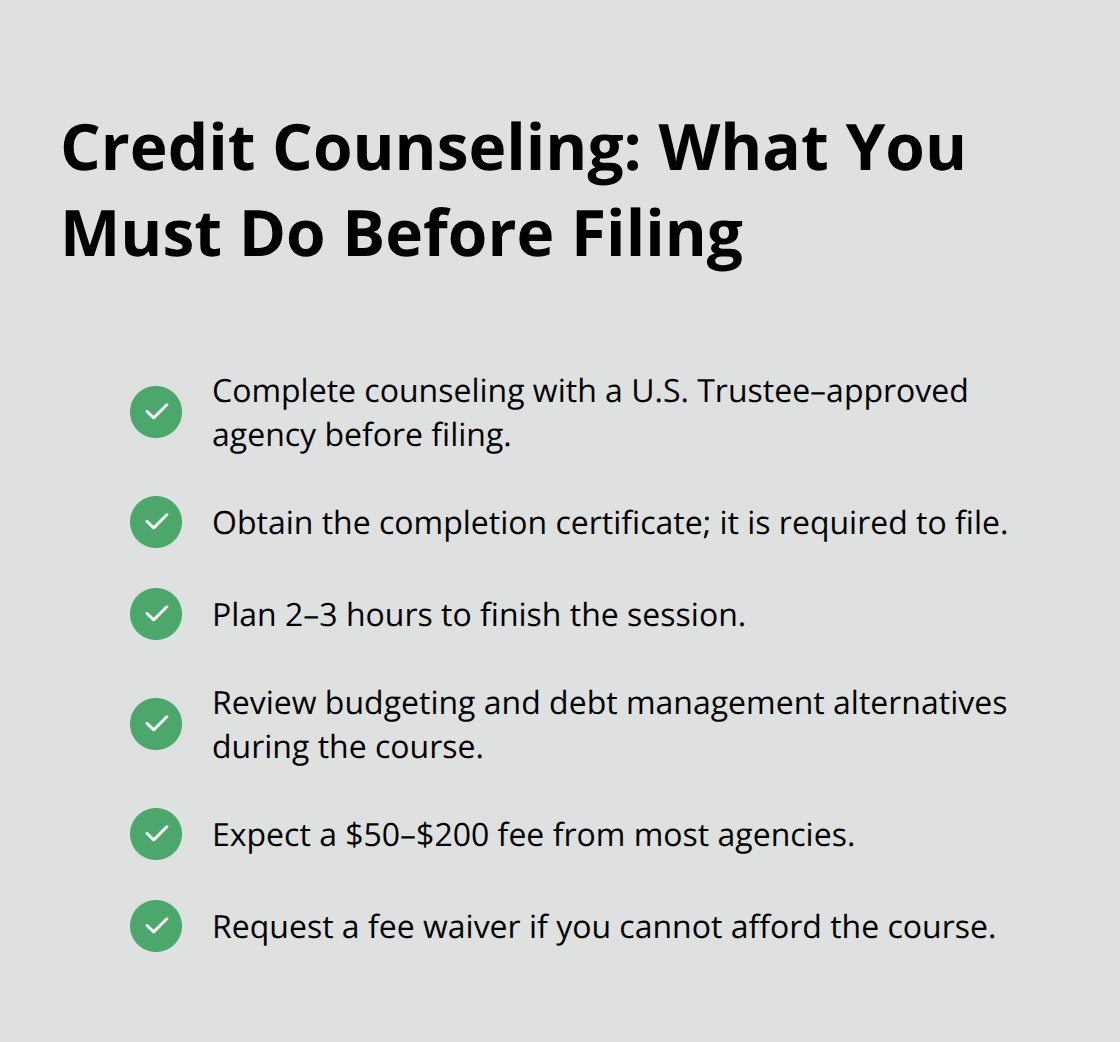
Once completed, you receive a certificate that becomes part of your filing packet.
Gathering Documents the Court Demands
Preparing your petition requires collecting specific documents that the court demands. You will need copies of pay stubs from the 60 days before filing, tax returns from the past two years, recent bank statements, and a complete list of all creditors with their addresses. The court requires only the names and addresses on your creditor matrix-nothing else. You must also provide a legible photocopy of a current government-issued photo ID and list only the last four digits of your Social Security Number on public filings for privacy protection.
The filing fee is $338 payable by money order or cashier’s check to Clerk, US Bankruptcy Court. If you cannot pay the full amount upfront, you can request installment payments using the Local Form Application for Individuals to Pay the Filing Fee in Installments, but you must pay at least half at the time of filing. If your income falls below the HHS Poverty Guidelines, you can apply for a filing fee waiver using Official Bankruptcy Form 103B, eliminating the fee entirely.
Filing Your Petition With Original Signatures
The actual petition and supporting schedules-including your property list, exemptions, income, expenses, and the means test calculation-must contain original signatures, not scanned copies. Electronic filing is available, but payment must arrive within 14 days by certified funds. The court will not accept unsigned documents or copies lacking wet signatures from you or your attorney.
What Happens at Your 341 Meeting
The court schedules a meeting of creditors, called the 341 meeting, after your petition is filed. You must appear in person and answer questions from the trustee and any creditors who show up. The trustee will ask about your income, assets, debts, and whether you own property with equity. Creditors rarely attend these meetings for consumer Chapter 7 cases, so most meetings involve only you and the trustee. The entire meeting typically lasts 10 to 15 minutes. Bring identification and prepare to discuss your financial situation honestly. Lying or misrepresenting facts at this meeting carries serious consequences, including potential fraud charges with penalties up to $250,000 and 20 years in prison according to federal law.
The Path to Discharge and Financial Recovery
After your 341 meeting, the trustee has a window to identify and sell any nonexempt assets. If you have no nonexempt property, the trustee will file a no-asset report and your case moves toward discharge. You must also complete a personal financial management course within 60 days after the first date set for your 341 meeting. This second course, different from the credit counseling you completed before filing, focuses on financial recovery and budgeting after bankruptcy. Once you finish this course and file the completion certificate, the court issues your discharge order, typically within four to six months from filing.
The discharge eliminates qualifying debts permanently. Student loans, child support, recent taxes, and criminal fines do not discharge, but credit card debt, medical bills, and most personal loans vanish. Co-signers on your debts remain liable after discharge, so they may still face collection efforts. After discharge, your post-bankruptcy income is yours entirely and creditors cannot pursue debts you discharged. Understanding which assets you can protect during this process becomes your next priority, as Florida law offers significant protections that many filers overlook.
What Florida Lets You Keep in Chapter 7
Florida’s bankruptcy exemptions rank among the most generous in the nation, which is why the state attracts filers seeking to protect their assets. The exemptions work by removing certain property from the bankruptcy estate, meaning the trustee cannot sell it to pay creditors. Understanding exactly what qualifies matters tremendously because claiming exemptions incorrectly or fraudulently carries penalties up to $250,000 and 20 years in prison according to federal law.
Your Home Receives Unlimited Protection
Florida’s homestead exemption stands out immediately-it protects unlimited equity in your primary residence if you own a single-family home on up to 160 acres outside a municipality or half an acre within city limits. However, this protection requires you to own the property for at least 1,215 days before filing; if you haven’t met that timeline, the federal cap of $214,000 applies instead. This distinction matters significantly because many recent Florida residents cannot claim the full homestead exemption and must work within the federal limitation.
Vehicles, Retirement Accounts, and Personal Property
Your motor vehicle receives protection up to $5,000 of equity in a single vehicle, which means you keep a financed car or truck worth more than what you owe. Retirement accounts including 401(k)s and IRAs receive substantial protection under both federal and Florida law, with a cap of $1,711,975 per person for cases filed between April 1, 2025 and March 31, 2028. Personal property including furniture, art, and electronics qualifies for $1,000 of protection, increasing to $4,000 if you don’t claim the homestead exemption. Life insurance proceeds payable to a beneficiary are fully exempt, along with the cash surrender value of life insurance and annuity contracts.
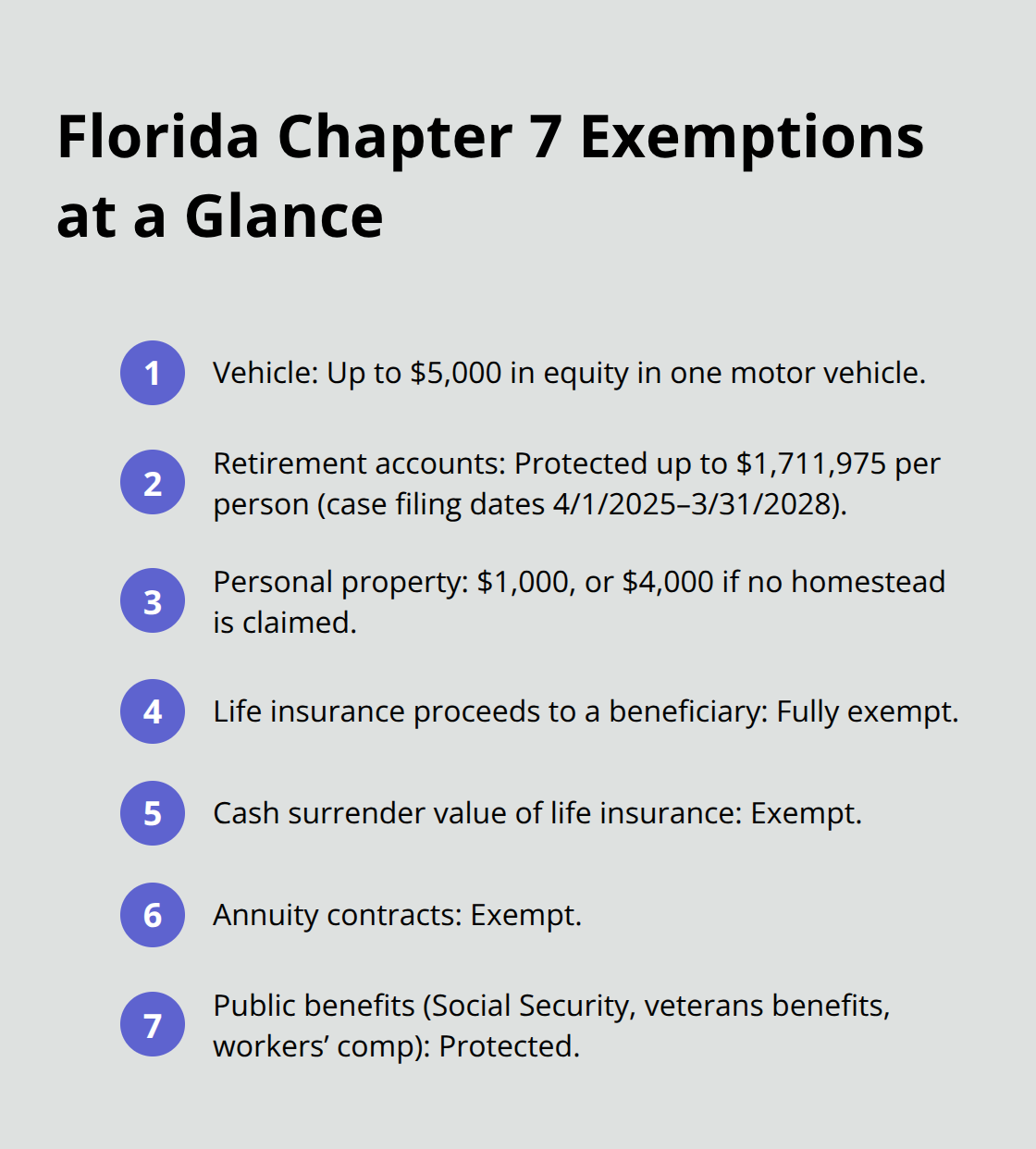
Public benefits like Social Security, veterans benefits, and workers’ compensation remain untouched by creditors and the bankruptcy process.
Residency Requirements Determine Which Exemptions Apply
To use Florida exemptions rather than exemptions from another state, you must have lived in Florida for at least 730 days in the two years before filing. If you haven’t met that requirement, you apply exemptions from whichever state you lived in longest during that two-year period, though you can file after just 180 days of Florida residence. This distinction matters because different states protect different amounts of property-some states protect far less home equity or offer no homestead exemption at all.
Listing Exemptions and Identifying Nonexempt Assets
When you file, you list your claimed exemptions on Schedule C, identifying specifically which property you claim as exempt and which exemption statute protects it. The trustee reviews these claims and can object if they believe you’ve over-exempted property or mischaracterized assets. Nonexempt assets-those not protected by exemptions-become part of the bankruptcy estate. Common nonexempt property includes a second home, a second vehicle, valuable art collections, inheritance proceeds received before filing, tax refunds, and substantial savings accounts beyond what exemptions cover. The trustee will sell this nonexempt property and distribute proceeds to creditors according to bankruptcy priority rules. If you own no nonexempt assets, the trustee files a no-asset report and your case moves directly toward discharge without any property liquidation. Understanding your specific situation requires detailed analysis of what you own, what you owe on it, and which exemptions apply to your circumstances.
Final Thoughts
Filing Chapter 7 in Florida eliminates qualifying debts permanently and stops creditor harassment immediately through the automatic stay. The process moves quickly-typically four to six months from filing to discharge-because the trustee liquidates nonexempt assets and distributes proceeds to creditors without requiring years of repayment. You keep protected assets under Florida’s generous exemptions, including your home with unlimited equity if you meet the 1,215-day ownership requirement, retirement accounts up to $1,711,975, and one vehicle with up to $5,000 of equity protection.
After discharge, your post-bankruptcy income belongs entirely to you, and creditors cannot pursue debts you discharged. The financial recovery phase begins immediately as the automatic stay halts collection efforts before your case reaches the 341 meeting. Many filers report feeling relief within weeks of filing because the constant pressure of creditor lawsuits and wage garnishments stops.
The complexity of filing Chapter 7 in Florida lies not in the basic steps but in maximizing your asset protection and avoiding costly mistakes. Mischaracterizing exemptions or providing inaccurate information carries serious consequences, including fraud penalties up to $250,000 and 20 years in prison. We at Harnage Law, PLLC guide you through each requirement, handle communications with creditors, and ensure your exemptions are claimed correctly so you keep everything Florida law allows.