Chapter 7 personal bankruptcy can feel overwhelming, but understanding how it works is the first step toward financial recovery. Filing for Chapter 7 means most of your unsecured debts get wiped away, though the process comes with real consequences for your credit and finances.
We at Harnage Law, PLLC know that Florida residents need clear answers about what happens to their assets, how their credit recovers, and what comes next. This guide walks you through each stage so you can make informed decisions about your financial future.
How Your Credit Score Changes During Chapter 7
The Immediate Impact on Your Credit Report
Filing Chapter 7 bankruptcy triggers an immediate drop in your credit score that most people underestimate. The filing itself appears on your credit report right away, and major credit bureaus typically lower scores by 130 to 200 points within days of filing, depending on your starting score. If you started with a score around 700, you can expect to see it fall to somewhere between 500 and 570. This hit stings, but it reflects reality: you are reorganizing your financial obligations, and lenders view that as higher risk.
The damage accelerates if creditors report charge-offs or collection accounts before your filing date, which many do once accounts reach 180 days past due. What matters now is understanding that this damage already happened through missed payments and defaults. The bankruptcy filing itself represents a controlled reset rather than additional destruction.
Credit Recovery Begins After Discharge
Your credit score starts climbing the moment your Chapter 7 case closes and debts are discharged, typically 60 to 90 days after your 341 meeting with creditors. Most people see modest improvements within 3 to 6 months post-discharge, with scores rising 50 to 100 points as the immediate crisis fades from recent history. Within 12 to 24 months, many filers qualify for car loans and credit cards again, though interest rates remain elevated.
The bankruptcy stays on your credit report for 10 years, but its impact weakens significantly after year three. Your path forward depends on discipline: pay every bill on time without exception, keep credit card balances below 30 percent of available limits, and avoid applying for multiple new accounts within short timeframes.
Rebuilding Your Credit Score Strategically
Secured credit cards designed for rebuilding work well here, requiring a cash deposit that becomes your credit limit. Some people reach scores of 650 to 700 within three to four years by maintaining this discipline, positioning themselves for conventional mortgage rates. The timeline is not quick, but it is predictable if you stay consistent.
Understanding how your credit recovers after Chapter 7 discharge sets the stage for the next critical question: which debts actually disappear through this process, and which ones stick around?
Which Debts Disappear in Chapter 7
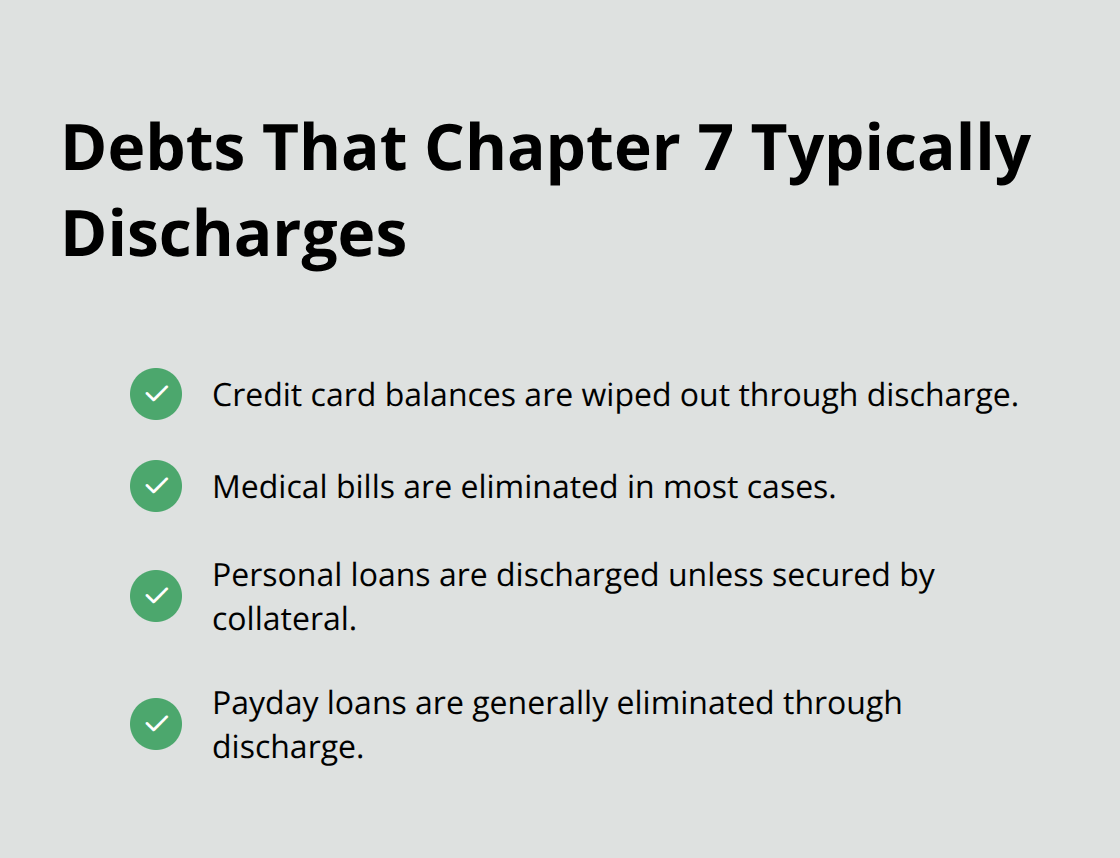
Chapter 7 bankruptcy eliminates most unsecured debts, but not all of them. Credit card balances, medical bills, personal loans, and payday loans vanish through discharge, which is why Chapter 7 appeals to people drowning in high-interest debt. The Federal Reserve reported that the average American household carries roughly $6,000 in credit card debt alone, and Chapter 7 wipes that away completely. Unsecured debts have no collateral backing them, which is why creditors take the biggest hit when discharge occurs.
If you owe $40,000 across multiple credit cards and medical collections, that entire amount disappears once the court grants your discharge 60 to 90 days after your creditors meeting. This is the core benefit of Chapter 7, and it is substantial.
Debts That Survive Chapter 7 Discharge
Certain debts refuse to die in bankruptcy. Child support and alimony obligations remain fully enforceable after discharge because Florida law protects family support above all else. Recent federal income taxes from the last three years also survive, though older tax debts may qualify for elimination depending on filing dates and payment history. Student loan debt stays on the books except in rare hardship cases where you can prove undue difficulty, which courts interpret narrowly. Criminal restitution orders, fines imposed by courts, and debts arising from fraud or willful injury also persist after discharge. If you caused a car accident through reckless driving and the judgment holder sued you successfully, that judgment debt does not disappear. The distinction matters enormously because you need to plan around these nondischargeable obligations when rebuilding your finances post-bankruptcy.
How Discharge Actually Works in Your Case
Discharge is not automatic or guaranteed. You must complete a personal financial management course and file the certificate within 60 days after your 341 creditors meeting to receive discharge. Failing to complete this course means your debts remain enforceable despite filing Chapter 7. The court also reviews your petition and schedules during the 341 meeting, and if the trustee or creditors object to discharge based on fraud or other misconduct, you could lose the entire benefit. This is why accuracy in your bankruptcy petition matters. Providing false information about income, assets, or debts constitutes fraud and can result in dismissal or denial of discharge. Verifying all numbers and documentation prevents these devastating outcomes.
What Happens to Debts Tied to Property
Secured debts like mortgages and car loans operate differently than unsecured debts. The creditor holds a lien against the property, meaning they can repossess your vehicle or foreclose on your home even after Chapter 7 discharge if you stop paying. Discharge eliminates your personal liability for the debt, but the lien survives unless you take additional steps to remove it. If you want to keep your car, you can reaffirm the loan, which means you agree to continue paying and the debt remains enforceable against you personally. If you want to keep your home, you must continue making mortgage payments or the lender will foreclose. Understanding this distinction prevents the dangerous mistake of assuming discharge means you own property free and clear when a lien still exists against it.
The next critical question becomes: which of your assets and property can you actually protect under Florida law, and what happens to everything else?
Assets and Property Protection in Florida Chapter 7
Florida Exemptions Protect Your Home
Florida bankruptcy law provides significant protection for the assets that matter most. The state has opted out of the federal exemption system, meaning Florida residents use state exemptions rather than federal ones, and these protections often exceed what other states offer. The homestead exemption stands out as the most powerful tool available: you can protect unlimited home equity regardless of value, provided you own no more than half an acre within a city or 160 acres elsewhere. This protection applies only if you owned the home for at least 1,215 days before filing, which equals approximately 3.3 years. If you have not met this timeline, a federal cap of $214,000 applies instead, still meaningful but far less generous. Your primary residence receives this protection even if you owe a mortgage, so the exemption covers the equity you have built, not the debt itself.
Vehicles and Personal Property Stay Protected
Motor vehicles receive protection up to $5,000 of equity per vehicle in Chapter 7, allowing many people to keep a financed car through continued payments. Personal property including furniture, electronics, and household goods receives protection up to $1,000, or $4,000 if you do not claim the homestead exemption. These limits cover most household items that people need to maintain their daily lives after discharge.
Retirement Accounts and Life Insurance Remain Safe
Retirement accounts receive nearly complete protection in Florida bankruptcy, covering 401(k)s, 403(b)s, traditional and Roth IRAs, and SEP IRAs with a federal cap of $1.711 million per person for cases filed between April 2025 and March 2028. This means most people’s retirement savings survive Chapter 7 intact. Life insurance proceeds payable to a named beneficiary are fully protected, and the cash surrender value of life insurance policies also receives exemption protection.
Public Benefits and Support Income Stay Yours
Public benefits including Social Security, veterans benefits, and unemployment compensation cannot be touched by creditors even in bankruptcy, and Florida law shields these income streams completely. Alimony and child support received for your support and any dependents remain exempt as well. These protections ensure that your essential income sources remain available for living expenses after discharge.
Claiming Exemptions Correctly Matters
To use Florida exemptions, you must have lived in the state for at least 730 days during the two years before filing; if not, you apply exemptions from whichever state you lived in longest during the 180 days before the two-year lookback period. The key to protecting your assets lies in understanding which exemptions apply to your specific situation and claiming them accurately on your bankruptcy schedules. Inaccurate exemption claims can result in losing property you thought was protected, which is why working with a Florida bankruptcy attorney prevents costly mistakes.
Your Path Forward After Chapter 7
Life after Chapter 7 personal bankruptcy discharge requires intentional financial discipline, but the opportunity is real. Your debts are gone, your credit will recover, and your protected assets remain yours. Start with a realistic monthly budget that accounts for every dollar, tracking your actual spending for 30 days to identify where money goes. Use free tools like YNAB or simple spreadsheets to monitor cash flow so you make intentional choices rather than reactive ones.
Establish an emergency fund starting with $500 to $1,000 in savings before pursuing anything else. This buffer prevents you from returning to credit cards when unexpected expenses arise, and it protects you from future financial crises. Secured credit cards help rebuild your credit score faster than waiting alone-deposit $500 to $1,000 with a bank, receive that amount as your credit limit, and use the card for small purchases you pay off monthly (this demonstrates responsible borrowing to credit bureaus and accelerates your score recovery).
Within three to four years, you may qualify for a car loan or mortgage at reasonable rates if you maintain discipline. Avoid taking on new debt unless it serves a clear purpose like purchasing reliable transportation or buying a home. Contact Harnage Law, PLLC to discuss your Chapter 7 bankruptcy situation and post-discharge financial strategy.