Filing Chapter 7 bankruptcy in Florida doesn’t mean losing everything you own. State and federal laws provide substantial protections for your home, retirement accounts, vehicles, and other essential assets.
We at Harnage Law, PLLC help clients understand how asset protection in Chapter 7 works and how to position themselves strategically before filing. The timing, structure, and documentation of your assets can make a significant difference in what you keep.
What Florida Protects in Chapter 7
Florida’s bankruptcy laws rank among the strongest in the nation for protecting your assets. The state allows you to use state exemptions instead of federal ones, giving you a significant advantage. The homestead exemption stands out as the most powerful protection available-it shields unlimited equity in your primary residence as long as you own no more than half an acre in a city or 160 acres elsewhere. You must have owned the home for at least 1,215 days (roughly 3.3 years) before filing and declared it as your permanent residence to qualify. A $500,000 home with $450,000 in equity remains fully protected in Chapter 7, even if you owe significant unsecured debt.
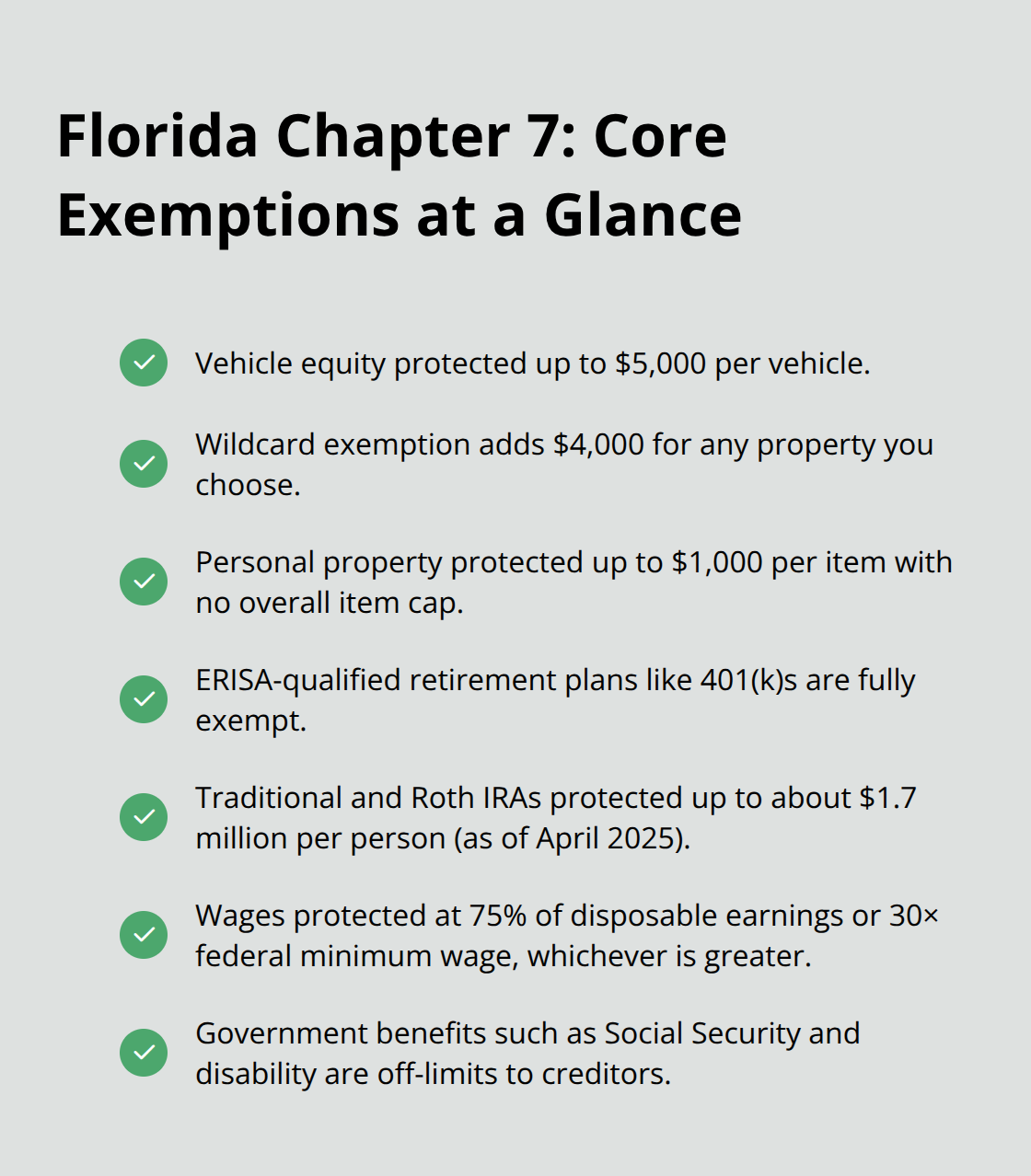
Florida protects vehicle equity up to $5,000 per vehicle, plus an additional $4,000 wildcard exemption that covers any property you choose. Personal property like furniture, clothing, electronics, and household goods receive protection up to $1,000 per item with no overall cap on the total number of items. Retirement accounts receive substantial protection-ERISA-qualified plans like 401(k)s are fully exempt, while traditional and Roth IRAs are protected up to approximately $1.7 million per person as of April 2025. Wages are protected at 75% of disposable earnings or 30 times the federal minimum wage, whichever is greater. Government benefits like Social Security and disability payments remain completely off-limits to creditors, meaning most people filing Chapter 7 in Florida retain far more than they initially expect.
These protections form the foundation of your asset preservation strategy, but understanding how to position your specific assets before filing requires careful planning and timing.
Strategy 1: Maximizing Your Homestead Exemption Before Filing
The homestead exemption offers unlimited protection, but only if you meet Florida’s strict requirements. You must own your primary residence for at least 1,215 days before filing and maintain it as your permanent home. This means if you purchased your house less than 3.3 years ago, you cannot access the full unlimited protection in Chapter 7. If you fall short of the 1,215-day requirement, federal bankruptcy law caps your homestead protection at $214,000, which severely limits your shield. Courts will not waive this requirement even if you purchased your home one day short of the deadline.
Converting non-exempt cash or investments into home equity before filing is legal, but it requires careful documentation and timing. Paying down your mortgage principal, making home improvements, or refinancing to pull cash and reinvest it in the property all strengthen your exemption claim. However, the trustee examines all financial transactions within two years before filing through the lookback period. Large, unusual transfers directly into home equity shortly before filing raise red flags and may face challenges as fraudulent transfers under federal law. Spreading conversions over several months and maintaining clear records showing legitimate home repairs, renovations, or principal payments rather than sudden lump-sum deposits creates the safest approach. Your transaction history matters significantly when the trustee reviews your case, which is why strategic timing and documentation separate successful asset protection from costly mistakes that lead to the next critical area: protecting retirement accounts and pension plans.
Strategy 2: Protecting Retirement Accounts and Pension Plans
ERISA-qualified retirement accounts like 401(k)s, 403(b)s, and traditional pensions receive unlimited federal protection in Chapter 7 bankruptcy, meaning your employer-sponsored plans remain completely off-limits to creditors regardless of their balance. IRAs and Roth IRAs are protected up to approximately $1.7 million per person as of April 2025, adjusted annually for inflation, which covers nearly all individual retirement savers. Florida law provides additional state-level protections for annuities and the cash surrender value of life insurance policies, layering protection on top of federal exemptions. This dual protection means you can hold substantial retirement wealth while discharging unsecured debts like credit cards and medical bills. Large contributions made within 120 days before filing trigger trustee scrutiny, so you should make contributions well in advance of your bankruptcy petition to avoid challenges.
Many filers leave cash in regular savings accounts when they could redirect funds into tax-advantaged retirement accounts before filing. Contributing to a traditional or Roth IRA up to the annual limit, maximizing 401(k) contributions through your employer, or funding a backdoor Roth strategy months ahead provides legitimate asset protection while building retirement security. Annuities purchased before financial distress emerged also receive strong exemption protection under Florida law, though purchasing them immediately before filing appears suspicious and invites trustee objections. Life insurance cash surrender values are protected, making permanent life insurance policies another avenue for sheltering assets. Meeting with a bankruptcy attorney at least six months before filing allows you to evaluate your retirement account strategy and ensure conversions appear reasonable rather than eleventh-hour asset shuffling designed to defraud creditors.
Understanding how to time your filing strategically around income fluctuations and the means test further strengthens your asset protection plan.
Strategy 3: Timing Your Filing to Preserve Exempt Assets
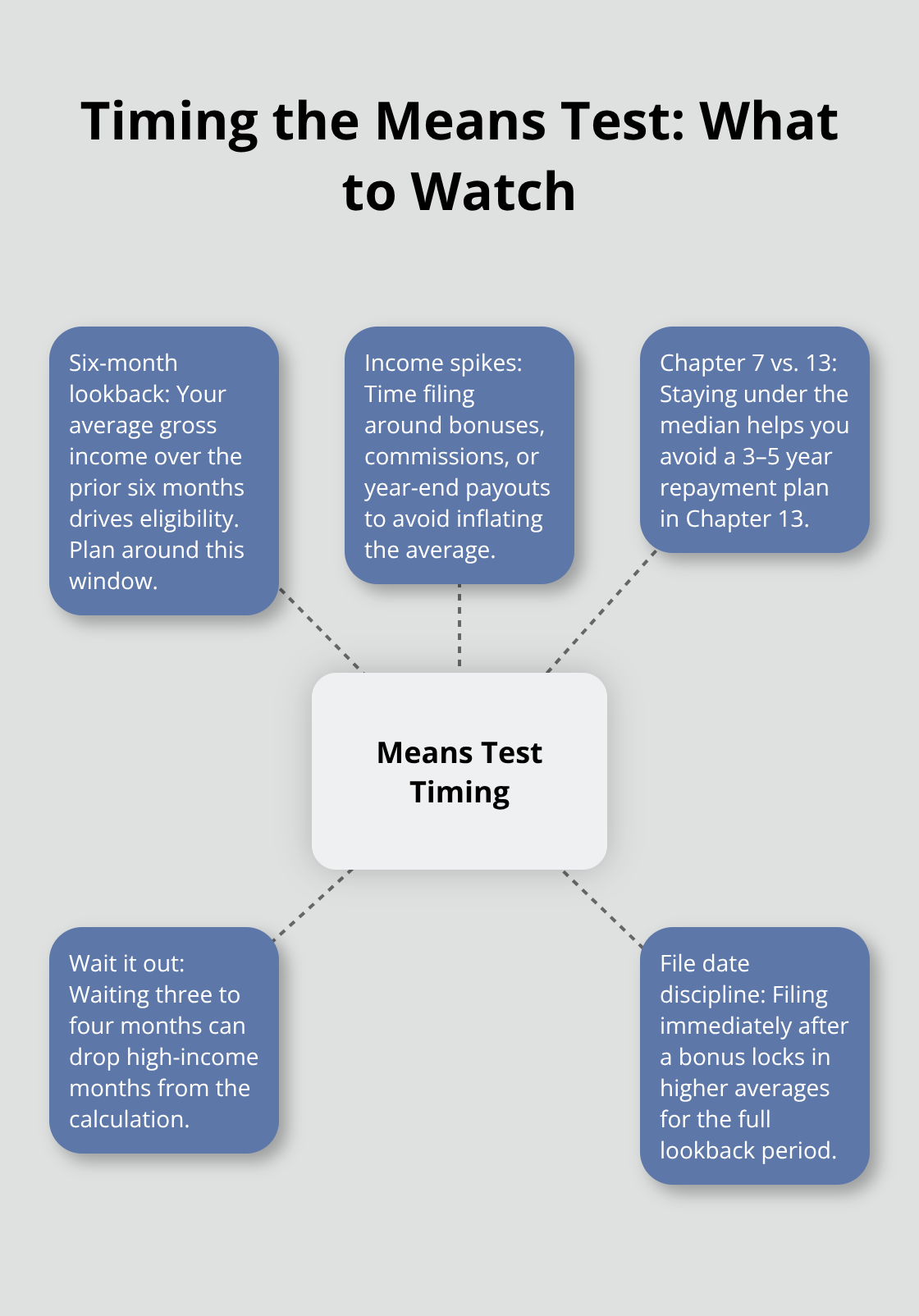
Your income level in the six months before filing determines whether you pass the means test, which directly affects what debts you discharge and what assets remain vulnerable. The means test compares your average gross income over this period against Florida’s median income threshold. If your income exceeds the threshold, you may face pressure to file Chapter 13 instead of Chapter 7, forcing a repayment plan that extends three to five years. Strategic timing around bonus payments, commission cycles, or year-end income spikes positions you below the threshold and qualifies you for Chapter 7’s faster debt discharge. Filing immediately after a bonus hits your bank account triggers higher income calculations for the entire six-month lookback period, whereas waiting three to four months allows older high-income months to drop from the calculation.
Non-exempt cash sitting in regular checking or savings accounts represents the easiest target for a Chapter 7 trustee to liquidate. Converting excess cash into exempt categories before filing eliminates this risk without triggering fraudulent transfer concerns. Purchasing a reliable vehicle within your state exemption limits, buying household furnishings and appliances your family actually needs, or prepaying insurance premiums for auto, home, or health coverage all qualify as legitimate spending on exempt items. Contributing to retirement accounts months before filing provides the strongest protection for larger cash amounts. Consulting with a bankruptcy attorney three to six months before your target filing date allows you to model different scenarios, identify which income months to include in your means test calculation, and execute conversions with proper documentation rather than scrambling to spend cash in the final weeks before filing-positioning you perfectly for the next critical strategy involving joint property protection.
Strategy 4: Using Tenancy by the Entireties to Shield Joint Property
Married couples in Florida hold a significant advantage in Chapter 7 bankruptcy through tenancy by the entireties, a form of joint ownership that shields property from individual creditors when both spouses own the asset together. Florida law treats tenancy by the entireties property as belonging to the married couple as a single unit rather than to each spouse individually, so a creditor pursuing only one spouse cannot force a sale or levy against the property. This protection applies to real estate, bank accounts, vehicles, and other assets held in both names as tenants by the entireties. The protection disappears immediately upon divorce, limiting this strategy to currently married couples. Only one spouse needs to file Chapter 7 bankruptcy for this protection to apply-the non-filing spouse’s separate creditors also cannot touch tenancy by the entireties property because the filing spouse’s bankruptcy estate does not include assets owned solely as part of a married couple.
Converting individual accounts or properties into tenancy by the entireties before one spouse files requires careful timing and documentation to avoid fraudulent transfer challenges. The conversion must occur well before financial distress becomes apparent and creditors begin pursuing collection actions. Transferring a bank account from individual ownership to tenancy by the entireties six months or more before filing appears reasonable, whereas doing so two weeks before filing looks like obvious asset hiding. Many married couples overlook this strategy entirely and fail to restructure their ownership before filing, missing substantial protection opportunities. Proper tenancy by the entireties conversions demand attention to detail and compliance with bankruptcy law, which leads directly into the next strategy: converting non-exempt assets into protected categories through legitimate spending and repositioning.
Strategy 5: Converting Non-Exempt Assets into Exempt Categories
Non-exempt cash sitting in your bank account represents the most vulnerable asset in Chapter 7 bankruptcy. The trustee can liquidate it immediately, whereas converting that same cash into exempt property shields it permanently from creditors. Florida’s exemption structure creates specific legal pathways for this conversion: you can purchase a vehicle up to $5,000 in equity, buy household furnishings and appliances your family actually uses, or invest in tools of trade if you’re self-employed. The key difference between a successful conversion and a fraudulent transfer lies in timing, documentation, and whether the purchase serves a genuine household need rather than asset hiding. Spending $3,000 on a reliable used car three months before filing, supported by purchase receipts and registration documents, appears entirely legitimate to a trustee.
Prepaying insurance premiums qualifies as another powerful conversion strategy that most filers overlook entirely. Florida law exempts insurance proceeds and disability benefits, so paying your auto insurance, homeowner’s insurance, or health insurance premiums six months in advance removes cash from your estate while protecting a necessary expense. A single parent with $8,000 in non-exempt cash could prepay one year of auto insurance ($1,200), fund a reliable replacement vehicle ($4,500 within the exemption), and purchase essential household items like a replacement refrigerator or bedroom furniture ($2,300) without triggering fraudulent transfer concerns. Each transaction requires supporting documentation: purchase agreements, receipts, and installation records for home improvements; vehicle title and registration for cars; and insurance policies showing payment dates for premiums. Maintaining organized records demonstrates to the trustee that conversions reflected genuine household needs rather than last-minute asset protection schemes designed to defraud creditors, which brings you to the final critical area where many filers stumble: avoiding the common mistakes that can derail your entire asset protection plan.
Strategy 6: Avoiding Common Asset Protection Mistakes
The two-year lookback period that trustees examine represents the most critical window for your financial decisions. Any transfer of property, payment to creditors, or conversion of assets during this timeframe faces potential scrutiny and reversal under federal bankruptcy law. Fraudulent transfers-defined as moving assets with intent to hinder, delay, or defraud creditors-carry severe penalties including denial of your entire bankruptcy discharge, meaning you remain liable for all debts despite filing. Courts don’t require proof that you intended fraud; transferring significant assets shortly before filing creates presumed fraud that you must then disprove with documentation. A $50,000 transfer to a family member two months before filing appears obviously fraudulent, whereas the same transfer made two years earlier with clear documentation of legitimate business or personal reasons survives trustee challenges.
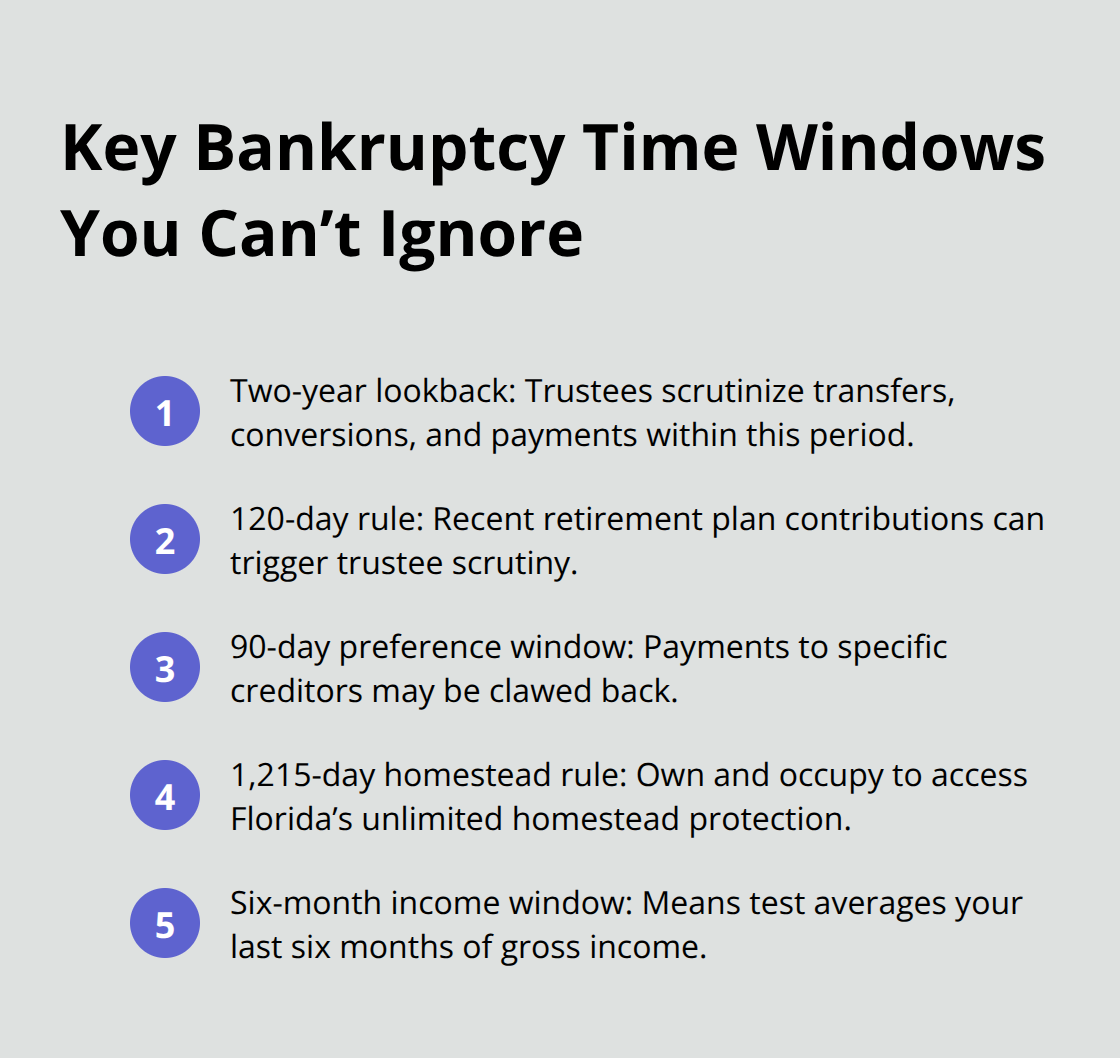
Preferential payments to specific creditors within 90 days before filing trigger automatic reversal under federal law, meaning the trustee recovers those payments and redistributes them equally among all creditors. Paying your mother $5,000 owed on a personal loan while ignoring your credit card company signals preferential treatment that the trustee will unwind. Incomplete or inaccurate disclosure of assets on your bankruptcy petition carries criminal penalties up to $250,000 and 20 years in prison according to 18 U.S.C. § 152, making honesty not just a legal requirement but an essential protection for your freedom. Failing to report a vehicle, hiding cash, or omitting property you own creates far worse consequences than losing that asset through the bankruptcy process. Transparent, well-documented asset conversions made months in advance of filing provide legitimate protection, whereas last-minute transfers designed to hide assets from creditors destroy your bankruptcy case entirely and lead directly into the final section on moving forward with strategic asset protection planning.
Final Thoughts on Asset Protection in Chapter 7
Asset protection in Chapter 7 requires planning that starts months before you file, not weeks before submission. The strategies outlined above work only when you execute them with proper timing, documentation, and legal guidance from someone familiar with Florida bankruptcy law. Starting this process alone or relying on general bankruptcy information leaves you vulnerable to trustee challenges, fraudulent transfer accusations, and missed opportunities to shield assets you could legally protect.
We at Harnage Law, PLLC guide clients through comprehensive asset inventory and exemption planning that identifies exactly what you own, what Florida law protects, and which conversions make sense for your specific situation. This process starts with a detailed financial review covering your home, vehicles, retirement accounts, cash savings, and personal property, then calculates your means test income and examines your two-year transaction history for any preferential payments or suspicious transfers. Many clients discover they can protect far more than they initially believed possible once we map out their complete financial picture against Florida’s generous exemption framework.
The timing of your filing matters enormously, as filing too quickly leaves conversions incomplete while filing too late allows high-income months to drop from your means test calculation. Contact Harnage Law, PLLC to schedule a consultation and begin your asset protection planning, and visit our Chapter 7 bankruptcy services to learn how we help Florida residents overcome financial challenges and rebuild their future.