
Chapter 7 bankruptcy can feel overwhelming when you’re worried about losing everything you own. The good news is that Florida law provides strong protections for many of your assets, and understanding these safeguards is the first step toward financial recovery.
At Harnage Law, PLLC, we help clients navigate how the impact of Chapter 7 bankruptcy on assets works in practice. This guide walks you through what actually happens to your property, which assets you can protect, and what to expect throughout the process.
What Happens to Your Assets in Chapter 7
When you file Chapter 7 bankruptcy in Florida, the court creates a bankruptcy estate that includes most of your property as of the filing date. A trustee is appointed to review your assets and determine which ones Florida exemptions protect and which ones the trustee can liquidate to pay creditors. The outcome depends entirely on whether your assets fall within Florida’s exemption limits or exceed them. This distinction determines what you actually keep and what the trustee may sell.
Your Home and Real Property
Florida’s homestead exemption offers the strongest asset protection in the state, and it applies automatically if you meet two requirements: you must have owned the property for at least 1,215 days before filing, and the home must not exceed half an acre inside city limits or 160 acres outside the city. If you satisfy these conditions, your home equity receives complete protection regardless of its value. The trustee cannot force a sale to reach equity in your home. However, if you fall behind on your mortgage payments, Chapter 7 does not stop foreclosure-the lender can still take the home. If you want to keep the home and remain current on payments, you can reaffirm the mortgage debt, which means you continue making payments and the lender retains the lien. If you have not owned the home for 1,215 days yet, Florida limits your exemption to approximately $170,350 in equity, so amounts above that threshold become non-exempt and available to the trustee.
Bank Accounts and Liquid Funds
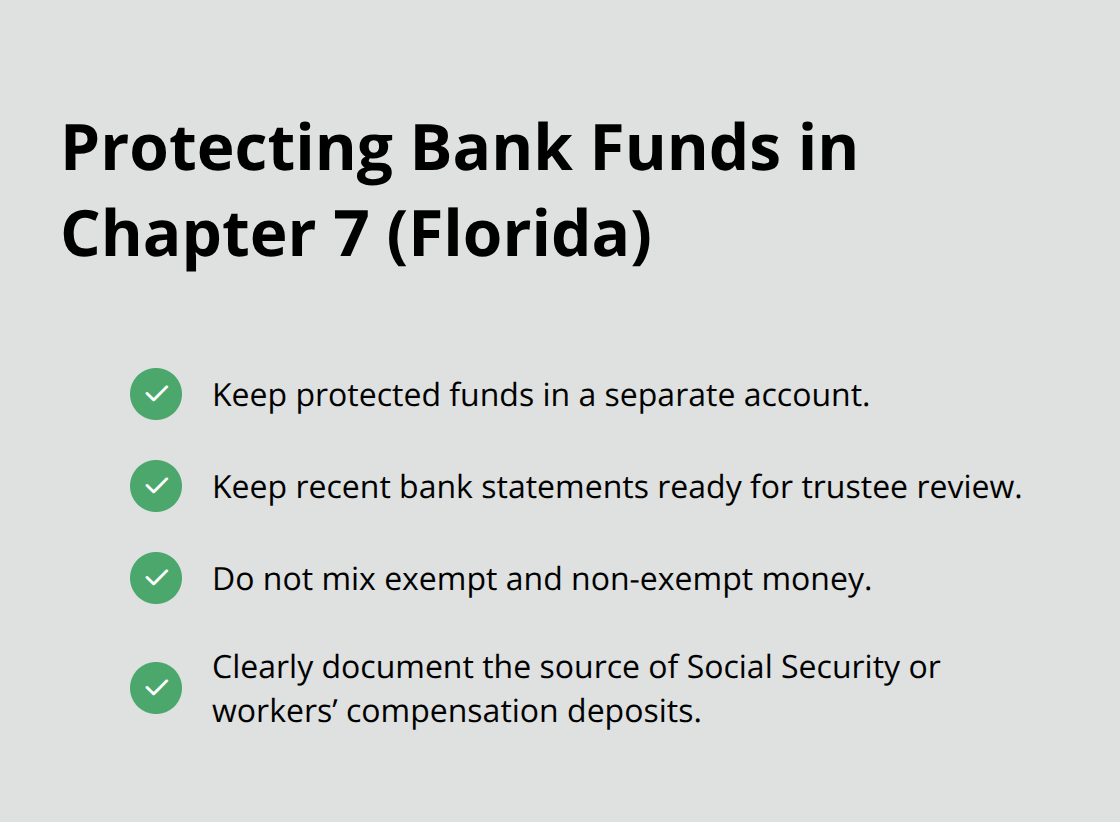
Your bank accounts and cash are generally non-exempt in Chapter 7 unless they contain protected funds like Social Security benefits or workers’ compensation, which remain fully exempt under Florida law. The trustee will examine your bank statements from the months before filing and may seize liquid funds to distribute to creditors. Keeping exempt funds separate from non-exempt funds is essential-mixing them in the same account can cause you to lose the exempt status of protected money.
Vehicles and Personal Property
Florida allows an exemption of $1,000 in equity per person or $2,000 for a married couple on vehicles. If your car is financed and you remain current on payments, you can reaffirm the loan and keep driving it; the equity protection applies to any paid-off portion. If your vehicle is paid off and worth more than $1,000, the trustee will likely sell it and return $1,000 to you in cash. Personal property-furniture, clothing, electronics, jewelry, and collectibles-receives protection up to $1,000 per person or $2,000 for a married couple. If you own items valued above this cap, the trustee may seize the excess, though many trustees abandon personal property when sale costs make liquidation impractical. The wildcard exemption provides an additional $4,000 for an individual or $8,000 for a married couple to apply to any personal property not covered by other exemptions (which can help protect excess vehicle equity or other valuables). Retirement accounts, including IRAs and 401(k) plans, receive 100 percent protection, as do life insurance proceeds and cash surrender values.
Understanding Non-Exempt Assets
Non-exempt assets are items the trustee can sell to pay creditors. These typically include luxury items, second homes, high-value vehicles beyond exemption limits, large cash savings above protected amounts, and investment accounts. The trustee evaluates each asset to determine whether sale costs make liquidation worthwhile. Many trustees abandon items when the expense of selling exceeds the recovery value, which means you keep the property even though it technically falls outside exemptions.
The trustee’s role in evaluating and distributing your assets sets the stage for what happens next in the bankruptcy process, from the initial filing through your eventual discharge.
Florida Exemptions Shield Your Assets
The Homestead Exemption: Your Home’s Complete Protection
Florida’s homestead exemption stands as the most powerful asset protection tool available in Chapter 7 bankruptcy. If you have owned your primary residence for at least 1,215 days and the property does not exceed half an acre inside city limits or 160 acres outside, your home equity receives complete protection regardless of value. A $500,000 home with $300,000 in equity remains entirely safe from the trustee. Your mortgage lender can still foreclose if you fall behind on payments, but the equity itself cannot be touched. If you have not yet reached the 1,215-day ownership mark, Florida caps your protection at approximately $170,350 in equity, so anything above that becomes available for liquidation. Waiting a few months to reach this threshold can mean the difference between protecting $50,000 in equity and losing it to the trustee.
Vehicle and Personal Property Protections
Your vehicle exemption covers $1,000 in equity per person or $2,000 for a married couple. If you owe $25,000 on a vehicle worth $26,000, you have only $1,000 in equity and the entire car stays protected if you continue making payments. A paid-off car worth $18,000 triggers trustee sale, with $1,000 returned to you in cash. The wildcard exemption then provides an additional $4,000 for an individual or $8,000 for a married couple to protect any personal property.
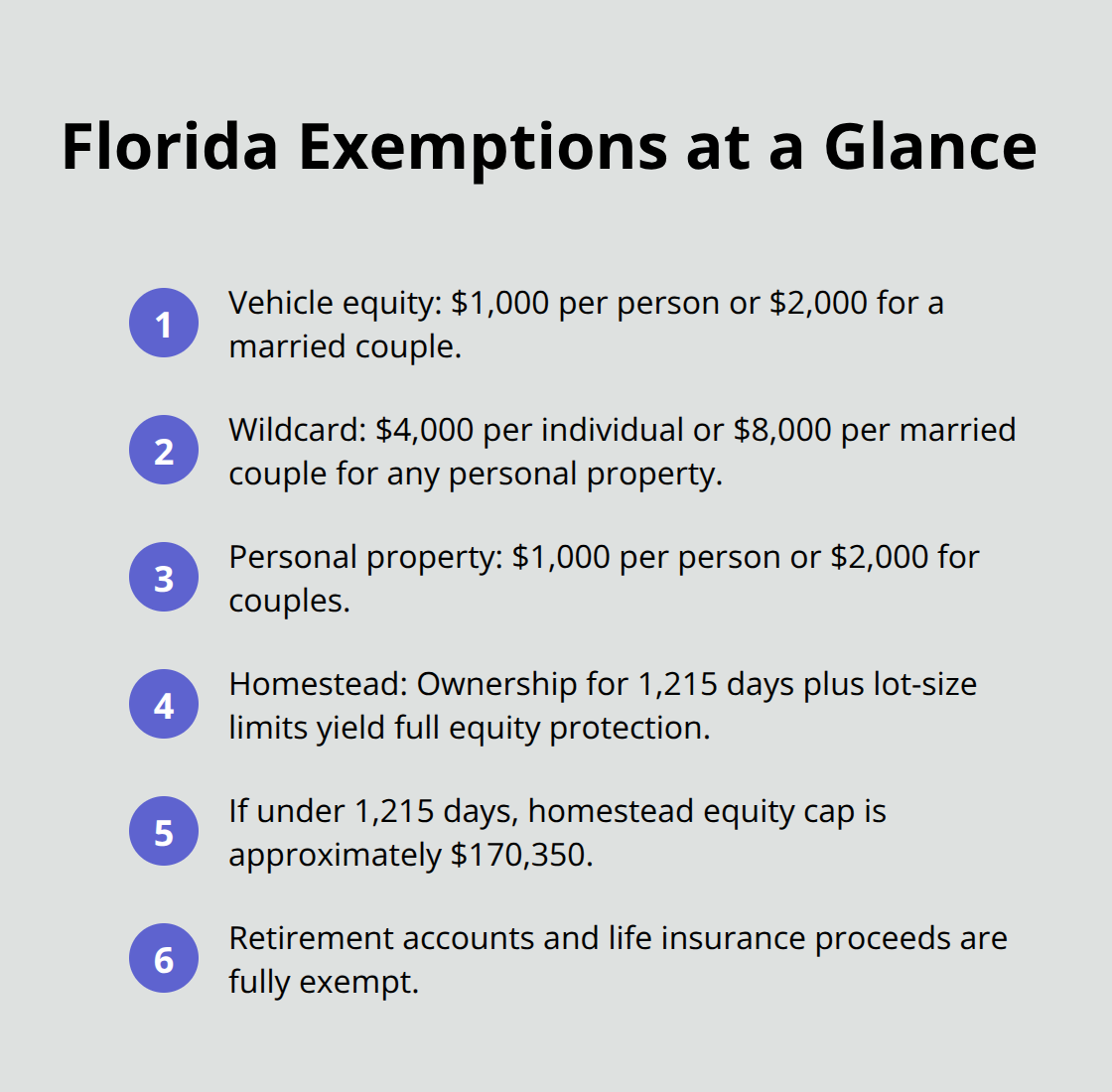
This combination allows you to protect $5,000 total on that $18,000 vehicle, leaving $13,000 at risk. Personal property like furniture, electronics, and clothing receives protection up to $1,000 per person or $2,000 for couples.
Retirement Accounts and Insurance Protection
Retirement accounts receive 100 percent protection regardless of balance. Your IRA, 401(k), and similar qualified retirement plans cannot be touched by the trustee. Life insurance proceeds and cash surrender values are also fully exempt. These protections apply automatically without requiring you to claim them separately on your bankruptcy schedules.
Avoiding the Commingling Trap
The critical mistake many people make is mixing protected funds with non-protected money in the same bank account. If you deposit your $10,000 Social Security payment into an account holding $8,000 in non-exempt funds, you risk losing the exempt status of your entire balance. Keep protected funds separate and clearly documented to maintain their exempt status throughout the bankruptcy process.
Asset Abandonment and the 341 Meeting
The trustee reviews assets at the 341 Meeting of Creditors approximately 21 to 40 days after filing. Many trustees abandon personal property when sale costs exceed recovery value, meaning you keep items even though they technically fall outside exemptions. Understanding these limits before filing allows you to structure your assets strategically and maximize what you retain. The trustee’s evaluation of your specific property determines which assets move forward to liquidation and which ones you protect through exemptions or abandonment, setting the stage for how the bankruptcy process unfolds from filing through discharge.
How Your Chapter 7 Case Moves from Filing to Discharge
The Automatic Stay and Initial Filing Requirements
Filing Chapter 7 bankruptcy in Florida triggers an automatic stay the moment your petition reaches the court, which immediately halts most collection actions against you and your property. Creditors must stop calling, lawsuits pause, wage garnishments cease, and foreclosure proceedings freeze. This protection applies broadly under federal bankruptcy law, though certain obligations like child support and alimony continue outside the stay. You must complete several forms before filing, including schedules listing all assets and liabilities, a detailed account of your income and expenses over the past six months, and proof of credit counseling completed within 180 days before filing. The filing fee totals $335 ($245 filing fee, $75 miscellaneous administrative fee, and $15 trustee surcharge), though you can request installment payments or fee waivers if your income falls below 150 percent of the federal poverty line.
The Trustee’s Role in Asset Evaluation
After filing, the court appoints a Chapter 7 trustee whose job is to evaluate which assets fall within Florida exemptions and which ones the trustee can liquidate. This trustee holds significant power to undo certain prepetition transfers, recover property, and maximize distributions to creditors, so full disclosure of all your assets and financial transactions is essential to avoid complications or denial of your discharge. The trustee reviews your schedules and bank statements to identify non-exempt property available for sale.
The 341 Meeting and Asset Liquidation
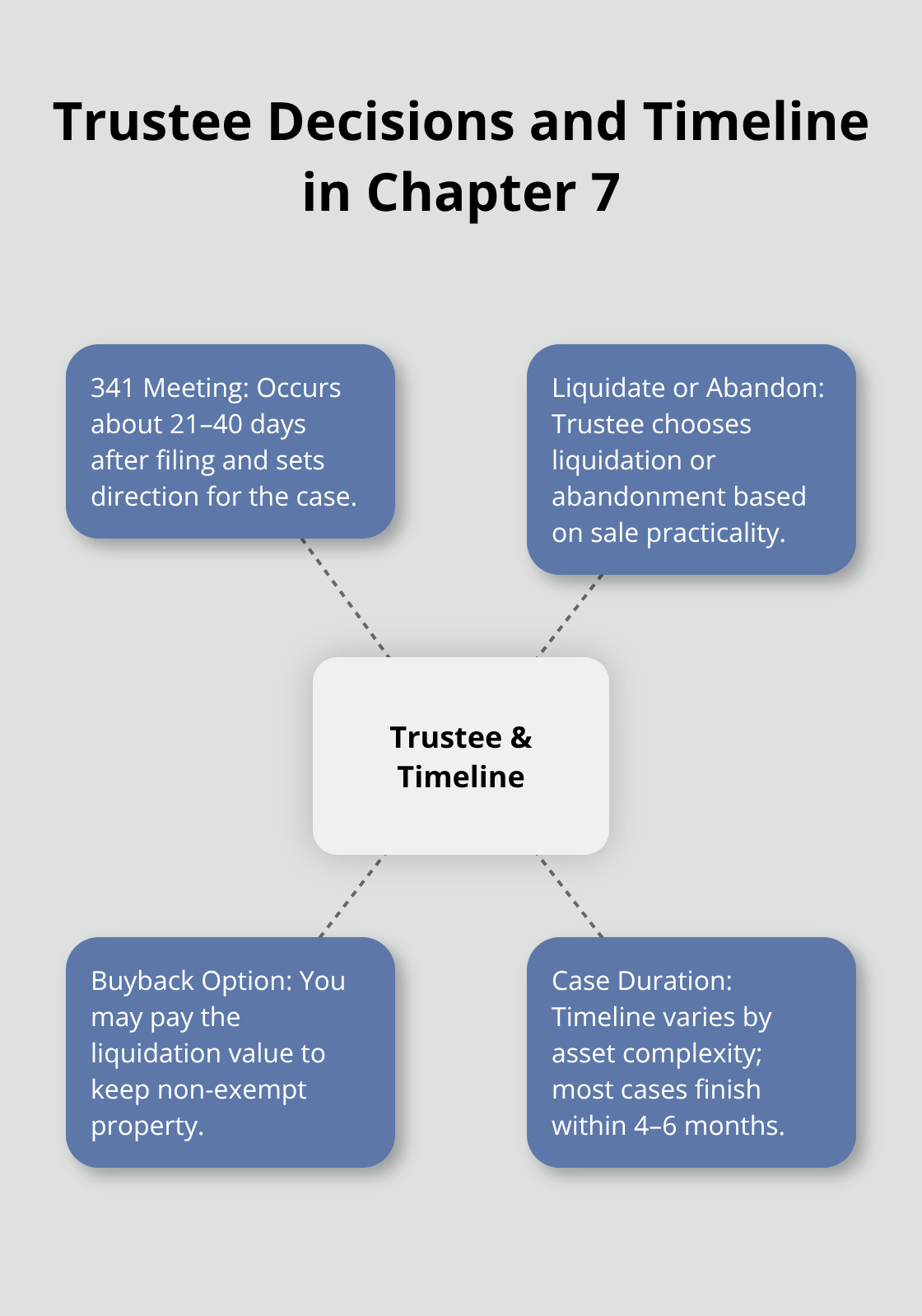
The 341 Meeting of Creditors occurs approximately 21 to 40 days after filing, where you answer questions from the trustee about your finances, assets, and debts under oath. This meeting determines whether the trustee will pursue asset liquidation or abandon property as impractical to sell. If you own non-exempt assets the trustee intends to sell, you have the option to pay the trustee the liquidation value to retain the property, which gives you control over what gets sold rather than waiting for auction results. The trustee’s liquidation timeline varies based on asset complexity and sale conditions, but most cases conclude within four to six months.
Discharge Timeline and Debt Relief
In most Florida Chapter 7 cases, the discharge arrives within 60 to 90 days after the 341 Meeting, freeing you from personal liability on unsecured debts like credit cards, medical bills, and personal loans. The vast majority of Chapter 7 filers receive a discharge without objection, though certain debts never disappear, including child support, alimony, recent income taxes, most student loans, and debts incurred through fraud or willful injury. Secured debts tied to collateral like mortgages and car loans may survive the discharge if you reaffirm them to keep the property, meaning the lender retains a lien even after the bankruptcy ends. Understanding these timelines and your role at each stage allows you to prepare documents accurately and avoid delays that could extend your case unnecessarily.
Final Thoughts
Chapter 7 bankruptcy in Florida offers a structured path to financial relief through strong asset protections that most states simply do not provide. The impact of Chapter 7 bankruptcy on assets depends heavily on understanding Florida’s exemptions, which shield your home equity completely if you meet the 1,215-day ownership requirement, protect $1,000 in vehicle equity per person, and safeguard retirement accounts and life insurance proceeds without limitation. These protections exist specifically to give honest debtors a genuine fresh start rather than leaving them stripped of all property.
The real value of Chapter 7 lies in what you actually keep combined with what gets discharged. Your primary residence typically remains yours if you stay current on the mortgage, your vehicle stays protected within exemption limits, and your retirement savings remain untouched. Meanwhile, unsecured debts like credit cards, medical bills, and personal loans disappear through discharge, usually within 60 to 90 days after your 341 Meeting, creating the financial breathing room needed to rebuild.
If you own non-exempt assets, Chapter 13 may serve you better by allowing you to keep everything while repaying debts through a three to five year plan. We at Harnage Law, PLLC help individuals and families overcome financial challenges by providing legal guidance through every step of the bankruptcy process, and we focus on stopping creditor harassment, preventing wage garnishments, and halting lawsuits while protecting your assets. Contact us to discuss whether Chapter 7 makes sense for your situation and what you can realistically expect to keep.