
Filing Chapter 7 bankruptcy without an attorney is possible in Florida, but it requires careful attention to detail and strict adherence to court rules.
We at Harnage Law, PLLC know that many people consider the do-it-yourself bankruptcy chapter 7 route to save money. This guide walks you through the requirements, filing steps, and pitfalls that could derail your case.
Do You Actually Qualify for Chapter 7 in Florida?
Income Thresholds: Your First Checkpoint
Before spending time on forms and court procedures, you need to know if Chapter 7 is even an option. Florida uses a means test that determines whether your income allows you to file Chapter 7 or forces you into Chapter 13. The threshold is straightforward: if your household’s current monthly income falls at or below the Florida median for your household size, you pass automatically. For a single filer, that median is $41,334 annually. For a household of two, it jumps to $51,839. For three people, $53,952.
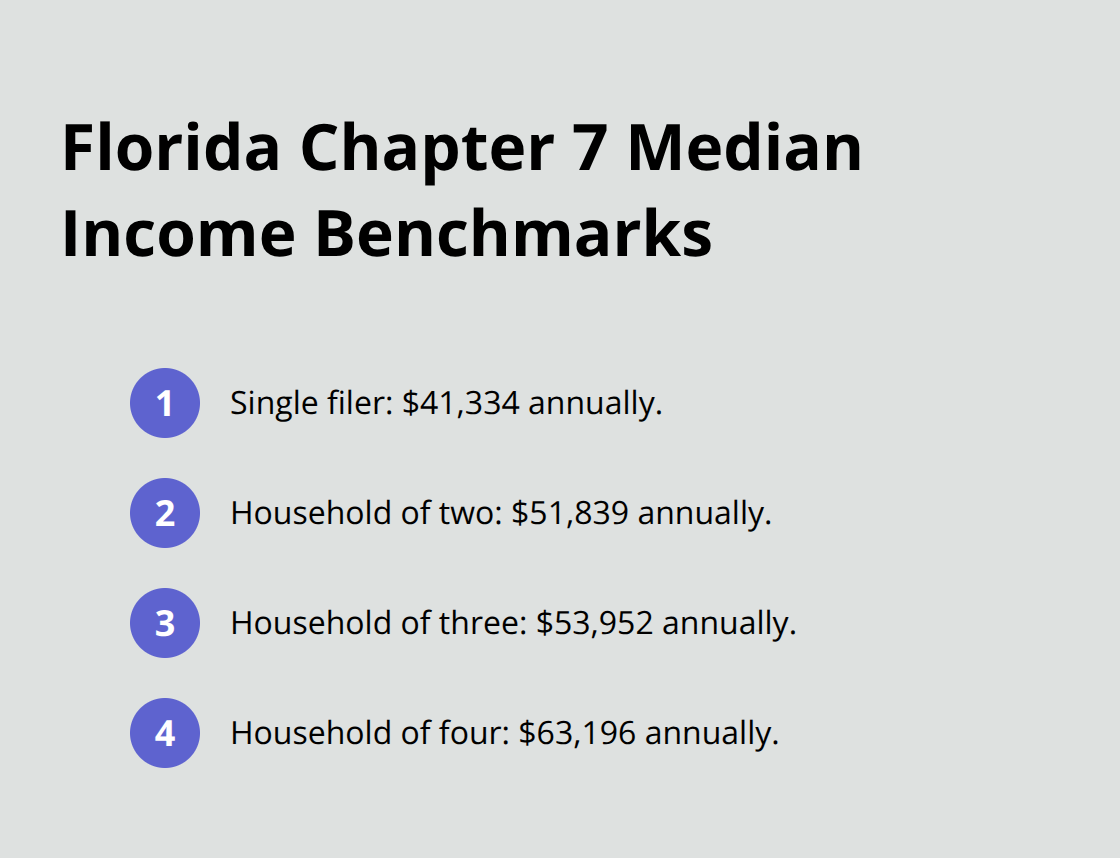
For four, $63,196. These numbers matter because they represent your first checkpoint.
If you fall below these thresholds, the means test stops there and Chapter 7 becomes available to you. The means test uses a six-month averaging period of your actual income, multiplied by twelve to establish your annual figure. This is why gathering recent pay stubs and tax returns matters-the court wants real numbers, not estimates.
Calculating Disposable Income When You Exceed the Median
If your income exceeds the median, the means test calculation becomes more complex. You subtract allowed expenses from your monthly income to find disposable income over the next 60 months. If that 60-month total falls below $7,475, you still qualify for Chapter 7. If it exceeds $12,475, Chapter 7 is closed to you. Between those numbers, additional calculations apply and determine your eligibility path.
Mandatory Counseling Requirements
Before filing, you must complete a credit counseling course from a DOJ-approved provider within six months of submission. This course typically costs $10 to $50 and can be completed online or by phone. After filing, you must complete a financial management course from an approved agency, again costing $10 to $50. These aren’t optional-failure to complete them results in dismissal of your discharge.
Florida Residency and Exemption Rules
Florida requires you to live in the state for at least 730 days before filing to use Florida exemptions, which protect your home equity up to half an acre in a municipality or 160 acres elsewhere (if you’ve owned the property for at least 1,215 days). If you haven’t met the residency requirement, you use the exemptions from the state where you lived longest during the 180 days before the two years prior to filing.
Form Selection and Legal Representation Requirements
Individual filers use the 100-series official bankruptcy forms, while corporations and partnerships use 200-series forms. Sole proprietors must use 100-series. Filing as an individual without an attorney is permitted only for individual debtors; non-individuals must have legal representation in this bankruptcy court. Once you confirm your eligibility and understand these foundational requirements, you’re ready to move into the actual filing process-starting with gathering the financial documents the court demands.
How to Gather Documents and Complete Your Bankruptcy Forms
Collect Your Financial Records First
The gap between knowing you qualify for Chapter 7 and actually filing comes down to paperwork and organization. You need two years of tax returns, six months of recent pay stubs, current bank statements, retirement account statements, vehicle registrations, and any documentation of assets you own. The court rejects approximations-it wants proof. Pull your free credit reports from Equifax, Experian, and TransUnion to identify every debt, including accounts that may not appear on recent statements.
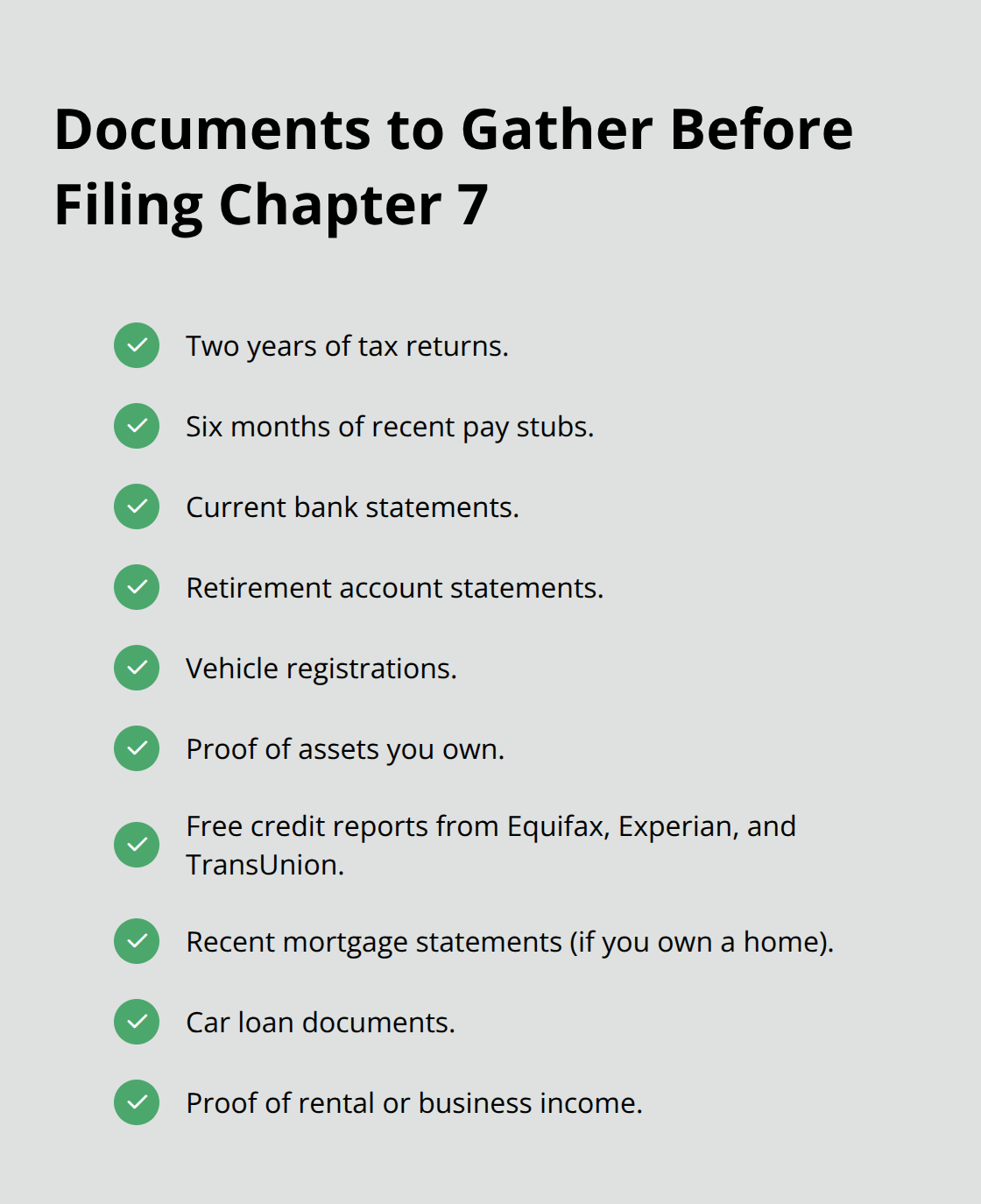
This step alone prevents the costly mistake of omitting creditors, which can invalidate your filing. You’ll also need recent mortgage statements if you own a home, car loan documents, and proof of any rental income or business income.
Complete the Official Bankruptcy Forms
The official bankruptcy forms total over 20 documents and can stretch to 70 pages depending on your situation. Form 106Sum serves as your summary of assets and liabilities, but the real work happens in Schedules A through J, which detail real property, personal property, income, expenses, and debts. Schedule D covers secured debts like mortgages and car loans. Schedule E/F handles unsecured debts including credit cards and medical bills. Form 106Sum/Summary and the Chapter 7 Statement of Your Current Monthly Income are mandatory-these forms determine whether you pass the means test or whether the trustee challenges your filing.
You must show only the last four digits of your Social Security Number on all documents. Print forms single-sided and verify exactly how many copies your local court requires before submitting. Most courts require the original petition with wet signatures, not fully unsigned copies. After filing, do not submit tax returns or bank statements to the court; these go directly to your Chapter 7 trustee.
When completing your forms, remember that the documentation you submit must accurately reflect all assets and properly claim available exemptions to avoid complications during the review process.
Handle the Filing Fee and Payment Options
The filing fee is $338, payable within 14 days by certified check or money order made payable to Clerk, U.S. Court. If you cannot afford the full amount upfront, you can apply for installment payments using the local form for paying fees in installments, with a minimum of 50 percent due at filing. For those with income under 150 percent of the federal poverty line, you can apply to waive the filing fee entirely using Official Bankruptcy Form 103B.
Submit Your Petition to the Court
File electronically through CM/ECF, the federal court’s electronic case filing system, or deliver documents in person to your local bankruptcy court. Upon filing, an automatic stay begins immediately, stopping most creditor calls, wage garnishments, and collection lawsuits. The clerk will assign you a case number, provide the trustee’s name, and schedule your 341 meeting of creditors, typically held about one month after filing and often conducted via videoconference. Once the court accepts your petition and the automatic stay takes effect, your attention shifts to preparing for the trustee meeting and understanding what happens next in your case.
What Mistakes Torpedo Your Chapter 7 Filing
The forms are completed, the fee is paid, and your petition sits ready for filing. This is when most filers think the hard part is over. It’s not. The mistakes that sink Chapter 7 cases happen after submission, when attention lapses and deadlines blur together. Cases collapse because filers underestimate what comes next. The trustee assigned to your case will request documents you didn’t anticipate providing. The court will set multiple deadlines spanning months. Counseling courses have narrow completion windows. A single missed deadline or incomplete disclosure doesn’t just delay your discharge-it can result in case dismissal, leaving you unprotected against creditors and forced to refile months later at additional cost. The $338 filing fee becomes wasted money. Your automatic stay dissolves. Creditors resume collection calls.
The financial relief you filed for evaporates.
Incomplete Financial Disclosures Trigger Investigations
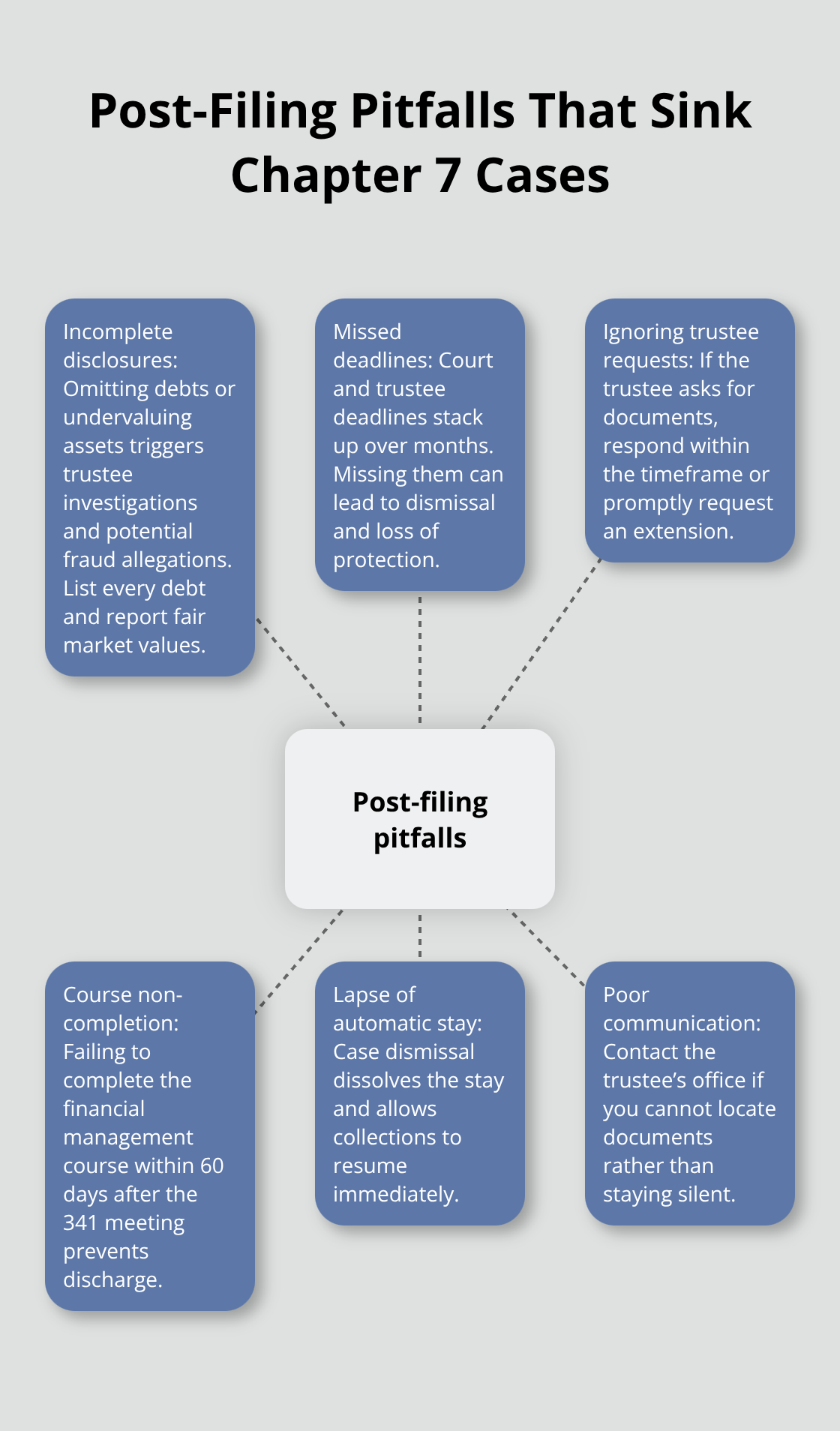
Incomplete financial disclosures are the fastest way to derail your case. Filers often omit debts they forgot about, undervalue assets to seem more sympathetic, or fail to disclose all sources of income. The court cross-references your filing against credit reports and tax returns-inconsistencies trigger trustee investigations and potential fraud allegations. You must list every debt, even old ones that don’t appear on recent credit reports. You must report all assets at fair market value, not at prices you wish they were worth. You must disclose rental income, side business income, and any other money flowing into your household. The trustee will verify these numbers against documentation you provide after filing.
Missing Deadlines Leads to Case Dismissal
Missing deadlines for required filings compounds the problem of incomplete disclosures. After your 341 meeting, the trustee may request tax returns, pay stubs, and bank statements within specific timeframes. Miss those deadlines and the trustee can recommend dismissal. The financial management course must be completed within 60 days after your 341 meeting-failure to finish prevents discharge entirely, even if everything else is perfect. The course isn’t optional padding; it’s a statutory requirement. Courts enforce these deadlines strictly.
How to Stay on Top of Court Deadlines
Document every deadline the court provides and set phone reminders for each one. Submit materials early rather than at the last minute. If the trustee requests documents, respond within the timeframe given, not days later. If you cannot locate something, contact the trustee’s office immediately to explain and request an extension rather than ignoring the request. These actions separate successful filers from those whose cases collapse after months of process. The trustee’s office staff can answer procedural questions about what documents they need and when they need them (though they cannot provide legal advice). Treat every deadline as non-negotiable, because the court does.
Final Thoughts
Filing Chapter 7 bankruptcy yourself in Florida works when your financial situation is straightforward and you commit to every procedural requirement. The process demands accuracy in your forms, timely submission of documents, and completion of mandatory counseling courses. You must gather comprehensive financial records, calculate your means test correctly, and understand Florida’s exemption rules. Most importantly, you cannot afford to miss deadlines or provide incomplete information to the court or trustee.
The complexity of bankruptcy chapter 7 do it yourself filing increases significantly when your situation involves a home with equity, multiple properties, business income, or disputes over what property you can keep. If the trustee challenges your exemptions or questions your financial disclosures, you’ll face situations where court procedures and legal arguments matter enormously. If you have a car loan you want to reaffirm or if you’re trying to stop a foreclosure, the decisions you make carry long-term consequences that require informed guidance.
We at Harnage Law, PLLC help individuals and families navigate Chapter 7 bankruptcy by providing personalized legal guidance through every step of the process. Our firm focuses on discharging qualifying debts, stopping creditor harassment, preventing wage garnishments, and halting lawsuits. If your case involves complications or if you want professional representation from someone who understands Florida bankruptcy law, contact Harnage Law, PLLC to discuss your situation.