Filing Chapter 7 bankruptcy without a lawyer is possible in Florida, but it requires careful attention to detail and strict adherence to federal and state rules. The process involves gathering documents, completing forms, and meeting court deadlines-all of which have real consequences if done incorrectly.
We at Harnage Law, PLLC understand that many people consider DIY bankruptcy Chapter 7 to save money on legal fees. This guide walks you through each step so you know exactly what to expect.
1. Gather Your Financial Documents and Information
Start by collecting the last 60 days of pay stubs from every source of income, including wages, self-employment earnings, rental income, and any other regular payments. The bankruptcy court requires proof of income via the Declaration About Payment Advices, and you need this documentation to calculate your average monthly income over the past six months, which directly affects your means test eligibility. Pull your last two years of tax returns, all bank statements from the past three months, and documentation of any investment accounts or retirement savings. Florida bankruptcy courts are strict about income verification, and missing this paperwork forces delays or dismissals.
Next, create a complete list of every debt you owe, including the creditor name, account number, current balance, and whether the debt is secured (like a mortgage or car loan) or unsecured (like credit cards or medical bills). This list becomes your creditor matrix, which you must file with the court and format exactly as the clerk specifies, or the court will reject your petition. Document all property you own: your home’s current market value and remaining mortgage balance, vehicle equity after subtracting loan amounts, bank account balances, retirement accounts, personal property, and any other assets. Calculate your monthly expenses by tracking three months of actual spending on housing, utilities, food, transportation, insurance, and other necessities.
The court uses these figures to determine whether you pass the means test, and inaccurate expense numbers trigger trustee objections during your 341 meeting. Once you organize all this information, you’re ready to understand the Florida-specific rules that govern your filing and determine your eligibility to proceed.
2. Know Florida’s Bankruptcy Rules Before You File
Florida protects significantly more property than most other states through its debtor-friendly exemption laws. The homestead exemption covers unlimited home equity if you owned your property for at least 1,215 days before filing and it doesn’t exceed half an acre in a city or 160 acres elsewhere-without meeting that timeline, a federal cap of $214,000 applies instead. You can also protect up to $5,000 in vehicle equity, up to $1,000 in personal property like furniture and electronics, and all retirement account balances up to $1,711,975 per person for cases filed between April 1, 2025 and March 31, 2028.
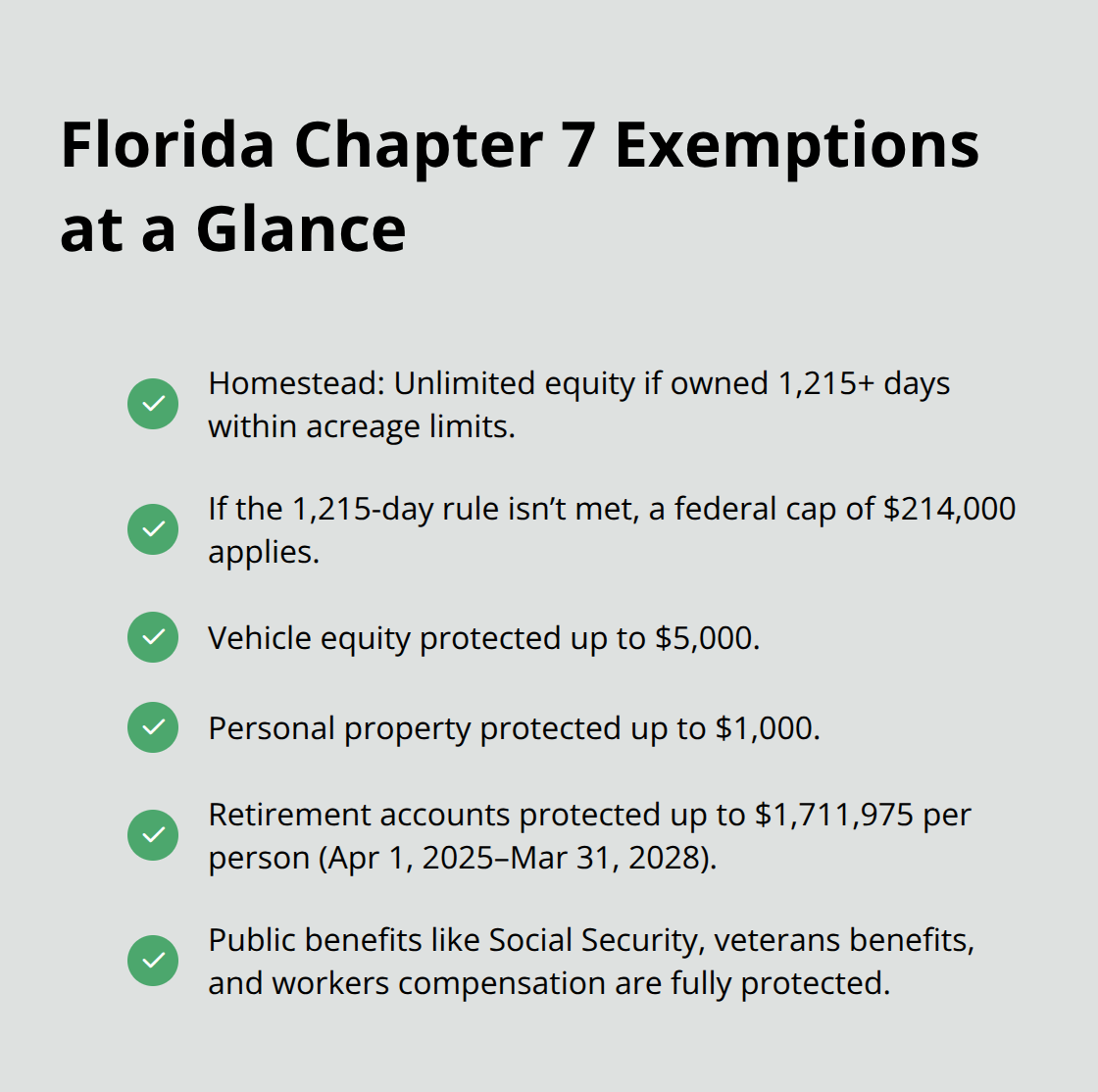
Public benefits including Social Security, veterans benefits, and workers compensation receive full protection, which matters significantly if these funds represent your primary income source.
Your household income determines whether you qualify for Chapter 7 in Florida. The state’s median income thresholds vary by household size: a single person earns $41,334 annually, a household of two earns $51,839, and a family of four earns $63,196. If your average monthly income over the past six months falls below your household’s median, you automatically pass the means test and qualify for Chapter 7. Courts require exact compliance with federal forms and local administrative procedures, particularly around creditor matrices and income documentation. Filing without understanding these Florida-specific rules almost guarantees rejection or dismissal, so verifying your exemption eligibility and income status against current state thresholds prevents costly court rejections and moves you toward completing the mandatory credit counseling requirement.
3. Complete the Required Credit Counseling Before Filing
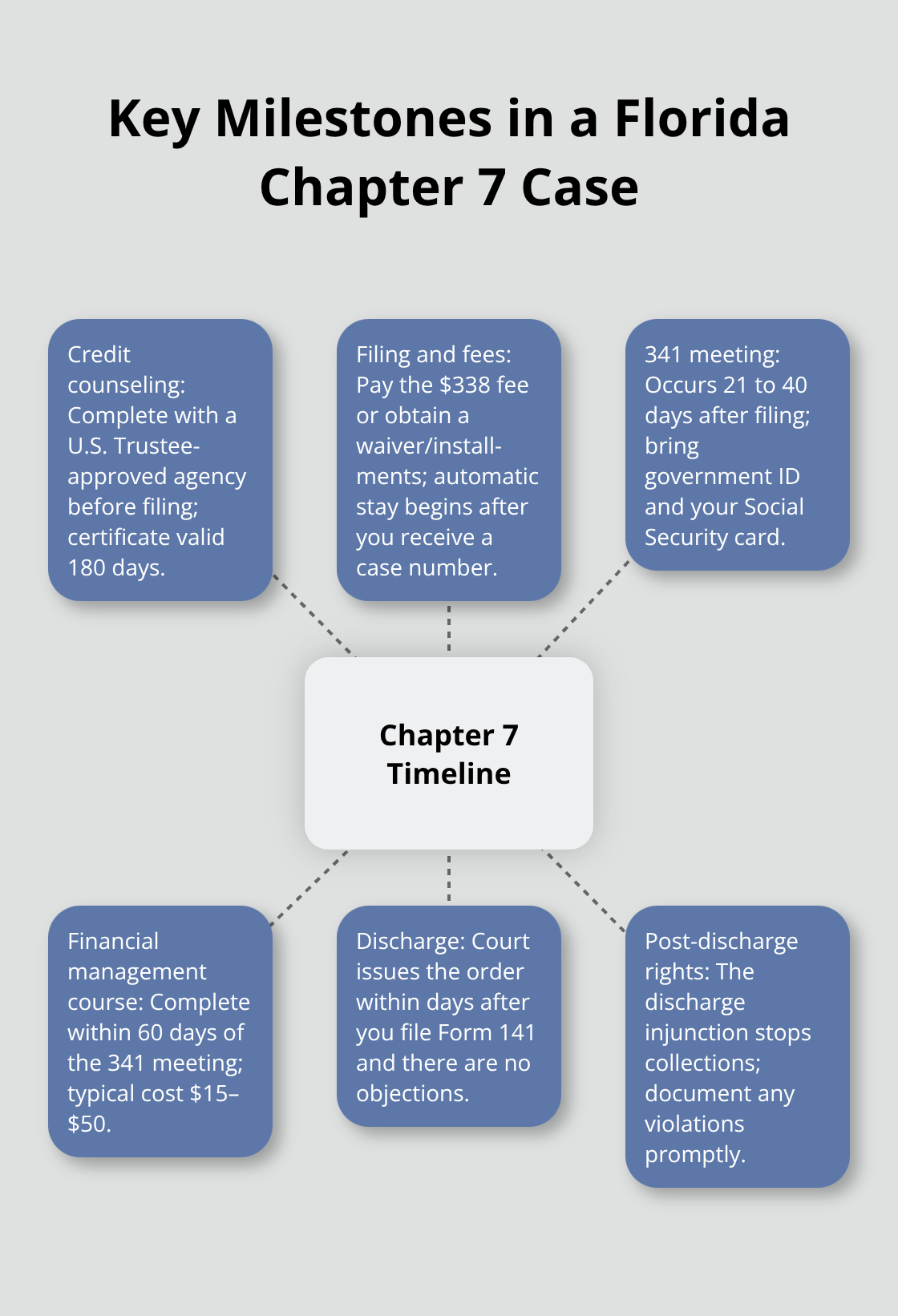
Federal law mandates that you complete credit counseling from a U.S. Trustee-approved agency before submitting your Chapter 7 petition to the Florida bankruptcy court. This requirement is not optional, and courts will dismiss your case if you file without proof of completion. The U.S. Trustee Program maintains the official list of approved agencies in Florida, and most offer sessions by phone or online, making the process accessible regardless of your location within the state. The counseling typically lasts one to two hours and covers budgeting, debt management alternatives, and the consequences of bankruptcy. You will receive a certificate of completion immediately after finishing the session, which you must file with your petition as Official Form 121.
The cost for credit counseling ranges from free to approximately $15 depending on your income level, with many approved agencies offering fee waivers for low-income filers. Complete this requirement as late as possible before filing your petition because the certificate expires 180 days after issuance, and courts will reject your filing if the certificate has expired. The counseling agency provides your certificate number, which you will need when completing your bankruptcy forms. With this critical step completed, you move directly into the technical work of filling out the required federal bankruptcy forms that determine your eligibility and discharge outcome.
4. Fill Out Official Bankruptcy Forms Accurately
Federal courts reject petitions that deviate from the required documents, and Florida courts enforce this rule strictly. Download the current forms directly from the U.S. Courts website, not from third-party sites, because outdated versions trigger automatic dismissals. Schedule A/B captures all property you own: list your home’s fair market value and the remaining mortgage balance, vehicle values and loan amounts, bank account balances, retirement accounts, and personal property like furniture and electronics. Florida courts scrutinize asset valuations closely, so provide realistic current values rather than inflated or deflated figures; undervaluing property to hide nonexempt assets constitutes fraud and can result in case dismissal or sanctions. Schedule C is where you claim your Florida exemptions, and this form directly determines what property the trustee can seize.
Schedule D requires you to list every secured debt-mortgages, car loans, and any creditor with a lien against your property-with the creditor name, account number, current balance, and collateral description. Schedule E/F covers all unsecured debts including credit cards, medical bills, personal loans, and payday loans; the creditor matrix you prepared earlier transfers here with exact name and address formatting. The Declaration About an Individual Debtor’s Schedules must accompany these schedules and certifies under penalty of perjury that your information is accurate. Courts take this certification seriously, and filing false information opens you to criminal charges. These forms determine your means test calculation and what debts discharge, so verifying numbers against your supporting documents prevents costly corrections or trustee objections at your 341 meeting before you move forward with calculating your income and completing the means test.
5. Calculate Your Income and Complete the Means Test
The means test determines whether Florida allows you to file Chapter 7 or forces you into Chapter 13 repayment. Start by calculating your average monthly income over the past six months by adding up all earnings from wages, self-employment, rental income, and other sources, then dividing by six. Compare this average monthly income against Florida’s median thresholds: single filers earn $41,334 annually, two-person households earn $51,839, and four-person families earn $63,196. If your average monthly income falls below your household size’s median, you pass the means test automatically and qualify for Chapter 7 discharge. This path eliminates your debts without requiring a repayment plan.
If your income exceeds Florida’s median, you must complete Official Form 106Sum and Official Form 106Coef to calculate your disposable income. Form 106Sum totals your current monthly income and subtracts allowed expenses using IRS and Census Bureau standards for Florida, not your actual spending. The form deducts legally required payments like taxes and mandatory insurance, plus reasonable expenses for food, housing, utilities, and transportation based on state and local averages rather than what you personally spend. If your projected disposable income over 60 months falls below $7,475, you still qualify for Chapter 7. If it exceeds $12,475, you cannot file Chapter 7 and must use Chapter 13 instead.
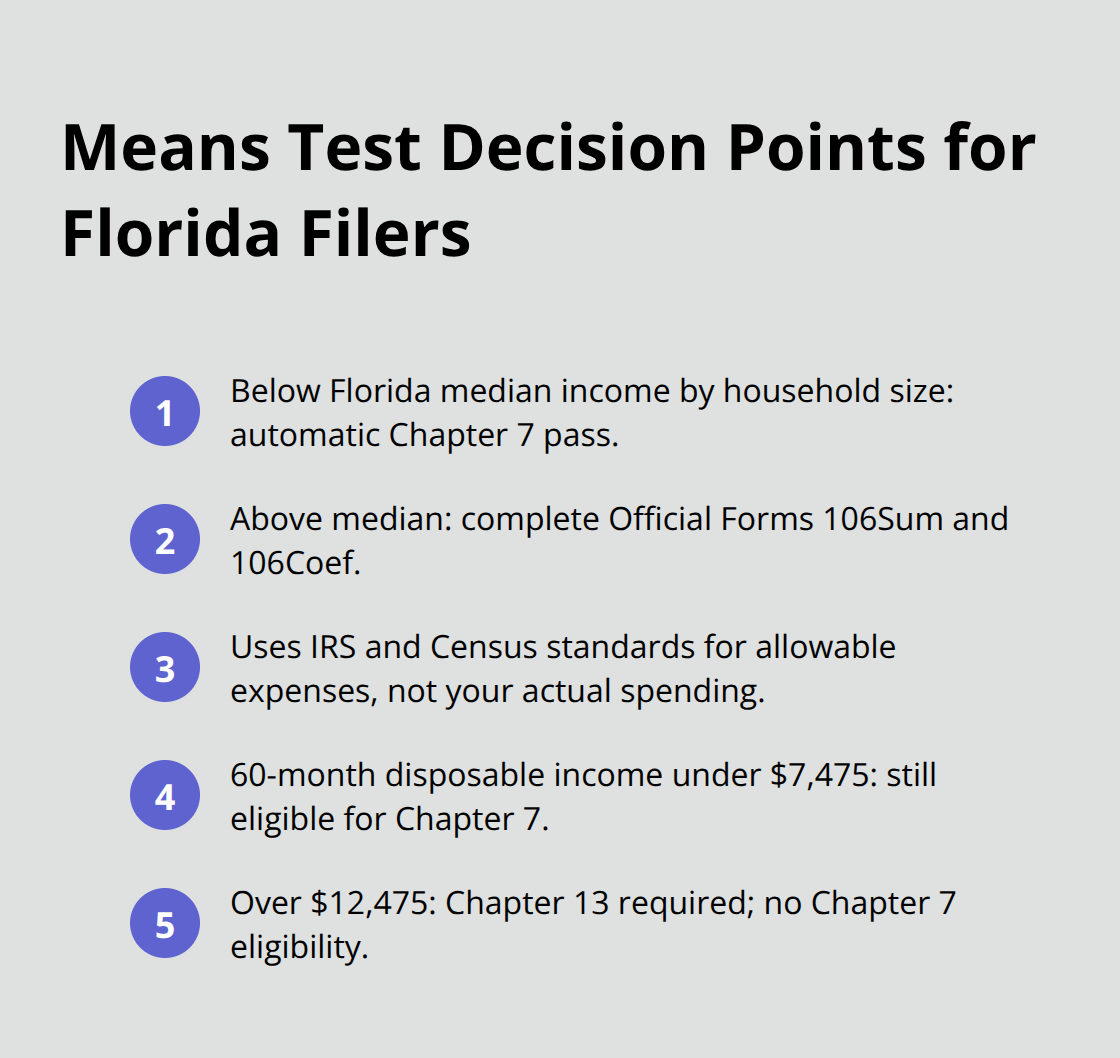
Amounts between these thresholds require additional calculations to determine your eligibility, making accurate income documentation essential for your petition’s success. The trustee will scrutinize your income figures during your 341 meeting, so verify all numbers against your supporting documents before filing. Once you complete these calculations and confirm your Chapter 7 eligibility, you move forward with preparing your petition and understanding the filing fees and payment options available to Florida filers.
6. File Your Petition and Pay Court Fees
The U.S. Bankruptcy Court for the Middle District of Florida charges a $338 filing fee, consisting of $245 for the filing fee, $78 for the administrative fee, and $15 for the trustee surcharge according to the fee schedule effective December 1, 2023. You must submit payment as a money order or cashier’s check payable to the Clerk, U.S. Bankruptcy Court-cash and personal checks face outright rejection. If you file electronically through the CM/ECF system, you have 14 days to submit payment after filing, which provides a brief window to arrange funds if needed. Florida courts process thousands of petitions annually, and missing this deadline triggers automatic dismissal regardless of how thoroughly you completed your forms. The filing fee represents a hard requirement with no flexibility, so confirm payment arrangements before you upload your petition.
If $338 strains your budget, Florida courts allow fee waivers or installment plans under Official Bankruptcy Form 103B. To qualify for a waiver, your income must fall at or below the federal poverty guidelines set by the U.S. Department of Health and Human Services-for a single person in 2026, that threshold sits at approximately $15,060 annually. If you don’t qualify for a waiver but need payment flexibility, request an installment plan where your initial payment must equal at least half the $338 fee, with remaining balances due within specific timeframes the court establishes. Some filers split the fee across two or three installments to manage cash flow without triggering dismissal. Once the court processes your payment and accepts your petition, you receive a case number via email notification and the automatic stay takes effect immediately, halting creditor calls, collection lawsuits, wage garnishments, and foreclosure proceedings while your Chapter 7 case moves forward.
With your petition filed and fees paid, you now face the mandatory meeting with the Chapter 7 trustee-a critical step that determines whether your case proceeds smoothly toward discharge or encounters complications that require additional action.
7. Attend Your Trustee Meeting and Complete Your Discharge Requirements
The Chapter 7 trustee meeting, officially called the 341 meeting of creditors, occurs 21 to 40 days after you file your petition with the Florida bankruptcy court. Despite its name, creditors rarely attend this meeting; the trustee verifies your financial information, examines your asset claims, and questions any inconsistencies between your forms and supporting documents. Arrive 15 minutes early with your government-issued photo ID and Social Security card, which the trustee requires before the meeting begins. The trustee asks about your income sources, employment history, asset valuations, and whether you intentionally undervalued property or mischaracterized exemptions. Answer every question directly and honestly because providing false information under oath constitutes perjury and triggers criminal charges, case dismissal, or denial of discharge.
If the trustee finds nonexempt property, they may seize and sell it to pay creditors, or in Chapter 13 situations, you repay its value through a plan. Most meetings last 10 to 15 minutes for straightforward cases, though complex situations involving business income or disputed exemptions take longer. After the trustee meeting concludes, you must complete a post-filing financial management course from a U.S. Trustee-approved provider within 60 days of your 341 meeting to receive your discharge. This second mandatory course differs from pre-filing credit counseling and focuses on budgeting, rebuilding credit, and avoiding future debt problems. The course costs approximately $15 to $50 and takes two to four hours, available online or by phone through approved agencies.
File your completion certificate, Official Form 141, with the court before the 60-day deadline expires or the court will deny your discharge even though all other requirements are satisfied. Once the court receives your certificate and the trustee confirms no objections exist, you receive your discharge order within days, eliminating qualifying unsecured debts permanently.
With your discharge finalized, understanding what happens next-including which debts survive bankruptcy and how to rebuild your credit-determines whether you truly achieve the fresh financial start that Chapter 7 provides.
Final Thoughts on Your DIY Bankruptcy Chapter 7
Your discharge order arrives within days after the court receives your financial management course certificate and confirms the trustee has no objections. This order eliminates qualifying unsecured debts permanently, including credit cards, medical bills, personal loans, and payday loans, though certain debts survive discharge such as student loans, child support, alimony, recent tax debts, and debts incurred through fraud. Your credit report shows the bankruptcy filing for ten years, but your score starts recovering within months as you demonstrate responsible financial behavior through secured credit cards and on-time payments.
Creditors sometimes attempt collection on discharged debts after your case closes, which violates the discharge injunction and the Fair Debt Collection Practices Act. If a creditor calls, sends collection letters, or reports a discharged debt to credit bureaus, you should document everything and respond immediately because violations carry statutory damages of $1,000 per violation plus attorney fees. Monitor your credit report carefully and maintain low balances on new accounts to accelerate your recovery, with most filers seeing credit scores improve by 100 to 150 points within two years of discharge.
Complications occasionally arise during or after your DIY bankruptcy Chapter 7 case, particularly around asset disputes, creditor objections, or exemption challenges that require legal navigation. If the trustee objects to your exemptions, creditors file motions against your discharge, or violations of your discharge order occur, we at Harnage Law, PLLC provide legal guidance and representation to protect your rights. Contact Harnage Law, PLLC if complications emerge or creditors violate your discharge order.