Filing for Chapter 7 bankruptcy without a lawyer is possible, but it requires careful attention to Florida’s specific rules and deadlines. The process involves multiple forms, court appearances, and decisions that directly affect your financial future.
We at Harnage Law, PLLC see many people attempt this path alone and face serious consequences. This guide walks you through what you need to know before deciding whether to go it alone or seek professional help.
Can You Pass the Means Test and What Happens to Your Debts
Understanding the Means Test in Florida
The means test acts as the first real barrier when you file Chapter 7 in Florida. This test determines whether you qualify to liquidate debts through Chapter 7 or must file Chapter 13 instead. You calculate your average monthly income from the last six calendar months, then multiply that figure by 12 to find your annual income. If your current monthly income falls below the Florida median for your household size, you pass automatically and proceed with Chapter 7. A single person faces a threshold of $41,334 annually; a household of four reaches $63,196. These thresholds increase with household size, climbing to $111,796 for a household of ten. If you exceed the median, you must complete the full means test calculation, which accounts for actual living expenses deducted from your income using national, Florida, and local standards from the IRS and Census Bureau.
Calculating Disposable Income and Your Chapter 7 Eligibility
The calculation determines your disposable income over the next 60 months. If that figure falls below $7,475, you pass the test and can file Chapter 7. Between $7,475 and $12,475, you must perform additional calculations. Above $12,475 means you likely cannot use Chapter 7 and must consider Chapter 13 instead.
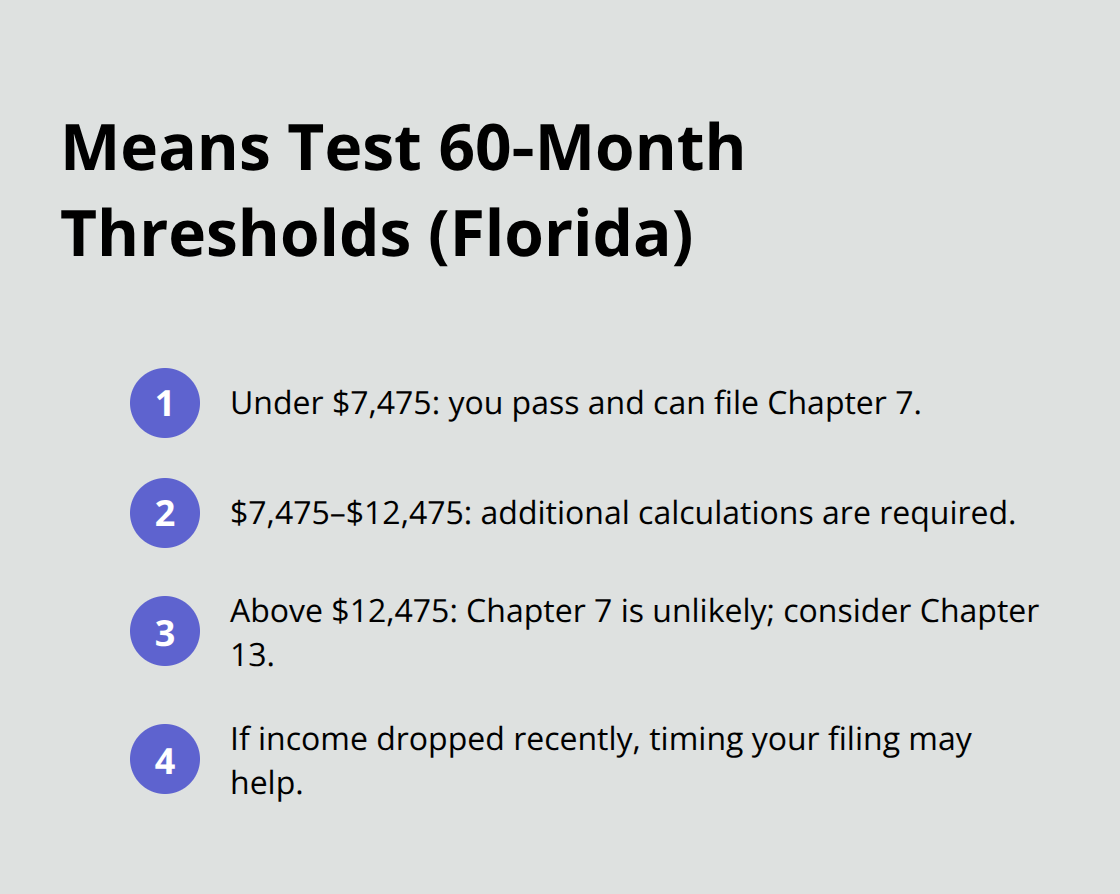
One practical tip: if your income has declined over the last six months, delaying your filing by one or two months might drop you below the median threshold and preserve your Chapter 7 eligibility without the burden of the full means test calculation.
Which Debts Disappear and Which Survive
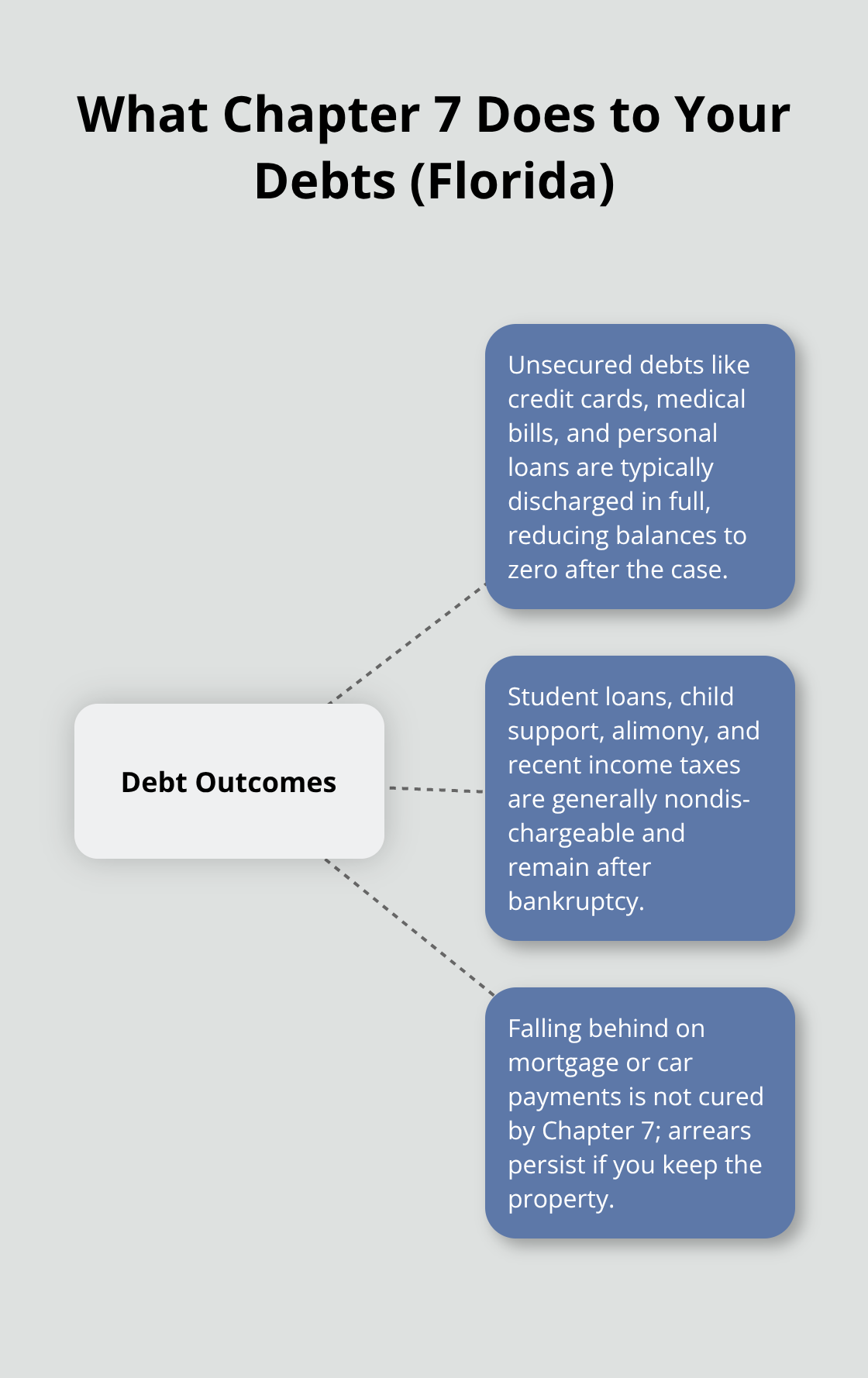
Not all debts vanish in Chapter 7, and understanding which ones do matters significantly. Unsecured debts like credit card balances, medical bills, and personal loans are typically discharged completely, meaning you owe nothing after the case closes. Student loans, child support, alimony, and recent income taxes generally cannot be discharged and will survive the bankruptcy. If you fall behind on mortgage or car payments and want to keep the property, Chapter 7 will not help you catch up on those arrears.
What Happens to Your Assets
Chapter 7 operates through liquidation, meaning the trustee sells your non-exempt assets and distributes the proceeds to creditors by priority. You keep only what Florida law allows you to exempt. Homestead exemptions protect up to $215,000 of your primary residence’s equity as of 2024. Motor vehicle exemptions allow you to keep one vehicle worth up to $10,000 in equity. Personal property exemptions cover household furnishings, clothing, and tools up to $10,000 total. If you own a home with significant equity beyond the exemption limit, a home equity line of credit, rental properties, investment accounts, or valuable collections, the trustee will likely liquidate these assets to pay creditors.
Moving Forward With Your Filing Decision
This reality shapes the hardest truth about Chapter 7: it forces you to surrender property to settle debts. Filing without understanding what you will lose leads to shock and regret during the process. The next section walks you through the actual filing steps and what you must prepare before you submit your petition to the court.
The Three Mandatory Steps Before Your Court Date
Complete Credit Counseling First
Before you submit anything to the court, Florida requires you to complete credit counseling from an approved agency. This is not optional, and filing without proof of completion will result in immediate dismissal. The U.S. Trustee maintains the official list of approved providers for Middle Florida, and you must use one of these agencies or your petition gets rejected. Schedule your course as soon as you decide to file because most providers take three to five business days to issue your certificate. The course itself typically lasts two hours and costs between $50 and $100. Once you pass, keep the certificate accessible because you will file it with your initial petition.
Prepare Your Petition and Schedules With Precision
The court requires you to file at least 13 separate documents, and every single one must be completed accurately using only the official forms from the Middle Florida bankruptcy court website. Do not use forms from other courts or outdated versions. Start with Official Form 101, the Voluntary Petition, followed by Form 106Sum, which summarizes your assets and liabilities. Then file Schedules A through J, which detail your property, exemptions, creditors, income, and expenses. You must also complete Form 106-Sum, the Statement of Financial Affairs, and Forms 122A-1 and 122A-2, which are the means test calculations.
Include Form 121, your Statement About Your Social Security Numbers, and attach your Certificate of Credit Counseling. The Creditor Matrix requires the name and address only for each creditor, nothing else, and formatting errors here cause processing delays. Print everything on 8.5 by 11 inch white paper, sign and date every document with wet ink, do not staple or punch holes, and ensure every page is legible. If you have an eviction judgment, you must include Form 106-A/B to inform the court of your housing situation.
The filing fee is $338, and you must pay it in certified funds only, never cash or personal checks. If you cannot pay upfront, file Form 103A to request installment payments or Form 103B to request a fee waiver based on your financial circumstances.
Navigate Courthouse Rules and File Your Documents
Middle Florida’s Clerk’s Office is open Monday through Friday from 8:30 a.m. to 4 p.m., and you can file in person at the Tampa division if you live in Fort Myers, or at your county’s location if you are elsewhere in the jurisdiction. Bring a valid government-issued photo ID because the court will not accept your filing without it. You will pass through federal courthouse security, and electronic devices are generally prohibited, so leave your phone and laptop at home.
Pro se filers cannot file electronically, so you must file in person or by mail. If you mail your petition, include a copy of your photo ID and use certified mail with a return receipt. The court must receive your filing fee within 14 days of submission if you are paying by mail.
Prepare for the 341 Meeting and Debtor Education
After filing, you will receive a case number and notice of your 341 meeting of creditors, which typically occurs 40 to 60 days after filing. This is the meeting with the trustee assigned to your case, and you must attend. The trustee will ask questions about your income, expenses, assets, and debts. Prepare by reviewing all your filed documents and bringing documentation of your income from the last 60 days.
Within 60 days after your 341 meeting, you must complete the Debtor Education course from another approved provider and file the certificate of completion. Without this certificate, the court will not issue your discharge, and your debts will not be eliminated. The next section covers what happens during the trustee meeting and how to handle the questions you will face.
What Goes Wrong When You File Alone in Florida
Missing Deadlines and Paperwork Errors
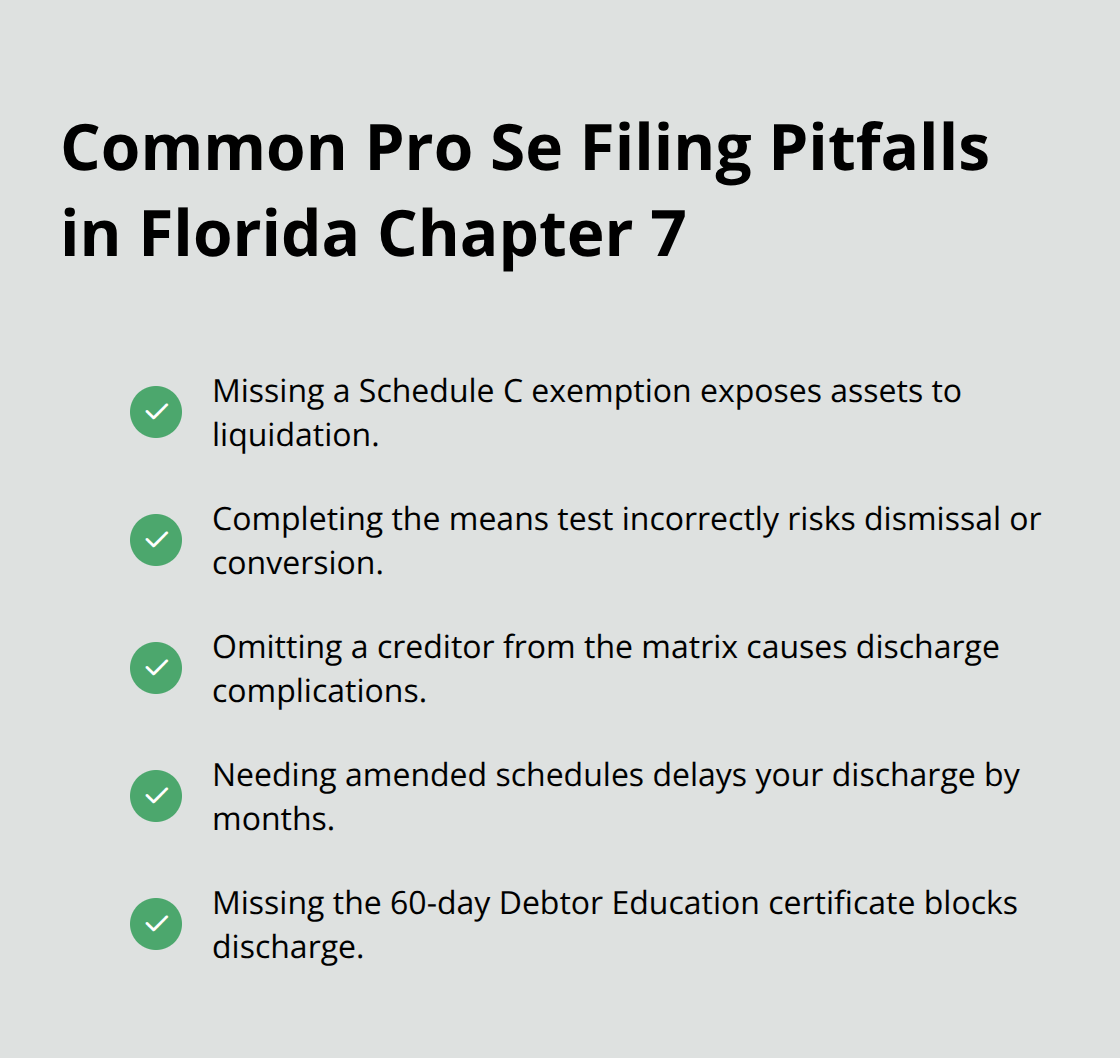
Filing Chapter 7 without legal representation exposes you to errors that destroy your case and waste months of your time. Court staff cannot provide legal advice, and they will not catch mistakes in your paperwork before you file. The Clerk’s Office processes documents mechanically, checking only that forms are legible, signed, and dated correctly. A missing exemption on Schedule C means the trustee can liquidate assets you thought were protected. An incorrectly completed means test calculation triggers dismissal or forces conversion to Chapter 13. One filer in Middle Florida omitted an entire creditor from the matrix and faced complications with discharge because that creditor received no notice. The court gives you one chance to file correctly, and corrections after submission require amended schedules and additional filings that delay your discharge by months. Missing the 60-day deadline to file your Debtor Education certificate stops your discharge cold, leaving debts technically unpaid even though you completed everything else.
Inadequate Asset Protection Strategies
The consequences of inadequate asset protection hit hardest in cases involving home equity, retirement accounts, and personal property. Florida allows homestead exemptions up to $215,000 in equity, but only if you claim it correctly on Schedule C using the precise legal language the court expects. A filer who lists the exemption incorrectly or forgets to list it at all watches the trustee demand the difference in equity as payment to creditors. One Middle Florida case involved a home with $250,000 in equity; the pro se filer claimed only a $50,000 exemption, and the trustee forced a sale to recover the remaining $200,000.
Retirement Accounts and Personal Property Losses
Retirement accounts like IRAs receive strong federal protection under bankruptcy law, but you must know which accounts qualify and how to claim them. A 401k stays protected; a brokerage account masquerading as retirement savings does not. Personal property exemptions cover household goods and tools up to $10,000, but filers often overlook valuable collections, jewelry, or hobby equipment that exceed this limit. You must itemize and value everything or risk losing it to the trustee’s liquidation process.
Final Thoughts
Filing for Chapter 7 bankruptcy without a lawyer in Florida remains legally permissible, but the risks typically outweigh the savings. The process demands precision with forms, strict adherence to deadlines, and strategic decisions about asset protection that shape your financial outcome for years. Court staff cannot guide you through these choices, and mistakes made during filing cannot always be corrected.
The consequences of errors-losing home equity you could have protected, failing to discharge debts properly, or facing case dismissal-usually cost far more than professional representation would have. A lawyer advises whether you should file at all, which chapter truly fits your situation, and whether certain debts can actually be discharged. They handle the trustee meeting, manage amendments if circumstances change, and guide you through the discharge process without the anxiety of wondering whether you completed everything correctly.
If you cannot afford traditional legal fees, free and low-cost legal services exist through the Legal Services Corporation and the American Bar Association’s Legal Help resources. Contact Harnage Law, PLLC for a consultation if you have significant assets, complex debt situations, or concerns about what you might lose. We help individuals and families discharge qualifying debts and protect their assets while stopping creditor harassment and preventing wage garnishments.