Filing Chapter 7 bankruptcy in Florida comes with significant protections that many people don’t fully understand. The state offers some of the strongest exemption laws in the country, which means you could keep more of your assets than you think.
At Harnage Law, PLLC, we’ve seen countless clients miss out on these protections simply because they didn’t know what exemptions applied to them. This guide breaks down exactly how Chapter 7 bankruptcy Florida exemptions work and what you need to know to protect yourself.
How Exemptions Let You Keep Your Assets in Chapter 7
Bankruptcy exemptions are specific assets or amounts of money that federal and state law protect from creditors during Chapter 7. When you file, a trustee is appointed to collect your nonexempt property and sell it to pay creditors. Exemptions create a shield around certain assets, meaning the trustee cannot touch them. Florida law defines which assets qualify for protection, and these protections are remarkably broad. You’re not walking into Chapter 7 defenseless-the law actually gives you substantial tools to preserve what matters most.
What Makes Florida Exemptions Different
Florida’s exemptions rank among the most generous in the nation, which is why many people strategically move to Florida before filing bankruptcy. The state has opted out of federal exemptions entirely, meaning you use Florida’s list instead.
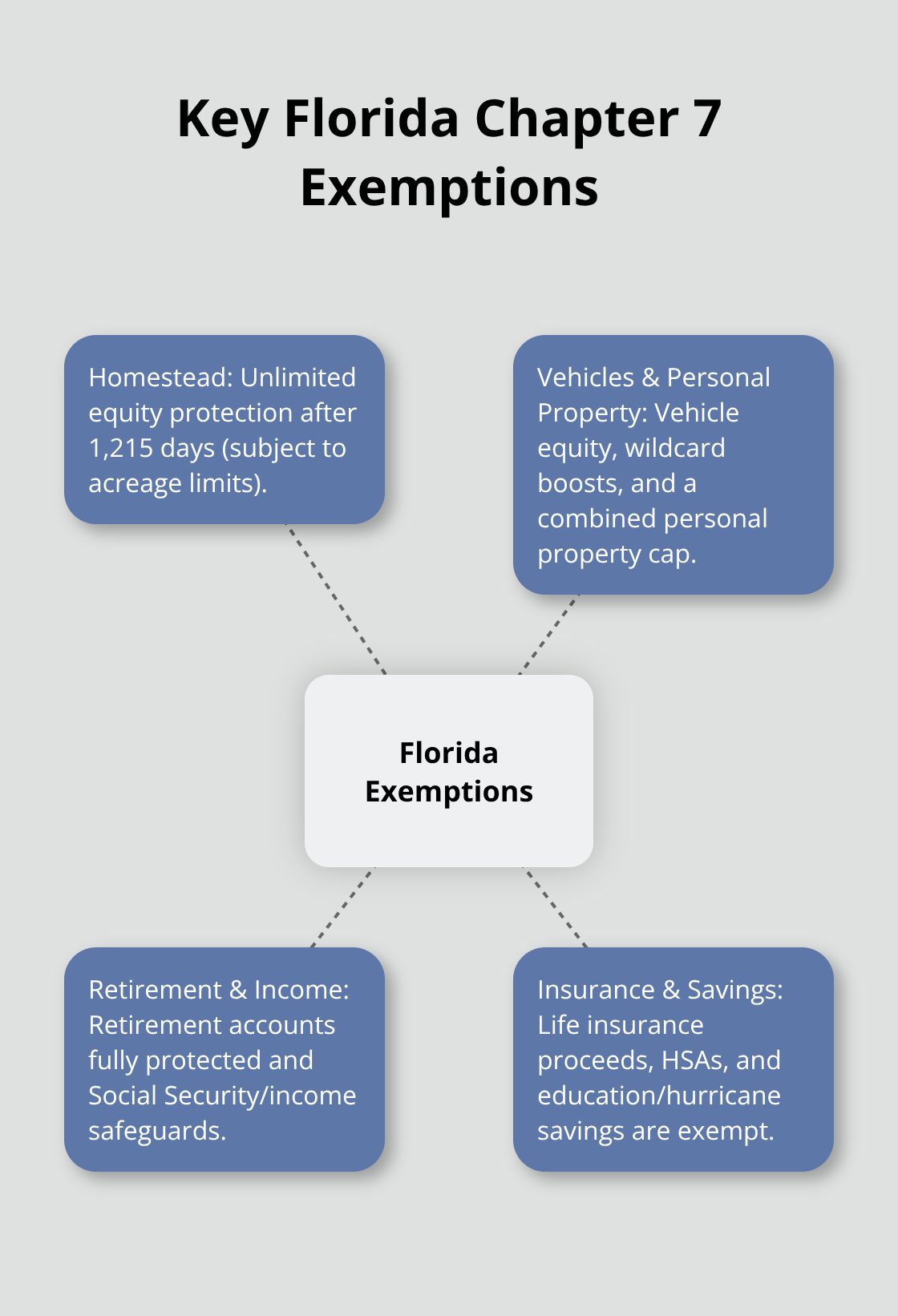
This matters because Florida protects unlimited equity in your primary home if you’ve owned it for at least 1,215 days and it’s under 0.5 acres inside a municipality or 160 acres outside. Compare this to the federal cap of approximately $189,050 for cases filed between January 2022 and March 2025, and you see why residency matters. If you haven’t met the 1,215-day requirement, you fall back to the federal cap, which still protects substantial home equity. Your residency timeline directly affects how much of your home you keep, so understanding your exact filing date relative to when you moved to Florida is essential.
Assets You Actually Keep
Personal property exemptions in Florida cover up to $1,000 across all items like furniture, electronics, and clothing, or $4,000 if you don’t claim homestead protection. Vehicles receive protection up to $1,000 in equity per person, with the ability to add your wildcard exemption to boost that protection. Retirement accounts (including 401(k)s, 403(b)s, and IRAs) are fully exempt with current caps reaching $1,711,975 per person for cases filed between April 2025 and March 2028 under federal rules. Social Security benefits, veterans benefits, unemployment compensation, and workers’ compensation remain completely protected. Wages receive shielding up to $750 per week for heads of household or 75% of your wages-whichever is higher-when paid or deposited in the last six months. Life insurance proceeds payable to named beneficiaries are fully exempt, as is the cash surrender value of permanent policies. Health savings accounts, education savings accounts, and hurricane savings accounts all receive protection.
How These Protections Apply to Your Situation
These protections aren’t theoretical-they apply directly to real money and real property you own right now. The specific exemptions that matter most depend on what you own and your family structure. Married couples filing jointly can double many exemptions, which significantly increases the total value of protected assets. Understanding which exemptions apply to your particular assets prevents costly mistakes during the filing process. The next section covers common errors people make when claiming these protections, and how to avoid them.
How Florida’s Main Exemptions Protect Your Specific Assets
Your Home Receives Unlimited Protection Under Florida Law
Your primary residence gets the strongest protection available under Florida law. If you owned your home for at least 1,215 days before filing, Florida protects unlimited equity in your primary residence as long as the property stays within size limits: 0.5 acres inside a municipality or 160 acres outside. This unlimited protection applies regardless of your home’s value-a $500,000 home receives the same protection as a $2 million home. The ownership structure matters tremendously, however. You must hold title individually or jointly with a spouse. If your home is titled to a corporation, LLC, or irrevocable trust, the homestead exemption vanishes entirely, and you lose this protection. Many clients encounter this mistake when they set up LLCs for liability reasons without understanding the bankruptcy consequences.
If you haven’t reached the 1,215-day mark, the federal cap of $189,050 applies instead for cases filed between January 2022 and March 2025. This still protects substantial equity but limits your protection significantly. Your filing date relative to your move to Florida determines everything here, so calculating your exact residency days before filing prevents expensive surprises.
Vehicles and Personal Property Get Layered Protections
Vehicles receive protection up to $1,000 in equity per person, but you can add your wildcard exemption to cover an additional $4,000, effectively protecting up to $5,000 total per person in one vehicle. Personal property like furniture and electronics receives $1,000 in protection, or $4,000 if you don’t claim homestead exemption.
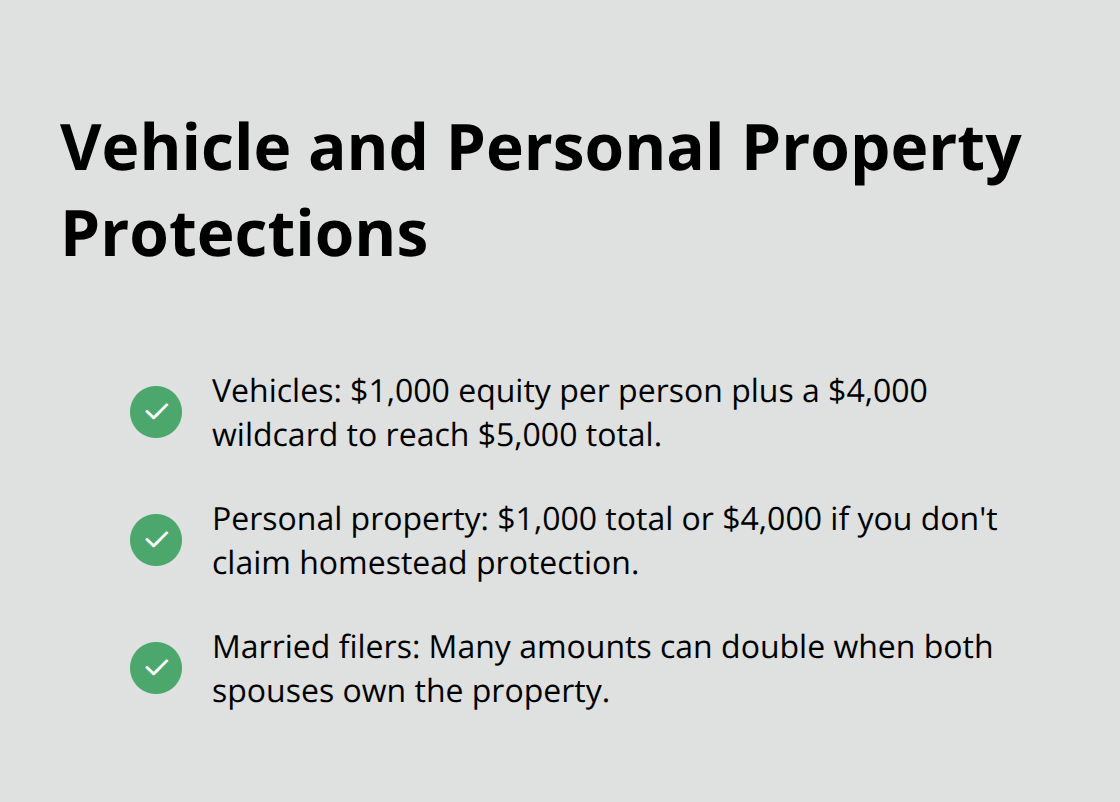
Married couples filing jointly can double these amounts when both spouses own the property, which substantially increases total protected value across all categories.
Retirement Accounts and Income Stay Completely Protected
Retirement accounts including 401(k)s, 403(b)s, and IRAs are fully exempt with caps reaching $1,711,975 per person for filings between April 2025 and March 2028 under federal rules. Wages receive protection at $750 per week for heads of household, or 75% of total wages, or 30 times the federal minimum wage, whichever amount is highest when paid or deposited within the last six months. Social Security benefits, veterans benefits, unemployment compensation, and workers’ compensation all remain completely protected and untouchable by creditors.
Insurance and Savings Accounts Receive Full Exemption
Life insurance proceeds payable to named beneficiaries are fully exempt, meaning your family’s financial safety net survives bankruptcy. The cash surrender value of permanent policies also receives full protection. Health savings accounts, education savings accounts, and hurricane savings accounts receive full protection as well. These layered protections mean that creditors cannot reach the money you’ve set aside for medical emergencies, your children’s education, or hurricane preparedness.
Understanding which exemptions apply to your particular assets prevents costly mistakes during the filing process. The specific exemptions that matter most depend on what you own and your family structure. The next section covers common errors people make when claiming these protections and how to avoid them.
Exemption Mistakes That Cost You Money
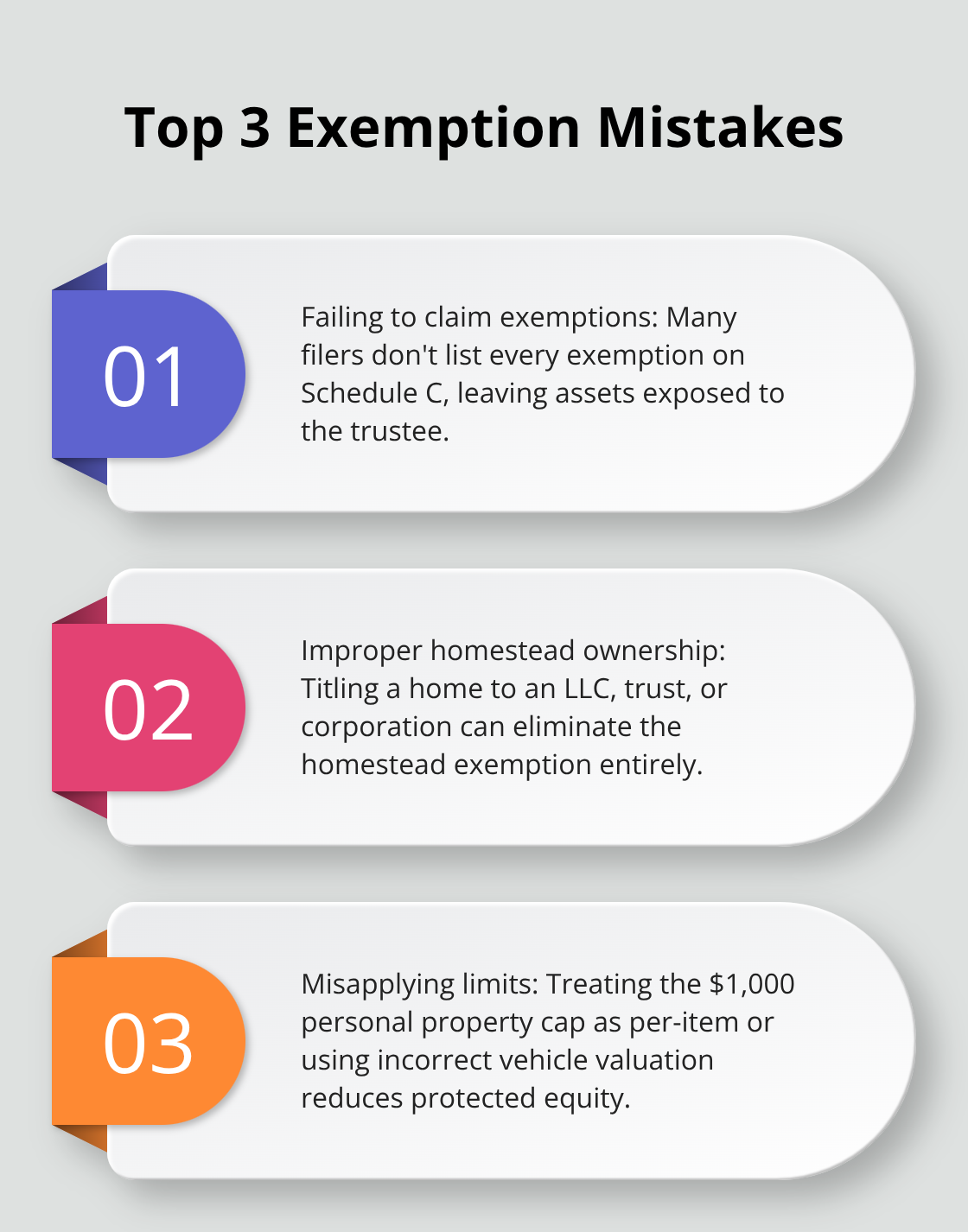
Most people filing Chapter 7 in Florida make one of three critical errors that directly reduce the assets they protect. The first mistake is simply not claiming exemptions they’re entitled to use. You must affirmatively list every exemption on your bankruptcy petition, Schedule C. If you don’t claim an exemption, the trustee treats that asset as nonexempt and can sell it to pay creditors. Clients lose thousands in vehicle equity, personal property, and retirement savings because they fail to claim available wildcard exemptions or don’t understand that multiple exemptions can stack together. Your wildcard exemption of $4,000 can combine with your vehicle exemption to protect up to $5,000 total in one car, but only if you claim both on your filing documents. Many filers assume the court automatically protects everything they think should be protected, then discover too late that they needed to actively claim those protections.
Homestead Ownership Structure Determines Your Protection Level
The second major mistake involves misunderstanding the homestead exemption’s ownership requirement. Your home must be titled individually or jointly with a spouse to qualify for Florida’s unlimited protection. If your home is held by an LLC, corporation, or irrevocable trust, the homestead exemption disappears completely, and you fall back to the federal cap of $189,050 for cases filed between January 2022 and March 2025. This ownership structure issue catches many business owners and people who created LLCs for liability protection without consulting a bankruptcy attorney. The title on your deed determines everything about homestead protection, and transferring property after financial problems appear may trigger fraudulent transfer concerns.
Additionally, you must have owned the home for at least 1,215 days before filing to access the unlimited exemption. If you haven’t met that timeline, you’re stuck with the federal cap regardless of Florida residency, which means understanding your exact purchase date relative to your intended filing date is essential.
Personal Property Limits and Vehicle Valuation
The third mistake involves applying exemption limits incorrectly to your specific property. Personal property exemptions protect $1,000 total across all items like furniture, electronics, and clothing, not $1,000 per item. People frequently overestimate what they can protect because they think each category receives separate protection. Married couples filing jointly can double exemptions when both spouses own the property, but only if the property is titled jointly or held as tenants by the entirety. Single filers cannot access the doubled amounts, and incorrectly claiming married exemption amounts as a single filer creates problems with the trustee.
Vehicle valuation presents another practical challenge. You must use replacement value, not loan payoff amount, when calculating equity. If you owe $15,000 on a vehicle worth $16,000, your equity is $1,000 and fully protected under the vehicle exemption. However, if the vehicle is worth $20,000 with a $15,000 loan, your equity is $5,000, and you can only protect $1,000 without claiming your wildcard exemption. Undervaluing vehicles to hide equity from the trustee constitutes fraud and carries serious criminal penalties, so accurate valuation from the start prevents this trap. Professional appraisals for vehicles worth more than $10,000 establish clear, defensible values on your petition.
Residency Timing and Fraudulent Transfer Concerns
The timing of your filing also affects which exemptions apply. If you’re moving to Florida, your residency clock doesn’t start until you establish domicile, and you must live in Florida for at least 730 days before using Florida exemptions in Chapter 7. Moving to Florida specifically to access the unlimited homestead exemption requires careful documentation of your intent to remain in the state, and the trustee will scrutinize any recent move that appears bankruptcy-driven. These mistakes are preventable with proper attention to detail on your filing documents.
Final Thoughts
Florida’s Chapter 7 bankruptcy exemptions provide real protection for your assets when you claim them correctly and understand how they apply to your specific situation. The unlimited homestead exemption, layered personal property protections, and income safeguards create a framework that keeps most filers from losing property during bankruptcy. Your residency timeline, property ownership structure, and accurate asset valuation determine whether you maximize these protections or leave money on the table through preventable mistakes.
Chapter 7 bankruptcy Florida exemptions work powerfully in your favor when you file with complete information about your assets and proper documentation of your claims. Married couples benefit from doubled exemptions across multiple categories, retirement accounts stay completely protected regardless of balance, and your primary residence receives unlimited equity protection if you meet the 1,215-day ownership requirement. Vehicles, personal property, wages, and insurance proceeds all receive specific protections that creditors cannot penetrate.
We at Harnage Law, PLLC help you protect your assets through personalized legal representation tailored to your specific situation. Contact Harnage Law, PLLC today to schedule a consultation and discuss how Chapter 7 bankruptcy can protect what matters most to you and your family.