
Navigating bankruptcy can be complex, especially when it involves married couples. At Harnage Law, PLLC, we often hear the question: Can one spouse file bankruptcy alone in Florida?
The answer is yes, but it’s not always straightforward. This decision can have significant implications for both partners and their shared financial future.
What Is Individual Bankruptcy Filing in Florida?
Legal Basis for Solo Filing
Individual bankruptcy filing in Florida allows one spouse to seek debt relief without the other’s involvement. This option stems from federal bankruptcy laws, which recognize that financial situations can differ within a marriage. The law permits individuals to file for bankruptcy independently, even if they are married.
Reasons for Filing Alone
Several factors might prompt one spouse to file for bankruptcy independently:
- Debt Distribution: If most of the debt belongs to one person, it might be logical for that individual to file alone.
- Credit Score Protection: This approach can safeguard the non-filing spouse’s credit score and financial standing.
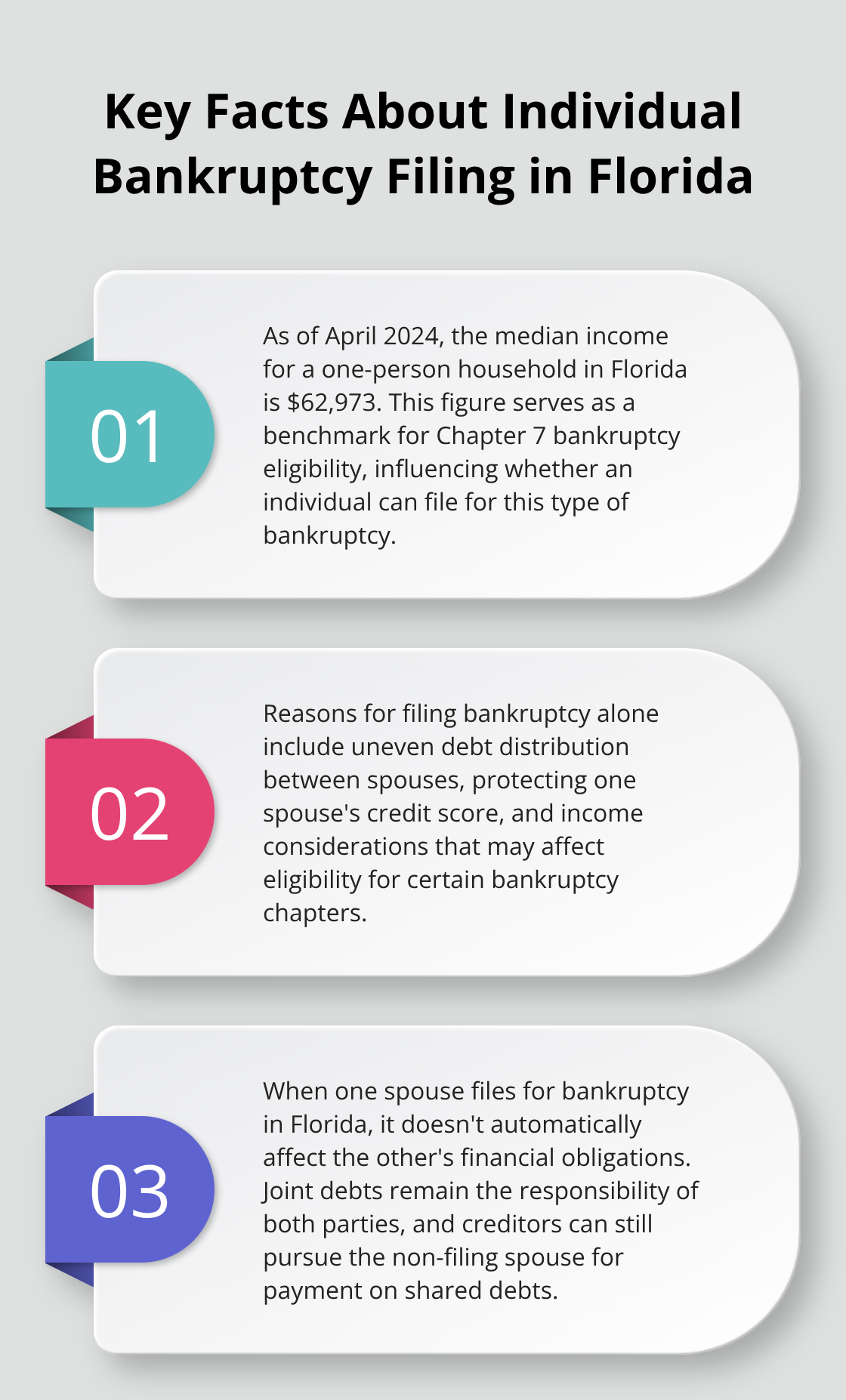
- Income Considerations: As of April 2024, the median income for a one-person household in Florida is $62,973 (a benchmark for Chapter 7 eligibility). If one spouse has a significantly higher income, filing separately might be necessary to pass the means test.
Impact on Joint Obligations
When one spouse files for bankruptcy in Florida, it doesn’t automatically affect the other’s financial obligations. However, joint debts remain the responsibility of both parties. Creditors can still pursue the non-filing spouse for payment on shared debts.
Financial Assessment
The decision to file individually often hinges on the couple’s overall financial picture. It’s critical to assess all aspects of your financial circumstances before making this decision. (This assessment should include a thorough review of individual and joint debts, assets, and income.)
Professional Guidance
Each bankruptcy case presents unique challenges and opportunities. (A consultation with a bankruptcy attorney can provide clarity on whether individual filing is the best strategy for your situation.) As we move forward, let’s examine how individual bankruptcy filing affects joint debts and assets in more detail.
How Individual Bankruptcy Affects Joint Finances in Florida
Joint Debts in Individual Bankruptcy
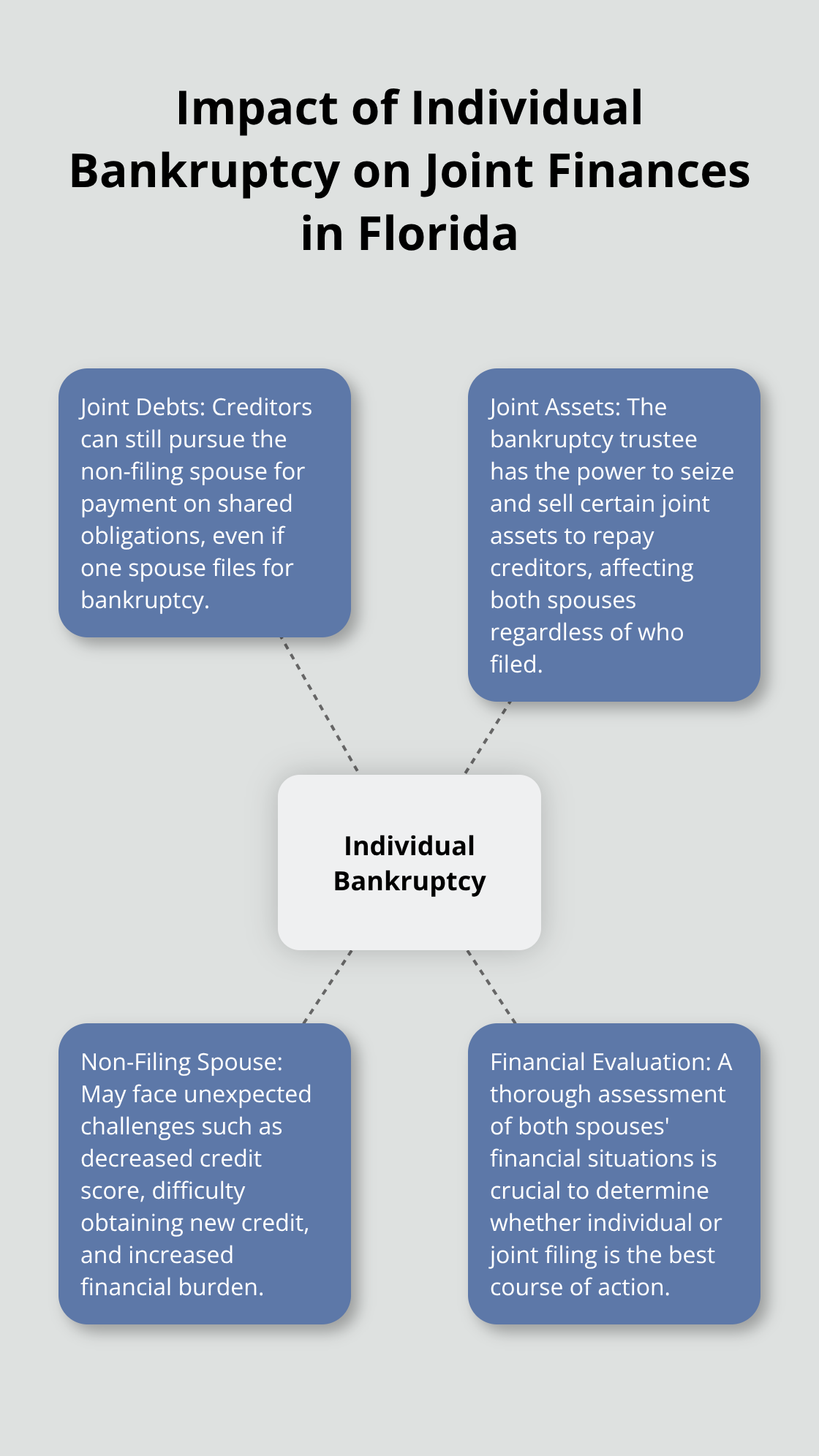
When one spouse files for bankruptcy in Florida, it doesn’t automatically free the other from joint debts. Creditors retain the right to pursue the non-filing spouse for payment on shared obligations. (For instance, if a couple has a joint credit card with a $10,000 balance, and one spouse files for Chapter 7 bankruptcy, the credit card company can still demand full payment from the non-filing spouse.)
This situation often surprises couples. Many incorrectly assume that individual bankruptcy filing will protect both parties. The non-filing spouse might unexpectedly find themselves solely responsible for debts they thought would disappear.
Impact on Jointly Owned Assets
Jointly owned assets in Florida can become contentious during individual bankruptcy proceedings. The bankruptcy trustee has the power to seize and sell certain joint assets to repay creditors, even if only one spouse filed. This can include shared bank accounts, vehicles, or investment properties.
For example, if a couple owns a vacation home together, and one spouse files for bankruptcy, the trustee might sell the property to satisfy creditors. This action affects both spouses, regardless of who initiated the bankruptcy.
Consequences for the Non-Filing Spouse
The non-filing spouse often faces unexpected challenges. Their credit score may decrease if joint accounts are included in the bankruptcy. They might also struggle to obtain new credit or loans in the future, as lenders may view them as high-risk due to their spouse’s bankruptcy.
Moreover, the non-filing spouse might need to pay a larger portion of household expenses. If the filing spouse’s wages are garnished or their income is restricted due to bankruptcy proceedings, the financial burden often shifts to the non-filing partner.
Financial Evaluation
A thorough evaluation of both spouses’ financial situations is essential to make an informed decision about whether individual or joint filing is the best course of action. This assessment should include a comprehensive review of individual and joint debts, assets, and income. (Professional guidance can prove invaluable in navigating these complex financial waters.)
As we move forward, let’s examine the pros and cons of individual bankruptcy filing to provide a clearer picture of this important decision.
Weighing Solo Bankruptcy Filing in Florida
Protecting Your Spouse’s Credit
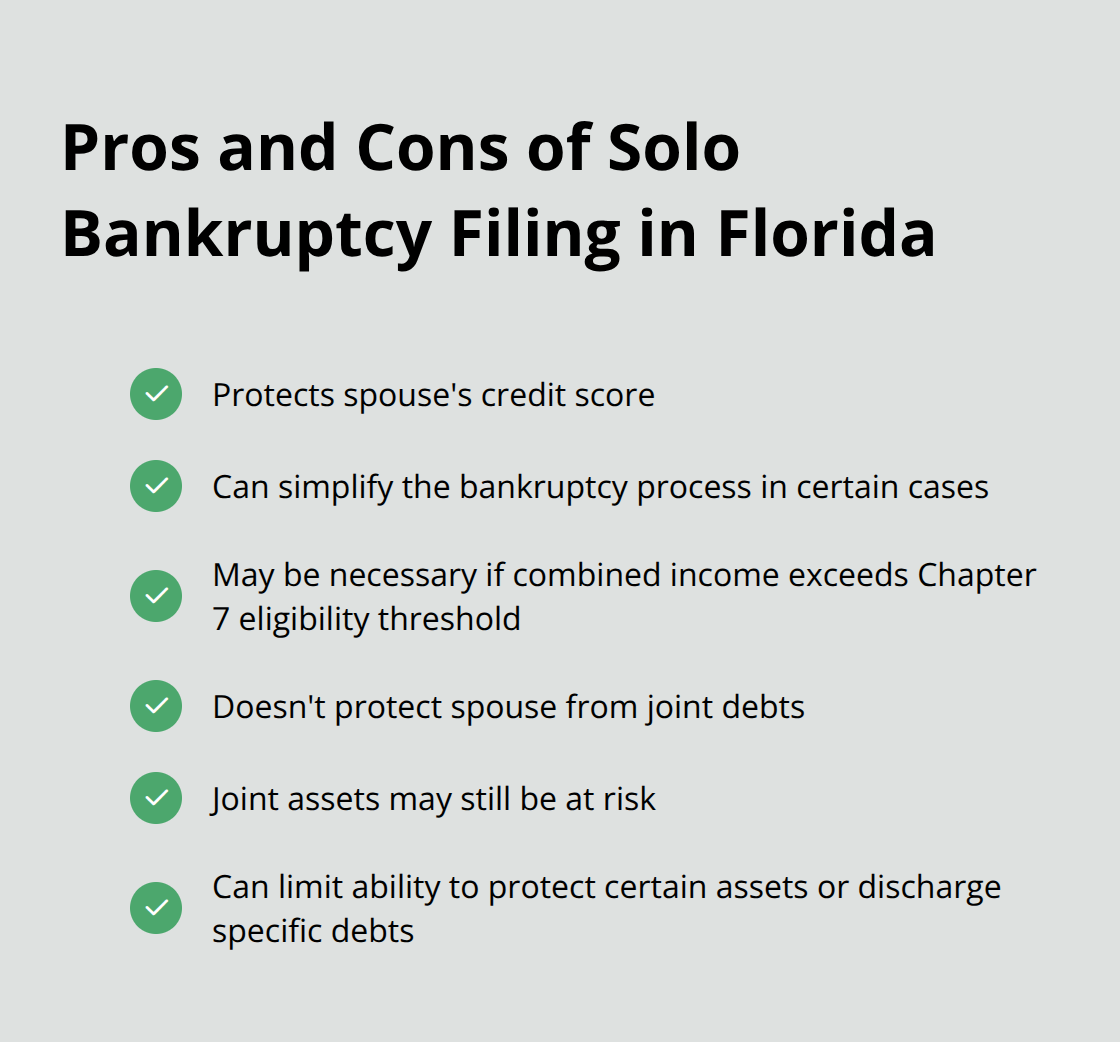
Filing for bankruptcy alone in Florida can protect your spouse’s credit score. When you file individually, your spouse’s credit report won’t show a bankruptcy filing. This can benefit your partner if they need to maintain a good credit score for employment or future financial endeavors.
Streamlined Process for Some
Individual filing can simplify the bankruptcy process in certain cases. If most of the debt is in your name, you might find it easier to navigate the proceedings without involving your spouse. (This applies especially if your spouse has a complex financial situation that could complicate the bankruptcy case.)
Potential Drawbacks
Individual filing isn’t always the best choice. A significant drawback is that it doesn’t protect your spouse from joint debts. Creditors can still pursue your partner for payment on shared obligations, which can lead to financial strain and potential legal issues for the non-filing spouse.
Asset Protection Challenges
The treatment of joint assets presents another concern. In Florida, the bankruptcy trustee has the authority to sell certain joint properties to satisfy creditors, even if only one spouse files. This can put shared assets at risk, potentially affecting both partners’ financial stability.
Income Considerations
The decision to file individually often depends on income levels. (As of April 2024, the median income for a one-person household in Florida is $62,973.) If your combined income exceeds the threshold for Chapter 7 eligibility, filing separately might become necessary. However, this approach can also limit your ability to protect certain assets or discharge specific debts.
Final Thoughts
The decision for one spouse to file bankruptcy alone in Florida requires careful consideration of multiple factors. Individual filing can protect a partner’s credit score and simplify the process in certain situations. However, it also carries risks, including continued liability for joint debts and potential loss of shared assets.
Bankruptcy law complexities and unique financial circumstances make professional legal advice essential before making any decisions. An experienced bankruptcy attorney can provide a comprehensive evaluation of your situation and help you understand the full implications of individual versus joint filing.
At Harnage Law, PLLC, we understand the intricacies of Florida bankruptcy law and the challenges couples face when considering this option. Our team will guide you through every step of the bankruptcy process, whether you choose to file individually or jointly. (We offer personalized legal services tailored to your specific needs.) Contact Harnage Law, PLLC today to explore your options and take the first step towards financial freedom.