Florida Chapter 7 eligibility depends on three main factors: your income, your debts, and your assets. Understanding these requirements is the first step toward determining whether bankruptcy can give you a fresh start.
We at Harnage Law, PLLC help people navigate these rules every day. This guide breaks down what you need to know.
Does Your Income Qualify for Florida Chapter 7?
The Median Income Test
Florida uses two income tests to determine whether you can file Chapter 7 bankruptcy. The first test compares your average monthly income over the past six months to the Florida median income for your household size. If your income falls below the median, you pass this test and can move forward with Chapter 7.
As of April 2024, the Florida median income ranges from $62,973 annually for a single person to $143,669 for eight people, with an additional $9,900 added for each person beyond that. To calculate your income accurately, add up your earnings from the last six calendar months and divide by six. This average monthly figure determines everything that follows.
Many people assume they earn too much to file Chapter 7, but the actual calculation often surprises them because it includes only the previous six months, not your current income or future earnings.
When Your Income Exceeds the Median
If your income exceeds the Florida median for your household size, you must complete the means test to determine whether you can file Chapter 7. The means test subtracts allowable monthly expenses from your average monthly income to calculate disposable income.
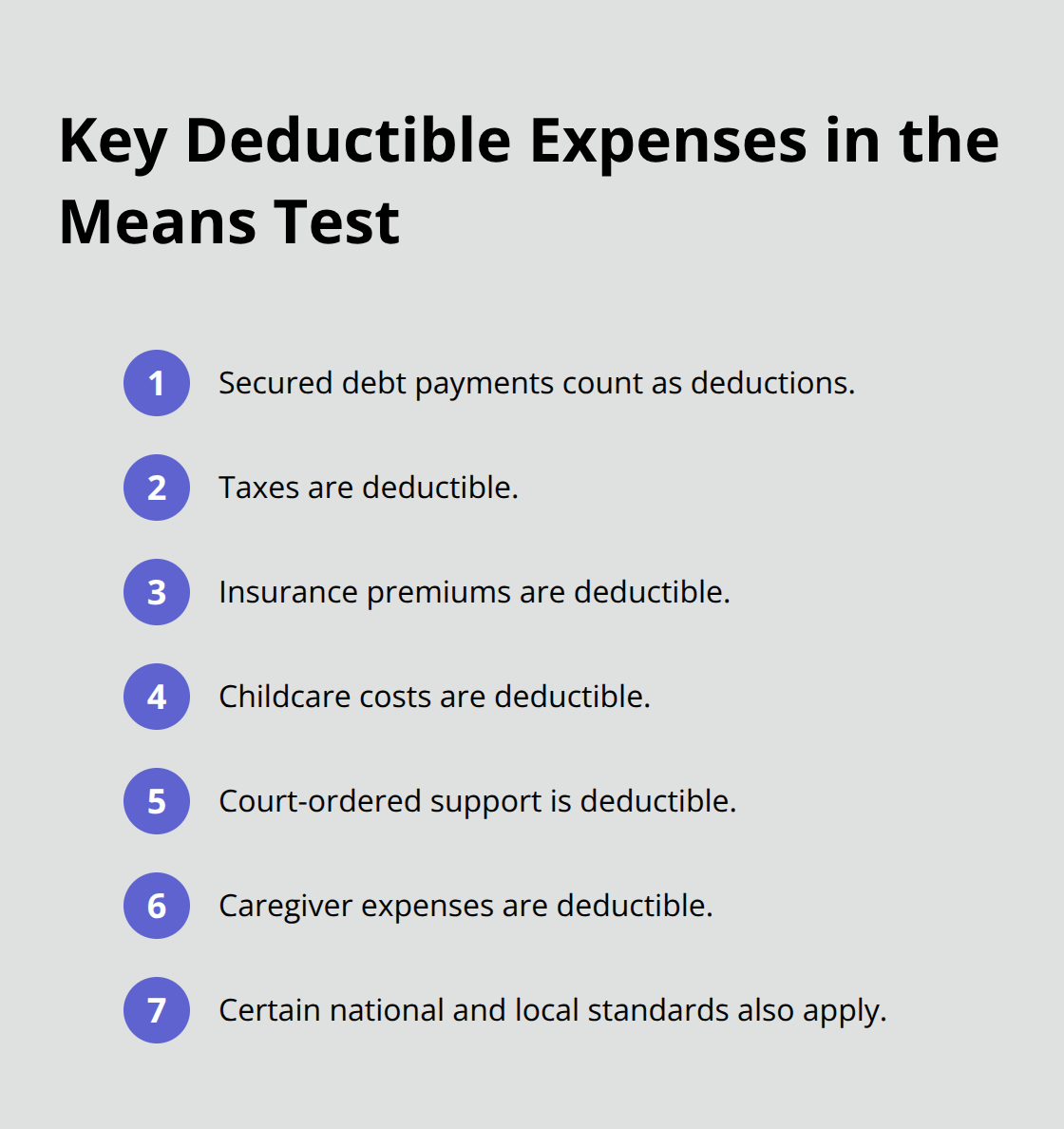
The IRS provides national standards for certain expenses like food, utilities, and transportation, while Florida and local standards apply to other categories. Deductible expenses include secured debt payments, taxes, insurance premiums, childcare, court-ordered support, and caregiver costs.
Calculating Your Five-Year Disposable Income
Once you calculate your monthly disposable income, multiply it by 60 to determine your five-year disposable income. If this figure falls below $7,475, you pass the means test and qualify for Chapter 7. If it exceeds $12,475, you fail the test and cannot file Chapter 7.
Between these thresholds, additional calculations determine eligibility based on your total unsecured debt. The means test contains multiple exceptions for business debt and disabled veterans, making the analysis more nuanced than the basic thresholds suggest.
Getting Your Numbers Right
Small calculation errors can affect your eligibility or result in case dismissal. The means test is complex, and having an attorney review your specific numbers protects you from costly mistakes. Your next step involves understanding which debts you can actually discharge through Chapter 7.
What Debts Can You Eliminate Through Florida Chapter 7
Chapter 7 bankruptcy discharges most unsecured debts, meaning you no longer owe them after your case closes. The key distinction lies between debts the court can eliminate and those that survive bankruptcy regardless of your filing. Understanding this difference determines whether Chapter 7 actually solves your financial problems or leaves you stuck paying certain obligations.
Credit Card Debt, Medical Bills, and Other Dischargeable Debts
Credit card balances, personal loans, and medical bills represent the largest portion of debts that Florida Chapter 7 eliminates. If you carry $15,000 in credit card debt across multiple cards, Chapter 7 discharges all of it. Medical bills from hospital stays, surgeries, or emergency care disappear through discharge. Utility arrears also qualify for elimination, meaning past-due electric, water, or gas bills no longer follow you. Payday loans, which trap many Floridians in cycles of debt, get discharged completely.
Deficiency balances from repossessed vehicles can be eliminated if the repossession occurred more than 910 days before you file, though the timing rules matter significantly. Personal injury judgments against you typically discharge unless they stem from drunk driving or willful misconduct. The Federal Trade Commission reports that the average credit card holder carries balances across 4.1 cards, making credit card discharge one of the most valuable aspects of Chapter 7 for most filers.
Debts That Survive Chapter 7 Bankruptcy
Certain obligations persist no matter what happens in your bankruptcy case. Child support and alimony obligations never discharge, period. Federal and state income taxes filed within three years of your filing date generally cannot be eliminated, though older tax debts sometimes qualify for discharge under specific conditions. Student loans rarely discharge unless you prove undue hardship, which requires showing you cannot maintain a minimal standard of living while repaying the debt.
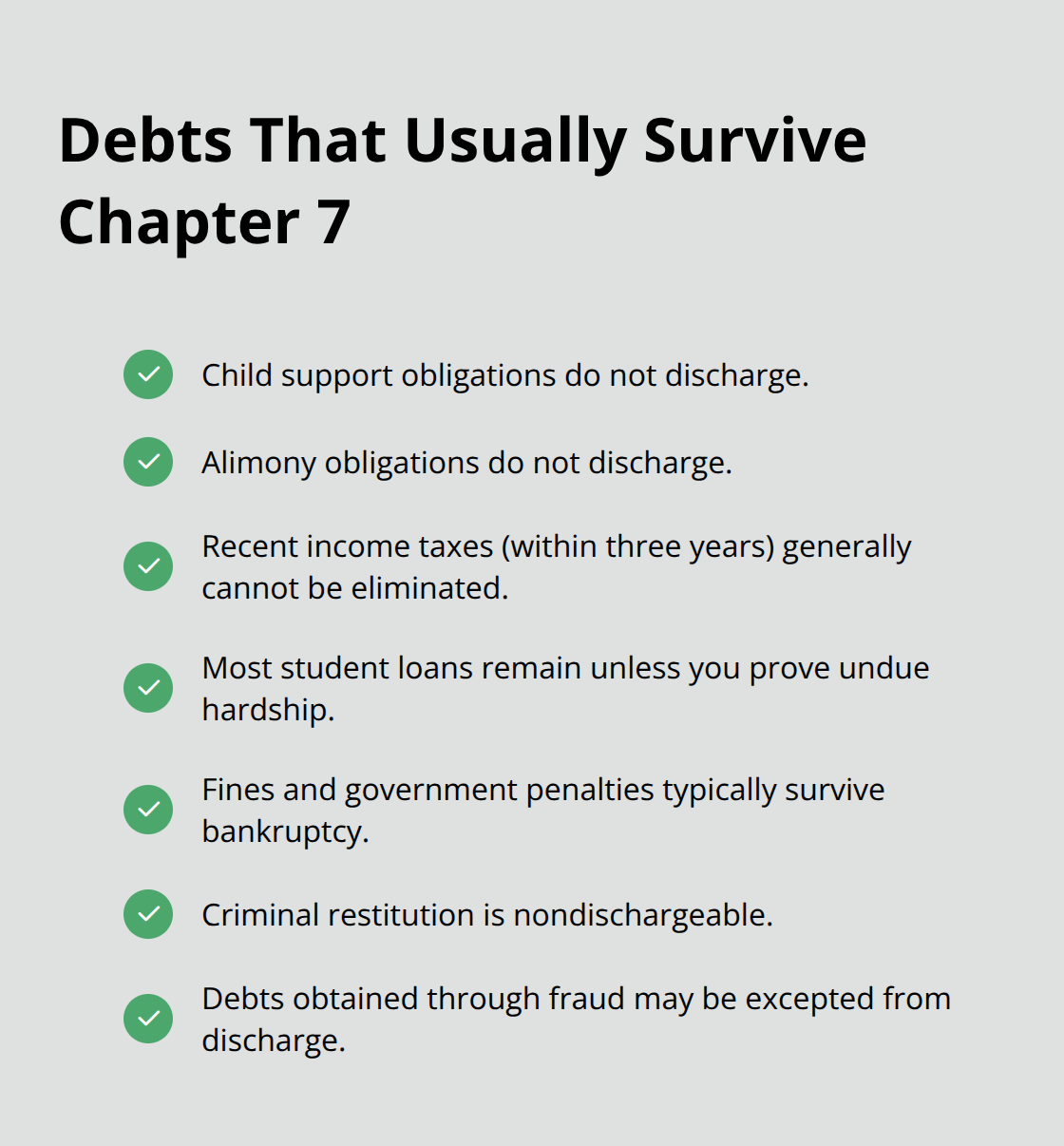
Recent court decisions have made undue hardship slightly easier to establish, but it remains a high bar. Fines and penalties imposed by courts or government agencies typically survive bankruptcy. Criminal restitution obligations are nondischargeable. Debts obtained through fraud or misrepresentation may not discharge if creditors challenge them in court, so hiding assets or lying on credit applications creates lasting liability.
How Chapter 7 Treats Secured Debts Differently
Mortgages and car loans differ from unsecured debts because they attach to specific property. Chapter 7 does not automatically eliminate a mortgage on your home or a loan on your vehicle. If you want to keep your home or car, you must continue making payments and stay current on the loan. If you choose to surrender the property, the debt discharges and the lender repossesses the collateral.
Surrendering a car through Chapter 7 eliminates any deficiency balance owed if the sale price falls short of what you owe, provided the vehicle was purchased for personal use rather than business. This protection matters because a $25,000 car with a $30,000 loan balance leaves you with a $5,000 deficiency that Chapter 7 eliminates completely. Knowing which debts discharge and which ones survive shapes your overall bankruptcy strategy and determines what assets you can protect through the process.
What Assets Do You Keep in Florida Chapter 7?
Florida’s Homestead Exemption Protects Your Home
Florida bankruptcy law shields far more property than most people realize. The state’s exemption system protects your home equity, vehicles, retirement accounts, and personal property from creditors through Chapter 7. As of April 2024, Florida homeowners with a primary residence can protect unlimited home equity if the property does not exceed half an acre in a municipality or 160 acres outside city limits, and you must have owned it for at least 1,215 days before filing. This homestead protection ranks among the strongest in the nation and applies automatically when you file. If both spouses own the home jointly and file together, you can double the homestead exemption, creating substantial protection for married couples.
Vehicle and Personal Property Exemptions
One vehicle receives protection up to $5,000 in equity, meaning if you owe $15,000 on a car worth $18,000, your $3,000 equity stays protected. Beyond the homestead and vehicle exemptions, Florida provides a wildcard exemption of $1,000 for any personal property, or $4,000 if you do not claim the homestead exemption. This wildcard covers items like jewelry, electronics, furniture, or collectibles that fall outside other protected categories.
Retirement Accounts and Public Benefits
Retirement accounts including IRAs, 401(k) plans, and most pension funds receive broad protection under both Florida law and federal limits that allow up to $1,711,975 per person for the 2025–2028 filing window. Social Security benefits, Veterans benefits, unemployment compensation, and workers’ compensation never enter your bankruptcy estate and remain completely protected.
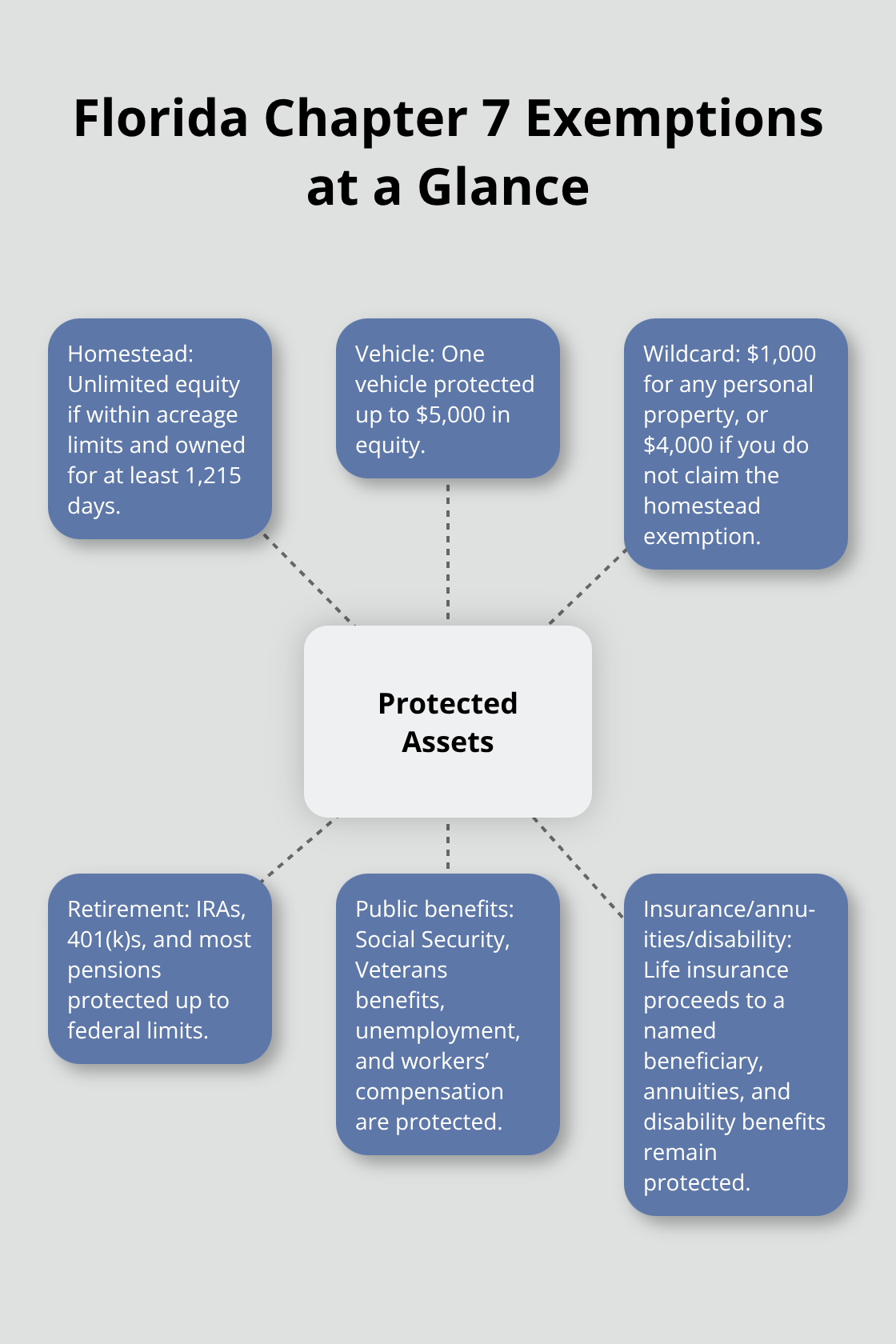
Life insurance proceeds payable to a named beneficiary, annuity income, and disability benefits also survive Chapter 7 intact.
Nonexempt Assets and the Trustee’s Role
The assets that do become nonexempt property get sold by the bankruptcy trustee to pay your creditors, which is why understanding your exemptions matters tremendously before filing. Nonexempt property typically includes significant cash balances beyond what exemptions protect, investment accounts, second vehicles, vacation homes, and valuable collections or equipment. Many Chapter 7 cases involve minimal nonexempt property because debtors fit their assets within Florida’s generous protections, but cases with substantial nonexempt assets may result in asset sales.
Residency Requirements and Exemption Accuracy
The Florida residency requirement states you must live in Florida for at least 730 days before filing to use Florida exemptions; if you moved to Florida recently, you use the exemptions from your previous state. Accuracy on your exemption schedule matters critically because misstatements can be treated as fraud and lead to case dismissal or loss of discharge. The trustee reviews your exemption claims and can object if values appear understated or exemptions misapplied. Having someone review your specific situation prevents expensive mistakes that could expose assets you thought were safe.
Final Thoughts
Florida Chapter 7 eligibility rests on three concrete factors: your income against the means test thresholds, which debts discharge, and what assets Florida law protects. Start by calculating your six-month average income and comparing it to the Florida median for your household size. If you exceed the median, the means test determines whether your five-year disposable income falls below $7,475, which would allow you to file.
Accuracy in your calculations and exemption claims prevents costly mistakes that could derail your case or expose assets you thought were safe. You must complete credit counseling within 180 days before filing, gather six months of pay stubs, and compile a complete creditor list with accurate addresses. The filing fee of $338 can be paid in installments or waived if you qualify financially.
We at Harnage Law, PLLC help Florida residents navigate this process from start to finish, guiding you through income calculations, debt analysis, and asset protection strategies tailored to your situation. Contact us today to discuss whether Florida Chapter 7 eligibility applies to your circumstances and what your next steps should be.