Filing for Chapter 7 bankruptcy in Florida involves seven key steps, from passing the means test to receiving your discharge. We at Harnage Law, PLLC understand that the process feels overwhelming without clear guidance.
This guide walks you through each requirement, deadline, and form you’ll encounter during your Chapter 7 filing in Florida.
Step 1: Pass the Means Test
The means test acts as Florida’s gatekeeper for Chapter 7 eligibility, and you must complete Official Form 122A-1 to determine your current monthly income. The test compares your household income against Florida’s median income threshold, which varies by family size. For a single filer in Florida, the median income sits around $56,000 annually according to U.S. Trustee data, though this figure updates regularly. If your income falls below this threshold, you likely qualify for Chapter 7 without further scrutiny. Earning more than the median does not automatically disqualify you; the calculation continues to measure disposable income after allowed expenses.
Form 122A-2, the Means Test Calculation, determines whether you have excess money each month. This form subtracts IRS-approved living expense amounts and secured debt payments from your income. The IRS expense multipliers come directly from Census Bureau data and include housing, utilities, food, transportation, and other necessities-not your actual spending. If your disposable income falls below $8,175 over 60 months (roughly $136 monthly), you pass and move forward with Chapter 7. Failing the means test does not end your bankruptcy options; Chapter 13 becomes your alternative path, allowing you to repay debts over three to five years instead of liquidating assets.
Gather recent pay stubs, tax returns, and expense records now to complete these forms accurately. The information you provide on these forms directly affects your eligibility, so accuracy matters at every step. Once you understand your means test results, you move to the next requirement: completing credit counseling from an approved Florida agency.
Step 2: Complete Credit Counseling Before Filing
You must complete a credit counseling course from an agency approved by the U.S. Trustee before filing your Chapter 7 petition in Florida. The U.S. Trustee maintains an official list of approved providers on their website, and most courses cost under $15 and take one to two hours to complete. You can take these courses online or by phone, making them accessible regardless of your schedule or location within Florida. The course covers budgeting basics, debt management alternatives, and financial planning fundamentals. Once you finish, the agency provides a certificate of completion that you must file with your petition.
The timing requirement is strict: you must complete this counseling within six months before filing your bankruptcy petition. Many filers complete the course just days before submitting their petition to maintain compliance and avoid scheduling conflicts. After you receive your certificate, attach it to your petition as the Certificate of Credit Counseling and Debt Repayment Plan, which is a mandatory filing document. Do not skip this step or use an unapproved provider, as doing so can result in case dismissal. The court will verify your certificate against the U.S. Trustee’s approved agency database, so accuracy and legitimacy matter at this stage.
With your counseling certificate in hand, you now shift focus to gathering the financial documents the court requires for your petition.
Step 3: Gather Your Financial Documents
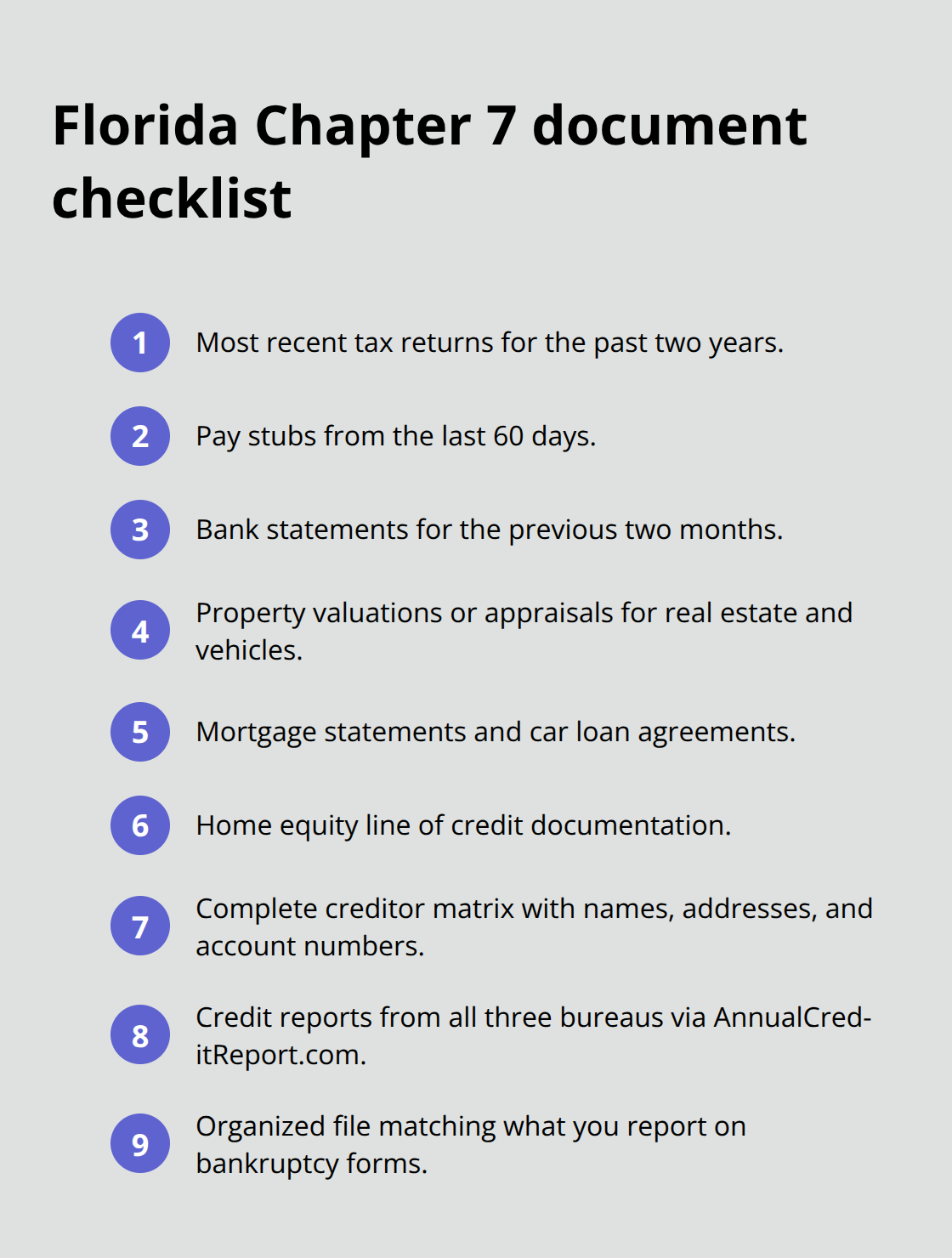
The Florida bankruptcy court requires specific documents before you file, and gathering them early prevents delays and eliminates last-minute scrambling. Obtain your most recent tax return from the past two years, all pay stubs from the last 60 days, and bank statements covering the previous two months-the court uses these to verify your income and spending patterns. Property valuations matter for the court’s asset assessment, so you should obtain recent property tax assessments from the county appraiser’s office or hire an appraiser if you own real estate or vehicles worth more than a few thousand dollars. Secured debt documentation like mortgage statements, car loan agreements, and any home equity line of credit paperwork must be included so the trustee understands what liens attach to your property. The U.S. Trustee requires you to provide these documents to prove your financial situation matches what you report on your bankruptcy forms.
Creating a complete creditor list demands accuracy because the court serves notice to every creditor you list, and missing a creditor can affect your discharge. Pull your credit reports from all three bureaus at no cost through AnnualCreditReport.com to catch creditors you may have forgotten, then compile names, addresses, and account numbers into your Creditor Matrix. You should include medical debts, utility companies, collection agencies, credit card issuers, and any informal loans from family members-the court needs all of them.
Many filers overlook small debts or old accounts, but these oversights can complicate your case later, so thoroughness now saves headaches during your 341 meeting. Once you have assembled these documents into an organized file, you move forward with completing the official bankruptcy forms that the Florida court requires.
Step 4: Complete Your Bankruptcy Forms and Schedules
The official bankruptcy forms are legal documents that the Florida court will scrutinize for accuracy and completeness. Form 106Sum/1 (Summary of Your Assets and Liabilities) provides the court with a snapshot of your financial position, while Schedules A through J list specific details about property, debts, income, and expenses. Schedule C is where you claim exemptions-the assets you protect from liquidation-and Florida law allows you to use either federal exemptions or Florida state exemptions depending on your situation, which significantly impacts what property you keep. The Statement of Financial Affairs (Form 106Sum/1) requires you to disclose any property transfers, lawsuits, or income changes from the past two years, and the court uses this information to identify potential fraud or hidden assets. Most filers make critical errors on Schedule C by either claiming too few exemptions (losing assets they could have kept) or incorrectly valuing property, so accuracy here directly affects your outcome.
The Chapter 7 Means Test forms (122A-1 and 122A-2) must use exact IRS expense multipliers from the U.S. Trustee website, not your actual spending, which trips up many self-filers who try to list what they really spend on groceries or gas. Official Bankruptcy Forms, available free through the federal courts system, are the only forms the Florida court will accept-third-party worksheets or outdated versions cause rejections and delays. You should consider consulting with a bankruptcy attorney if you have irregular income, self-employment earnings, or complex property situations, since miscalculations on these forms can result in your case being dismissed or converted to Chapter 13. The petition itself requires wet signatures (not electronic), and all schedules require the declaration that you swear under penalty of perjury that the information is true, making false statements a federal crime. Once you complete these forms with precision, you prepare to file your petition with the Florida bankruptcy court.
Step 5: File Your Petition with the Florida Bankruptcy Court
The Florida bankruptcy court system divides into three districts: Middle, Northern, and Southern, with your location determining where you file. If you live in Southwest Florida counties like Collier, Lee, or Charlotte, you file in the Middle District of Florida in Tampa, which handles thousands of Chapter 7 cases annually. Filing in the wrong district causes automatic rejection and forces you to refile, wasting time and potentially violating your credit counseling timeline, so verify your county’s assignment before submitting anything. The court’s website lists each district’s coverage area clearly, and contacting the clerk’s office takes five minutes if you remain uncertain about your location. Once you confirm your district, you prepare your petition packet with all completed forms, schedules, and supporting documents ready for submission.
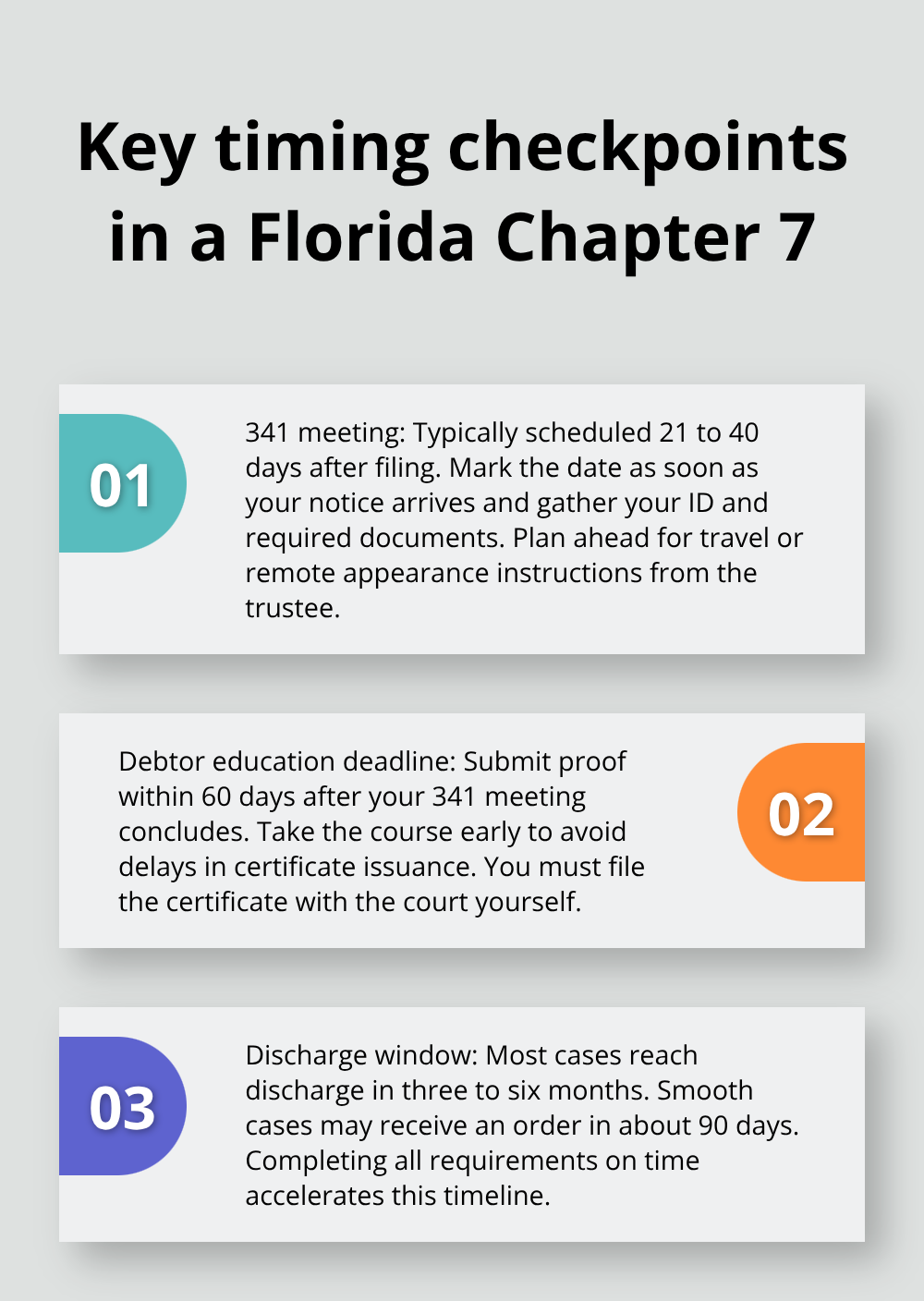
The filing fee stands at $338 as of 2026, payable by cashier’s check or money order within 14 days if filing electronically, according to the Clerk’s Office. If you cannot afford this fee upfront, you qualify for a waiver if your household income falls below 150 percent of federal poverty guidelines, which you request through Official Form 103B. Alternatively, the court permits installment payments with a minimum down payment of half the filing fee, though missing any payment triggers automatic dismissal of your case. The moment you file your petition, the automatic stay takes effect immediately, stopping wage garnishments, collection calls, lawsuits, and creditor harassment instantaneously. The court assigns a bankruptcy trustee to your case within days, and you receive notice of your 341 meeting date, typically scheduled 21 to 40 days after filing, along with instructions for submitting documents to the trustee-the next critical milestone in your Chapter 7 journey.
Step 6: Attend the 341 Meeting of Creditors
The 341 meeting of creditors occurs 21 to 40 days after filing and represents your most important interaction with the bankruptcy trustee assigned to your case. The trustee will ask detailed questions about your assets, debts, income, and the accuracy of information you provided on your bankruptcy forms under oath, so inconsistencies between your petition and verbal answers create serious problems. Bring your government-issued photo ID, Social Security card, and recent pay stubs to prove your identity and current income situation. Review your financial documents the night before to refresh your memory on details, especially regarding specific debts, property ownership, and any asset transfers you made before filing. Most meetings last between five and fifteen minutes, though complex cases involving significant assets or suspicious transactions extend longer.
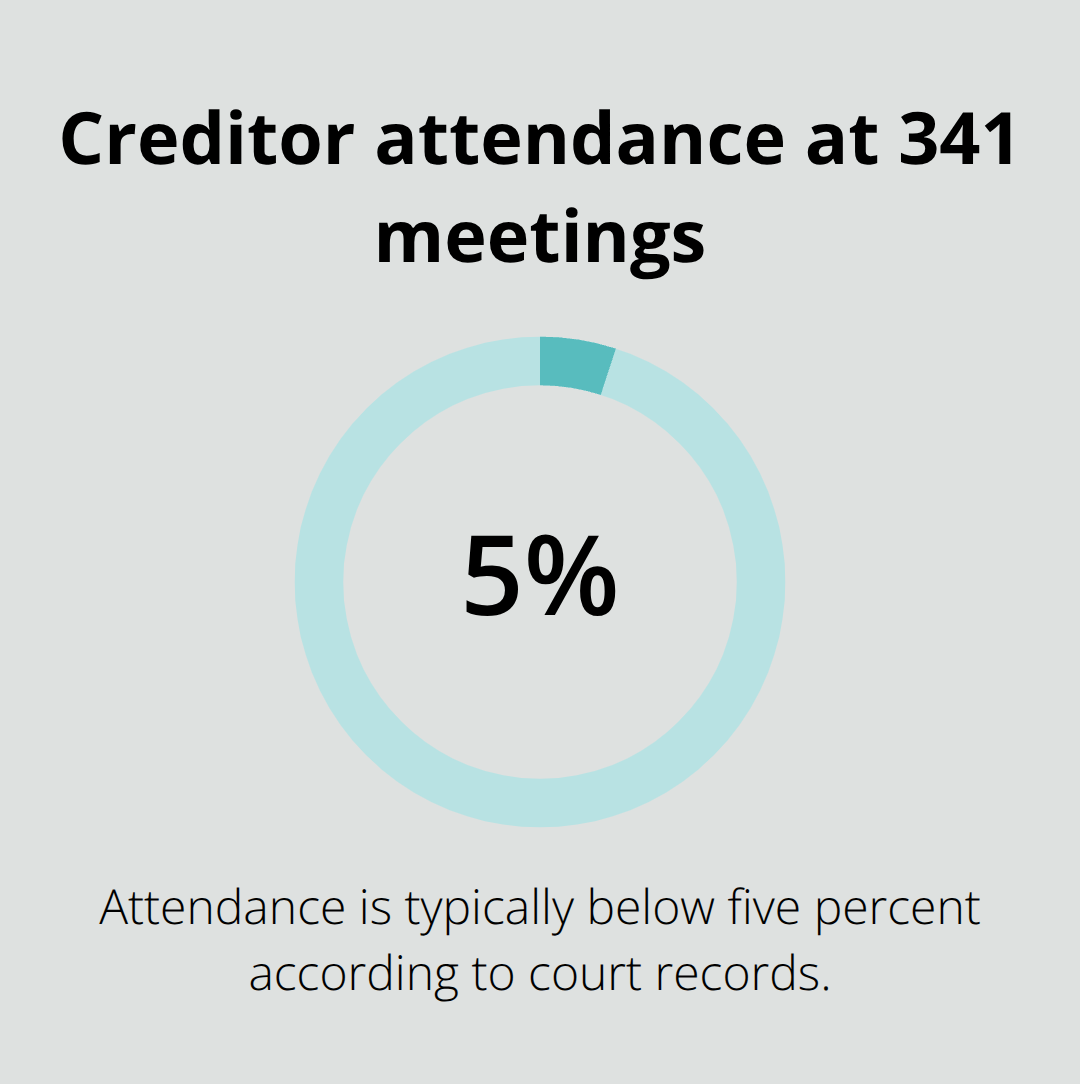
Creditors rarely attend 341 meetings despite the name, with attendance rates typically below five percent according to court records, so you should not expect confrontation from credit card companies or collection agencies. When creditors do appear, they ask basic questions about your ability to reaffirm secured debts or recover property, but aggressive questioning is uncommon since most creditors know Chapter 7 liquidation offers them minimal recovery.
Bring copies of any secured debt agreements if you plan to reaffirm a car loan or mortgage, as the trustee may discuss these options during the meeting. Answer every question truthfully and directly without volunteering extra information, and if you do not understand a question, ask the trustee to clarify rather than guessing at an answer that could damage your case.
With the 341 meeting behind you, one final mandatory requirement stands between you and your discharge: completing the financial management course that the court requires before releasing you from your debts.
Step 7: Complete Your Debtor Education Course
The financial management course you must complete after filing differs fundamentally from the pre-filing credit counseling you already took. Pre-filing counseling explores whether bankruptcy suits your situation and covers alternatives like debt management plans, while the post-filing debtor education course teaches money management strategies for your fresh start after discharge. The post-filing course covers budgeting, rebuilding credit, understanding credit reports, avoiding predatory lending, and protecting yourself from future financial crisis. Like pre-filing counseling, these courses cost under $15 and run one to two hours, with online and phone options available through U.S. Trustee-approved providers.
You must finish and submit proof of completion within 60 days after your 341 meeting concludes, as the court will not issue your discharge until you provide the completion certificate. Take the course as soon as possible after your 341 meeting rather than waiting until the final days, since course providers occasionally experience delays in issuing certificates. You are responsible for submitting proof directly to the bankruptcy court clerk-do not rely on the provider to handle this final step for you. Verify that the court received your certificate within a few days by checking the PACER case management system.
Once you submit your completion certificate and the court processes your discharge, your debts are released and your fresh start officially begins. The next section covers what happens immediately after discharge and how to protect your financial recovery moving forward.
Wrapping Up Your Chapter 7 Journey in Florida
Your Chapter 7 filing in Florida typically reaches discharge within three to six months from the date you submit your petition, though the exact timeline depends on whether creditors file claims and whether complications arise during the trustee’s review. Most cases move smoothly without delays, meaning you could receive your discharge order and official debt release within 90 days of filing. The bankruptcy court issues your discharge order after confirming you completed the required debtor education course, and this order legally releases you from personal liability on most unsecured debts.
From that moment forward, creditors cannot pursue collection actions, wage garnishments, or lawsuits against you for discharged debts, giving you genuine breathing room to rebuild. Rebuild your credit gradually by obtaining a secured credit card, making small purchases, and paying the balance in full each month to demonstrate responsible borrowing. Review your credit reports annually through AnnualCreditReport.com to catch errors or fraudulent accounts that could damage your recovery, and maintain an emergency fund of at least one month’s expenses to prevent future financial crises.
Working with legal guidance throughout your Chapter 7 filing Florida process substantially improves your outcomes and reduces the risk of costly mistakes. We at Harnage Law, PLLC assist individuals and families in overcoming financial challenges by providing legal guidance and representation through every step of the bankruptcy process, helping you discharge qualifying debts, stop creditor harassment, prevent wage garnishments, and halt lawsuits while protecting assets you can keep. Contact Harnage Law, PLLC if your situation involves complex assets, irregular income, or concerns about exemptions, as professional guidance ensures you navigate the process correctly and maximize your fresh start.