Not everyone qualifies for Chapter 7 bankruptcy in Florida. Understanding the Chapter 7 eligibility criteria is the first step toward determining whether this path makes sense for your financial situation.
At Harnage Law, PLLC, we help people navigate these requirements every day. This guide walks you through income limits, dischargeable debts, and the documentation you’ll need.
Income Limits and the Means Test in Florida
Understanding the Median Income Threshold
The means test acts as the gatekeeper for Chapter 7 bankruptcy in Florida. If your income falls below Florida’s median for your household size, you pass automatically and can move forward with filing. For a single person in Florida, that median sits at $41,334 annually. For a household of two, it’s $51,839. For three people, $53,952. For four people, $63,196.
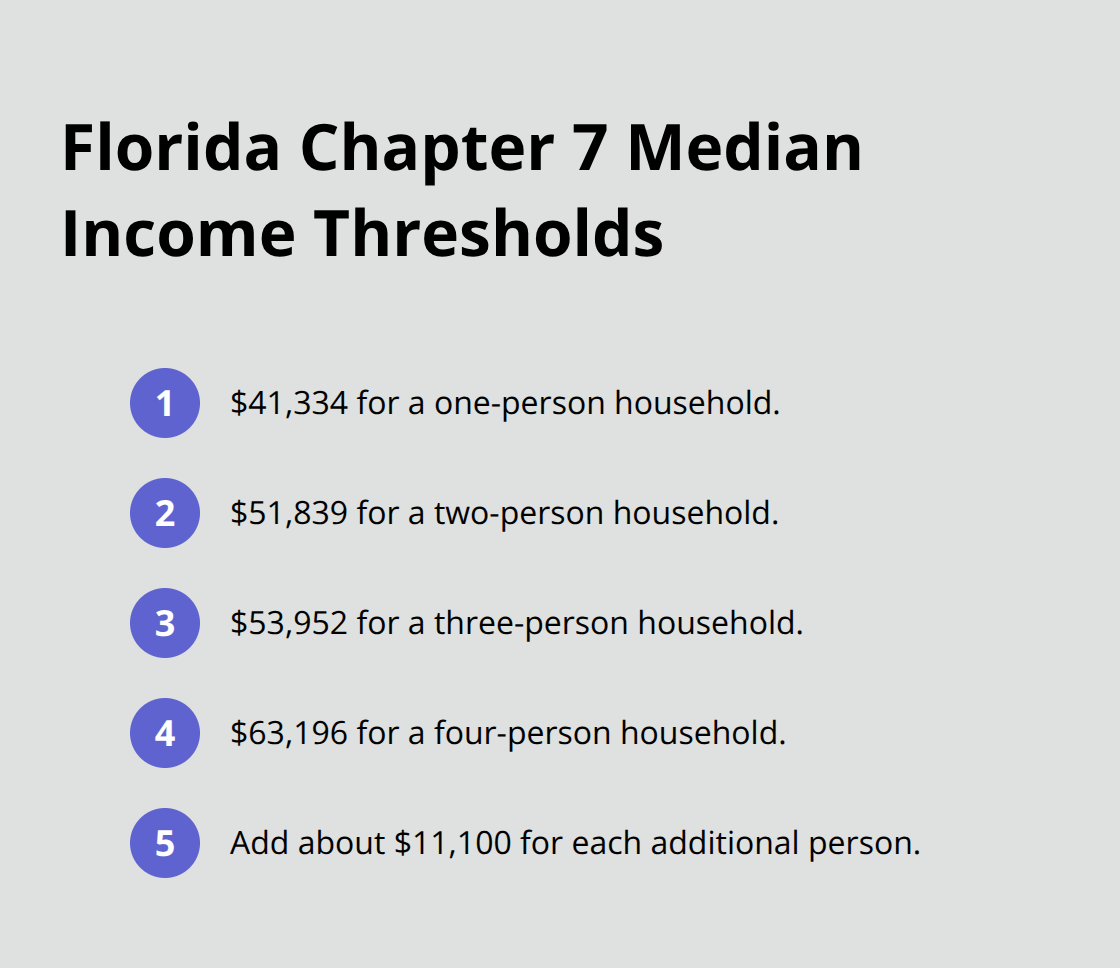
Each additional person adds roughly $11,100 to the threshold.
The calculation uses your average monthly income over the last six months, multiplied by twelve. If that number lands below your household’s median, you clear the first hurdle without further means test calculations. This is the fastest path through Chapter 7 eligibility.
How the Means Test Calculates Your Eligibility
If your income exceeds Florida’s median for your household size, the means test becomes more complex. You’ll complete Official Forms 122A-1 and 122A-2 to determine your disposable income after allowed expenses. The test subtracts legally required obligations, health and welfare costs, and other IRS-approved expenses from your gross income.
What remains is your disposable income. If your projected 60-month disposable income falls below $7,475, you pass the means test and can file Chapter 7. If it exceeds $12,475, you fail and Chapter 7 becomes unavailable, though Chapter 13 may remain an option. Income between these thresholds requires additional analysis to determine feasibility.
Disposable Income and What It Means for Your Case
The allowed expenses come from Census Bureau data, IRS standards, and Florida-specific figures, which means the calculation reflects real living costs in your state, not theoretical numbers. Many people with above-median income still qualify because the expense deductions are substantial.
Disabled veterans with debt incurred during active duty or homeland defense service may skip the means test entirely. The key is not what you earn-it’s what remains after legitimate expenses are paid. Waiting to file hoping your income drops below the median is risky and can backfire if creditors accelerate collection efforts during the delay.
Understanding whether your debts qualify for discharge matters just as much as passing the means test. Not all obligations disappear in Chapter 7, and knowing which debts you can eliminate helps you assess whether filing makes financial sense.
Debts You Can and Cannot Discharge in Florida Chapter 7
Which Debts Disappear in Chapter 7
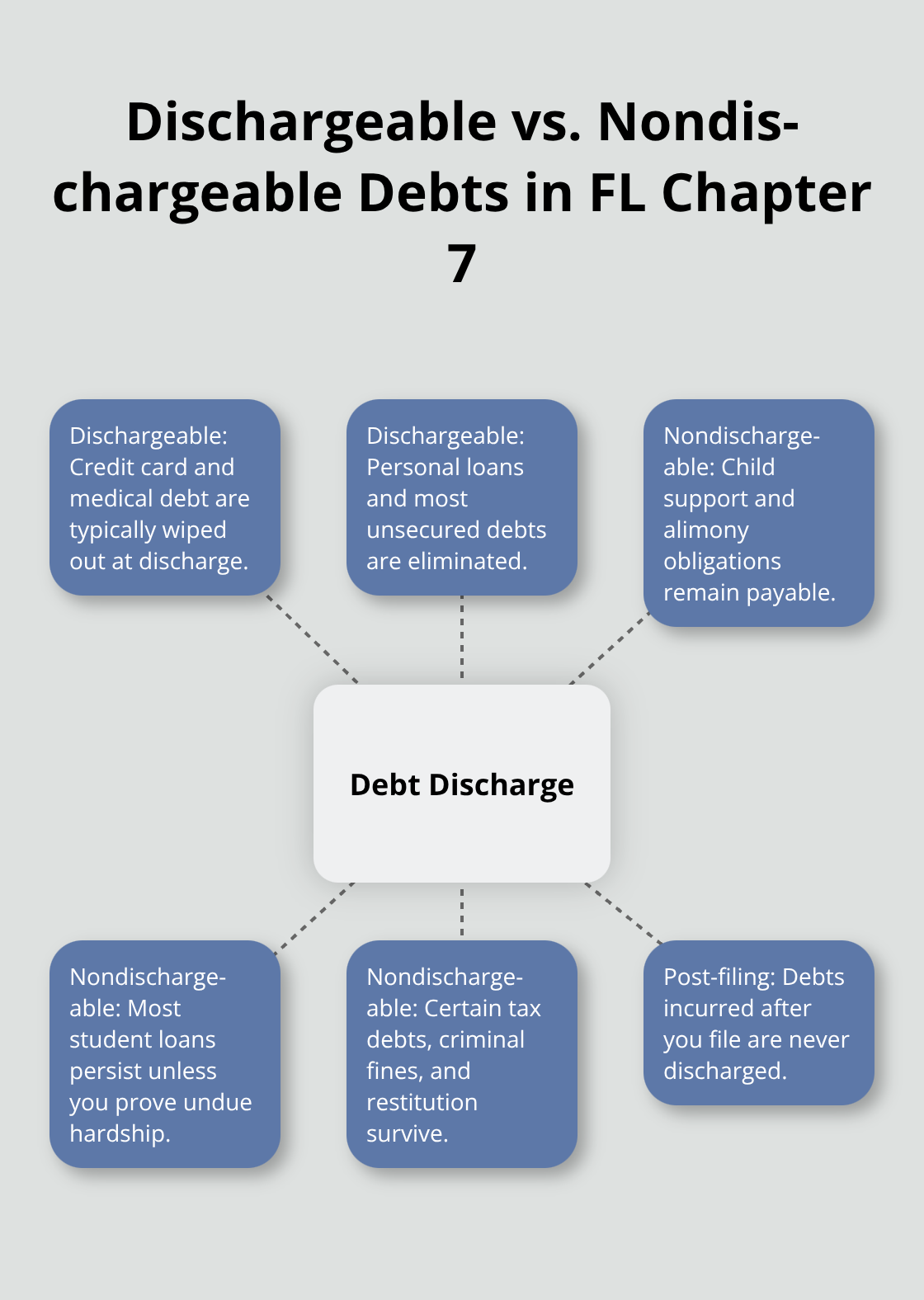
Chapter 7 discharge eliminates most debts, but not all of them. The distinction matters enormously because filing only makes sense if the debts burdening you actually qualify for elimination. Credit card balances, medical bills, personal loans, and most unsecured debts vanish upon discharge. According to the Bankruptcy Code under 11 U.S.C. §523(a), certain obligations survive the process regardless of your financial situation.
Debts That Survive Chapter 7
Child support and alimony claims remain your responsibility forever. Most student loans stick around unless you prove undue hardship-a high bar that requires showing you cannot maintain a minimal standard of living, cannot change your circumstances, and have acted in good faith. Certain tax debts, criminal fines, and court-ordered restitution also survive. Debts incurred after you file are never discharged since they fall outside the bankruptcy estate.
What Happens to Co-Signers
Co-signers on your debts remain liable even after your discharge, meaning creditors can pursue them for full payment. This reality matters if family members guaranteed your obligations. Your personal liability stops, but theirs continues.
Analyzing Your Debt Composition
Map your debts before filing. Calculate what percentage of your total debt load actually qualifies for discharge. If 80% of what you owe can be eliminated but student loans and child support make up the other 20%, Chapter 7 still provides substantial relief. However, if nondischargeable debts dominate your situation, Chapter 13 might serve you better by reorganizing payments over three to five years.
The means test proved you could theoretically file, but debt classification determines whether filing actually solves your problem. Your next step involves gathering the financial documents and records that Florida bankruptcy courts require to move forward with your case.
Financial Situation Assessment and Documentation in Florida Chapter 7
Required Documents for Your Florida Filing
The moment you decide to file Chapter 7 in Florida, you enter a documentation-intensive process. The bankruptcy court doesn’t care about your story-it cares about numbers. You’ll provide two years of tax returns, your most recent pay stubs covering the last 60 days, and bank statements from the past two months showing all accounts. The court also requires a complete list of creditors with account numbers and balances, a detailed inventory of everything you own with estimated values, and a schedule of your monthly living expenses broken down by category. Missing or incomplete documents delay your case, extend timelines, and create opportunities for creditors to challenge your filing. The Florida bankruptcy courts in the Middle, Northern, and Southern Districts all follow the same documentation requirements under the Federal Rules of Bankruptcy Procedure.
How Florida Exemptions Protect Your Assets
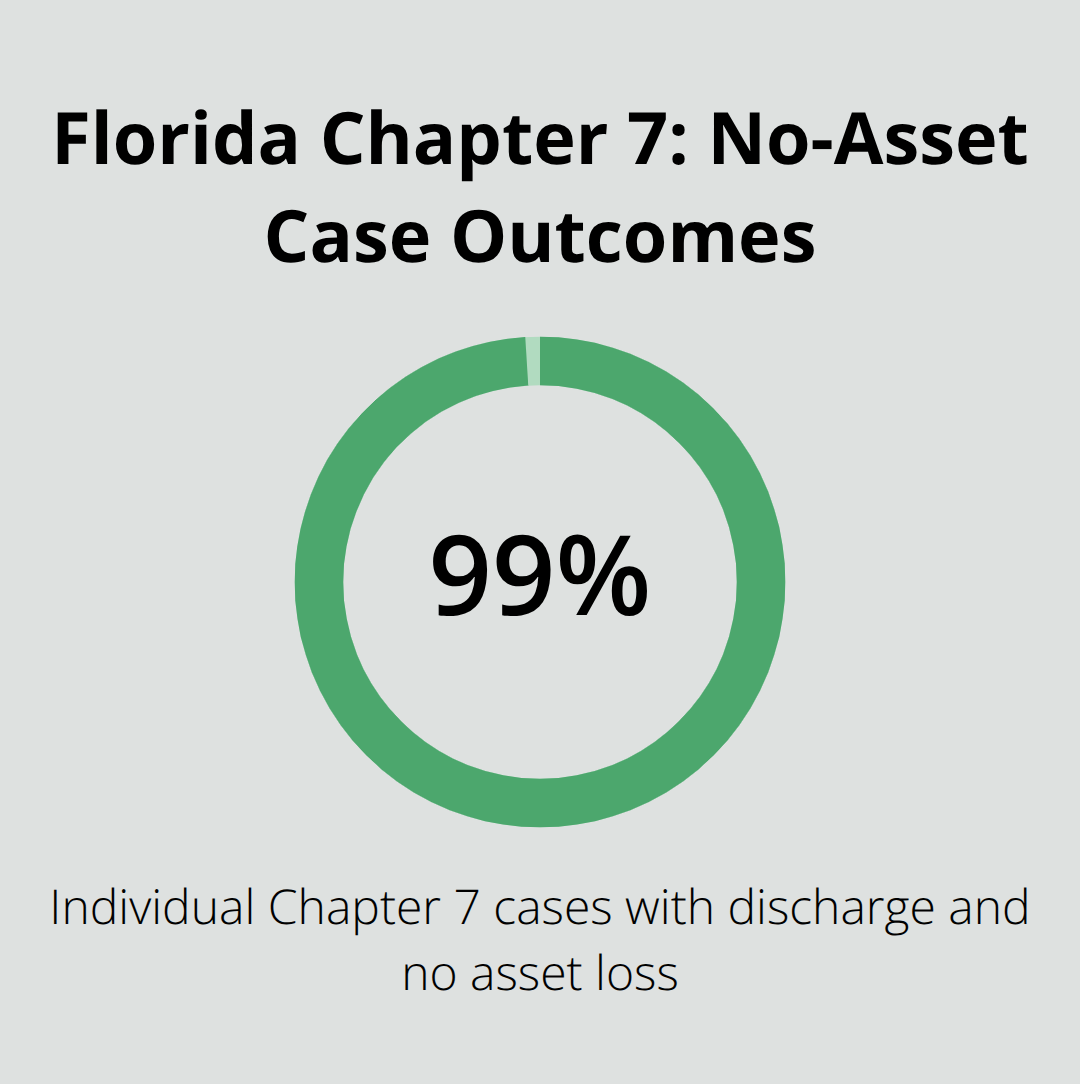
Your assets and liabilities tell the court whether Chapter 7 actually makes sense for your situation. You must disclose every asset-your home, vehicles, bank accounts, retirement savings, personal property-and the court will determine what’s protected under Florida exemptions and what’s vulnerable to liquidation. Florida’s homestead exemption can shield your primary residence entirely if you’ve owned it for at least 1,215 days and the property doesn’t exceed 160 acres or half an acre in a municipality, making home protection one of the strongest reasons to file in Florida rather than another state. Beyond homestead, Florida exemptions protect $1,000 in personal property, $1,000 for a motor vehicle, retirement accounts, disability benefits, and most government benefits. If your equity in assets falls within these protected amounts, the trustee cannot sell anything-this is why roughly 99% of individual Chapter 7 cases in Florida result in discharge without asset loss.
Calculating Nonexempt Equity
Calculate your nonexempt equity honestly before filing. If you have substantial nonexempt assets, Chapter 13 might preserve more of your property through a repayment plan rather than liquidation. The difference between what you owe on secured debts and what your property is worth determines whether the trustee has anything to liquidate for unsecured creditors. Cases that require extensive documentation, asset valuation, or creditor negotiations push costs higher, so understanding your asset situation upfront helps you anticipate total expenses.
Credit Counseling Requirements in Florida
Credit counseling is mandatory and must be completed within 180 days before you file. You’ll take an approved course from an agency listed by the U.S. Trustee, which typically costs $50 to $150 and takes one to two hours online or by phone. This isn’t optional-without proof of completion on your filing paperwork, the court will dismiss your case. After filing, you’ll need an additional financial management course before discharge is granted. These requirements exist because the bankruptcy system wants to confirm you’ve explored your situation thoroughly and understand the consequences of filing.
Final Thoughts
You’ve now reviewed the core Chapter 7 eligibility criteria that determine whether this bankruptcy option works for your financial situation. The means test income thresholds, the distinction between dischargeable and nondischargeable debts, and the documentation requirements form the foundation of your decision. If your income falls below Florida’s median for your household size, you’ve already cleared the primary hurdle.
Gather your financial documents now if you believe you qualify. Pull two years of tax returns, recent pay stubs, bank statements, and a complete creditor list, then calculate your nonexempt assets against Florida’s exemptions to understand what property the trustee could liquidate. Complete your mandatory credit counseling course and schedule a consultation with a bankruptcy attorney who understands Florida law.
We at Harnage Law, PLLC guide clients through this entire process and help you discharge qualifying debts while protecting your assets under Florida exemptions. We stop creditor harassment, prevent wage garnishments, and halt lawsuits as we walk you through every step of the bankruptcy process. Contact us for a consultation to discuss your specific situation and confirm whether Chapter 7 makes sense for your circumstances.