
Chapter 7 bankruptcy can feel overwhelming, especially when you’re worried about losing your possessions. The good news is that Florida law provides substantial protections for many of your assets.
At Harnage Law, PLLC, we help people understand which property they can keep and how Chapter 7 assets protection actually works in practice. This guide walks you through the exemptions available to you and the strategies that matter most.
What You Actually Keep in Chapter 7 Bankruptcy in Florida
Your Home and the Homestead Exemption
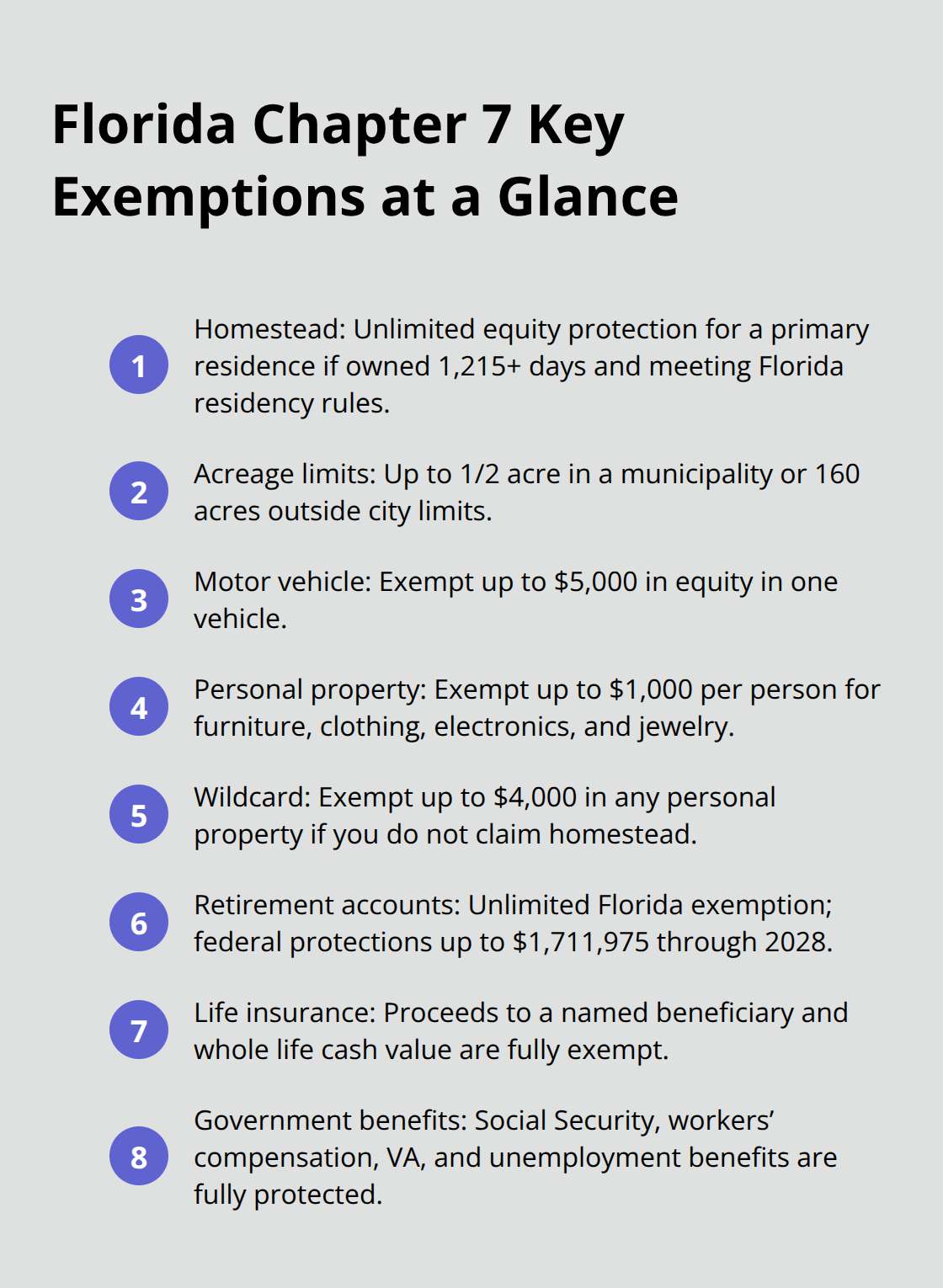
Florida’s homestead exemption stands out as one of the strongest asset protections in the nation. If you own a primary residence and have lived in Florida for at least 730 days before filing, you protect unlimited home equity-no cap, no limit. This applies to properties up to half an acre within city limits or 160 acres outside cities. The timing requirement tightens this protection significantly: you must have owned the property for at least 1,215 days (roughly three years and four months) before filing. If you haven’t met that timeline, federal law steps in with a temporary cap of $214,000 under 11 U.S.C. § 522(p). A homeowner who bought their house two years ago faces a hard ceiling on protection, while someone who purchased three years ago enjoys unlimited protection.
Vehicle Equity and Motor Vehicle Exemptions
Your vehicle receives protection, though within narrower boundaries. Florida allows you to exempt up to $5,000 in equity in a single motor vehicle under Fla. Stat. § 222.25(1). Most vehicles offer little protection because they depreciate 20 to 30 percent the moment you drive off the lot, and most people finance their vehicles, meaning the lender owns substantial equity. A financed car worth $25,000 with an $18,000 loan leaves only $7,000 in your equity-but you protect only $5,000 of that. The remaining $1,000 becomes nonexempt and subject to sale by the bankruptcy trustee.
Personal Property, Jewelry, and the Wildcard Exemption
Personal property protection in Florida covers everyday items like furniture, clothing, electronics, and jewelry up to $1,000 per person. If you don’t claim the homestead exemption on your residence, you gain access to a wildcard exemption worth $4,000 for any personal property. This swap makes sense for people who own modest homes with little equity but hold valuable items like jewelry, art, or collectibles.
Retirement Accounts and Life Insurance
Retirement accounts receive nearly complete protection in Florida, with unlimited exemption under Fla. Stat. § 222.21(2), plus federal protections capping at $1,711,975 per person for pensions and retirement accounts through 2028 according to 11 U.S.C. § 522(b)(3)(C). Life insurance proceeds payable to a named beneficiary are fully exempt under Fla. Stat. § 222.13 and § 222.14, protecting both term life proceeds and whole life policy cash values.
Government Benefits and Income Protection
Social Security, workers’ compensation, VA benefits, and unemployment benefits all remain fully protected and untouchable by creditors. The critical mistake people make is commingling exempt funds with nonexempt money in a single account. Once you mix a $10,000 Social Security deposit with $5,000 in nonexempt savings, the entire account loses its protected status. Keep exempt income and assets separate and traceable. File exemption claims correctly on your bankruptcy petition-missing an exemption means losing protection forever, even if you qualified. Understanding which exemptions apply to your specific assets sets the stage for the next phase: learning how Florida’s exemption framework compares to federal alternatives and which choice maximizes your protection.
How Florida’s Exemption System Actually Protects Your Assets
Florida’s Opt-Out Status and What It Means for You
Florida has chosen to opt out of federal exemptions entirely, which means you apply Florida’s exemptions exclusively when filing Chapter 7 bankruptcy in the state. This decision matters because Florida exemptions are demonstrably more generous than federal alternatives in critical areas like homestead protection. The homestead exemption alone-unlimited equity protection for a primary residence owned 1,215 days or longer-far exceeds the federal cap of $27,900 under federal bankruptcy law. However, this generosity comes with a trade-off. While Florida protects your home without limit, its motor vehicle exemption of $5,000 per vehicle ranks below some states, and personal property protection maxes out at $1,000 unless you forgo homestead protection entirely.
Dollar Amounts That Determine Your Protection
Understanding these specific dollar amounts prevents costly mistakes. A person with $8,000 in equity in their vehicle discovers too late that only $5,000 receives protection, leaving $3,000 subject to trustee liquidation. The math is unforgiving: if you own jewelry worth $3,500 and household goods worth $2,200, your $1,000 personal property exemption covers less than one-third of your actual possessions. This is where the wildcard exemption becomes tactical. If your home has minimal equity-say, a $150,000 house with a $145,000 mortgage-claiming homestead protection wastes valuable exemption space. Instead, skipping homestead allows you to claim $4,000 in wildcard protection for personal property, effectively quadrupling coverage for items like jewelry, art, or electronics. The choice between state and federal exemptions sounds academic until you realize you cannot switch mid-case; the decision locks in at filing.
What Happens to Non-Exempt Assets
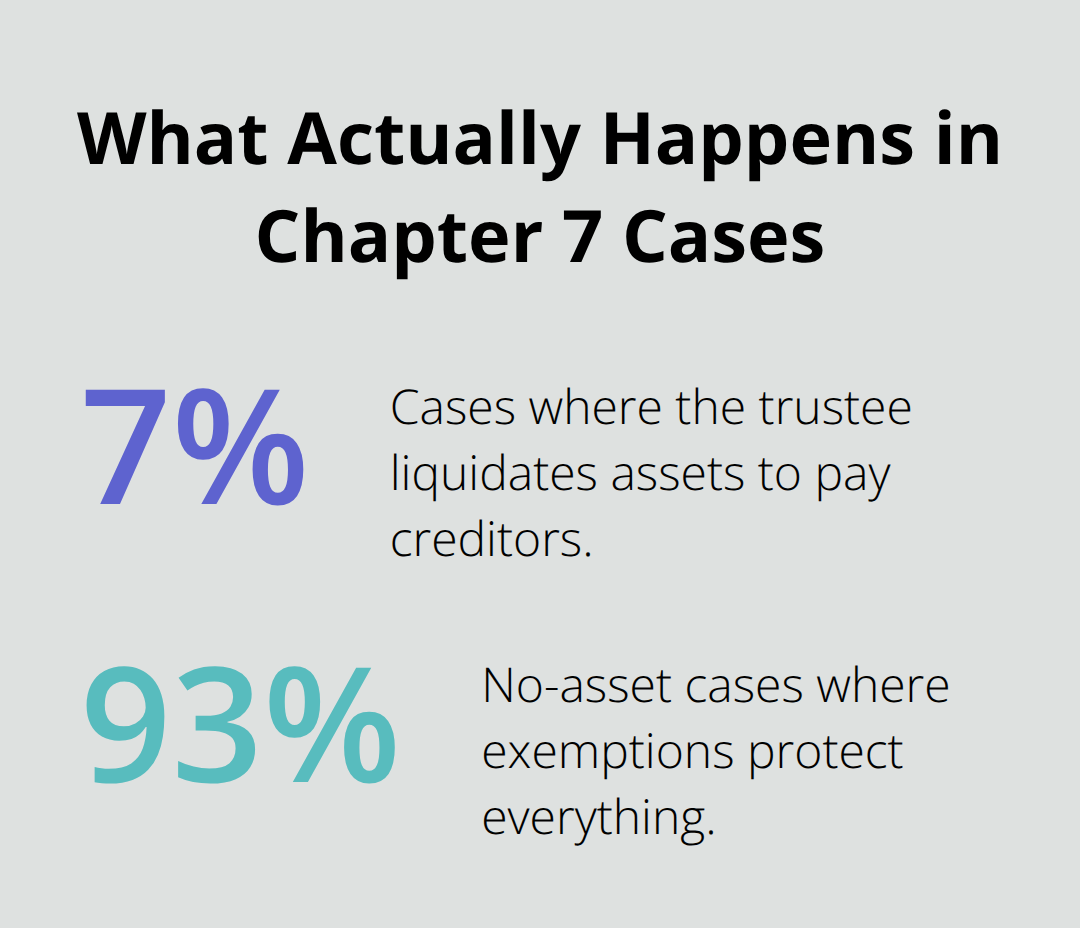
Non-exempt assets represent the property the bankruptcy trustee can liquidate to pay your creditors, and this is where the practical impact hits hardest. Investment accounts, second homes, vacation properties, high-value vehicles beyond the $5,000 exemption, cash savings exceeding wildcard limits, and luxury goods all fall into the non-exempt category. A person filing Chapter 7 with $15,000 in a brokerage account and no retirement account protection loses that entire amount unless another exemption applies. Second homes generate particular risk; Florida’s homestead exemption protects only your primary residence, leaving investment property completely exposed. The U.S. Courts report that approximately 7 percent of Chapter 7 cases involve liquidable assets, meaning the trustee actually sells property to pay creditors. The remaining 93 percent are no-asset cases where exemptions shelter everything.
The 341 Meeting and Trustee Scrutiny
Your case lands in that 93 percent category only if you properly claim every applicable exemption. Missing an exemption on your bankruptcy petition is permanent-you cannot add or amend it later to protect property the trustee has already identified. The 341 meeting of creditors, occurring 21 to 40 days after filing according to U.S. Courts procedures, gives the trustee formal opportunity to question your asset valuations and exemption claims. If you undervalue a piece of jewelry or misclassify personal property, the trustee can challenge your exemption and demand the item be turned over. Trustees specifically scrutinize luxury goods, collectibles, and high-value personal items.
Priority Order and What You Actually Recover
The liquidation process itself follows a strict priority order under 11 U.S.C. § 726: secured creditors and priority claims receive payment first, general unsecured creditors receive whatever remains, and you receive nothing unless funds remain after all creditors are paid. Most Chapter 7 cases produce no recovery for unsecured creditors because exemptions protect all or most assets. This creates a fundamental truth: maximizing exemptions directly determines whether you walk away with your possessions intact or watch the trustee auction your belongings to pay debts. Proper documentation and accurate valuation of your assets before filing become the foundation for protecting what matters most to you.
How to Protect Your Assets Before Filing
Strategic Timing and Tax Refunds
Timing your Chapter 7 filing strategically can mean the difference between keeping assets and losing them to the trustee. Tax refunds offer a concrete example: bankruptcy filings peak in March and April according to U.S. Courts data, driven by tax season. If you file in April after receiving a $5,000 refund, that money becomes part of your bankruptcy estate and may not be fully protected unless you claim it under the wildcard exemption. File in January or February, and your refund arrives after discharge, remaining completely outside the bankruptcy process. This single timing decision can protect thousands of dollars.
Income Averages and the Means Test
The means test calculation, which determines Chapter 7 eligibility, uses your average income from the six months prior to filing. If you anticipate a significant income drop-a job loss, retirement, or reduction in hours-waiting those six months allows your income average to fall, potentially keeping you eligible for Chapter 7 instead of being forced into Chapter 13. Conversely, if you expect a bonus or inheritance, filing before that money arrives prevents the trustee from claiming it as estate property.
Legal Asset Conversion Strategies
Asset conversion within legal boundaries strengthens your position considerably. Moving funds into a traditional IRA or 401(k) before filing adds to your unlimited retirement account exemption under Fla. Stat. § 222.21(2), which protects those accounts completely in Chapter 7. Paying down a secured debt like a car loan reduces the equity the trustee can liquidate. These moves must happen months before filing to avoid trustee challenges for fraudulent transfer, but they are legitimate asset protection strategies when executed properly.
Documentation and Valuation Standards
Accurate documentation of asset values is non-negotiable because the trustee will scrutinize your valuations at the 341 meeting. Bring receipts, appraisals, and photographs of personal property to establish replacement value, which is what matters in bankruptcy, not sentimental value. A jewelry collection you claim is worth $800 requires documentation-receipts, insurance appraisals, or jeweler valuations. Undervaluing items invites trustee challenges and potential perjury accusations. Overvaluing assets wastes exemption space on items worth less than you claim. The practical approach is conservative accuracy: list items at what they would actually sell for, not what you paid or what they mean to you.
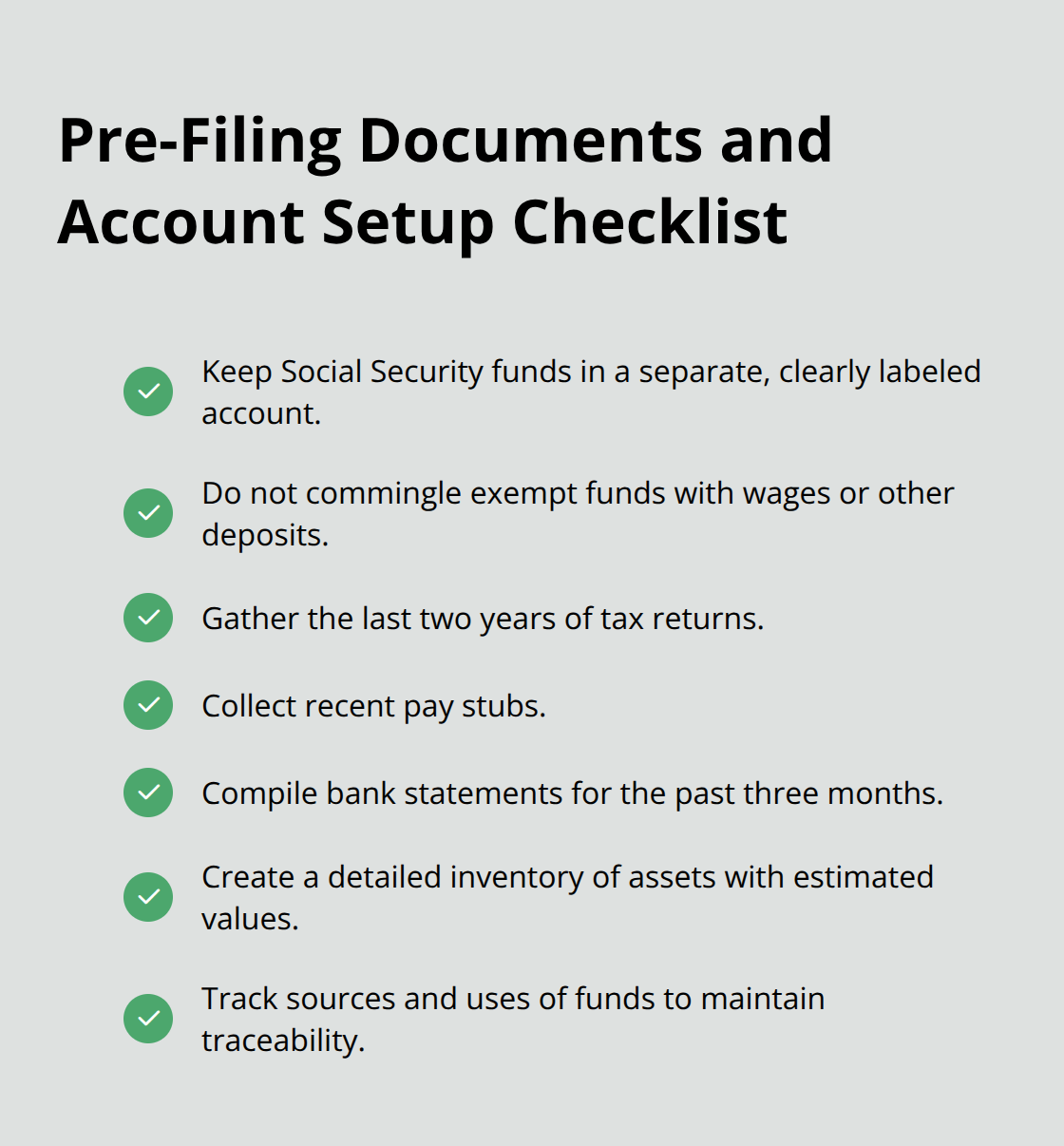
Account Separation and Fund Traceability
Keeping separate bank accounts for exempt funds prevents commingling problems. Your Social Security deposit should sit in an account clearly labeled and traceable as Social Security income, never mixed with paychecks or other money. When the trustee reviews your accounts, commingled funds lose their exempt status entirely. Document where every dollar came from and where it went. Gathering tax returns from the past two years, recent pay stubs, bank statements for the past three months, and a detailed inventory of all assets with estimated values before your initial consultation allows you to identify which exemptions apply to your specific situation and flag assets that need attention before filing.
Understanding legal representation costs and how they vary based on your asset protection needs helps you budget for the process. The difference between competent asset protection and careless filing often amounts to tens of thousands of dollars in property you keep versus property the trustee liquidates.
Final Thoughts
Florida’s Chapter 7 assets protection framework offers real, measurable shields for your property if you understand the rules and apply them correctly. Your home receives unlimited protection if you meet the ownership timeline, your retirement accounts stay completely safe, and your vehicle equity, personal property, and government benefits all have defined limits that you can work within strategically. The difference between keeping your possessions and losing them to the trustee often comes down to claiming every applicable exemption, documenting your asset values accurately, and timing your filing to avoid unnecessary losses.
The complexity lies not in the exemptions themselves but in applying them to your specific situation. A person with substantial home equity but minimal vehicle equity faces different protection priorities than someone with the opposite circumstances, and someone receiving a tax refund in April needs different filing timing than someone with stable income year-round. These individual details determine whether you maximize protection or inadvertently leave assets exposed to liquidation.
This is precisely why working with legal representation matters for Chapter 7 assets protection. We at Harnage Law, PLLC review your complete financial picture, identify which exemptions apply to your assets, flag non-exempt property that needs attention before filing, and ensure your petition claims every protection available under Florida law. Contact us to discuss how Chapter 7 bankruptcy can work for your situation and to understand your specific exemptions and asset protection strategy.