The means test is the first hurdle in a Florida Chapter 7 bankruptcy case, and it determines whether you qualify to file. Many people misunderstand how it works or make costly mistakes when calculating their numbers.
We at Harnage Law, PLLC help clients navigate this process with clear, practical means test Florida guidance so you know exactly where you stand.
How the Means Test Actually Works in Florida
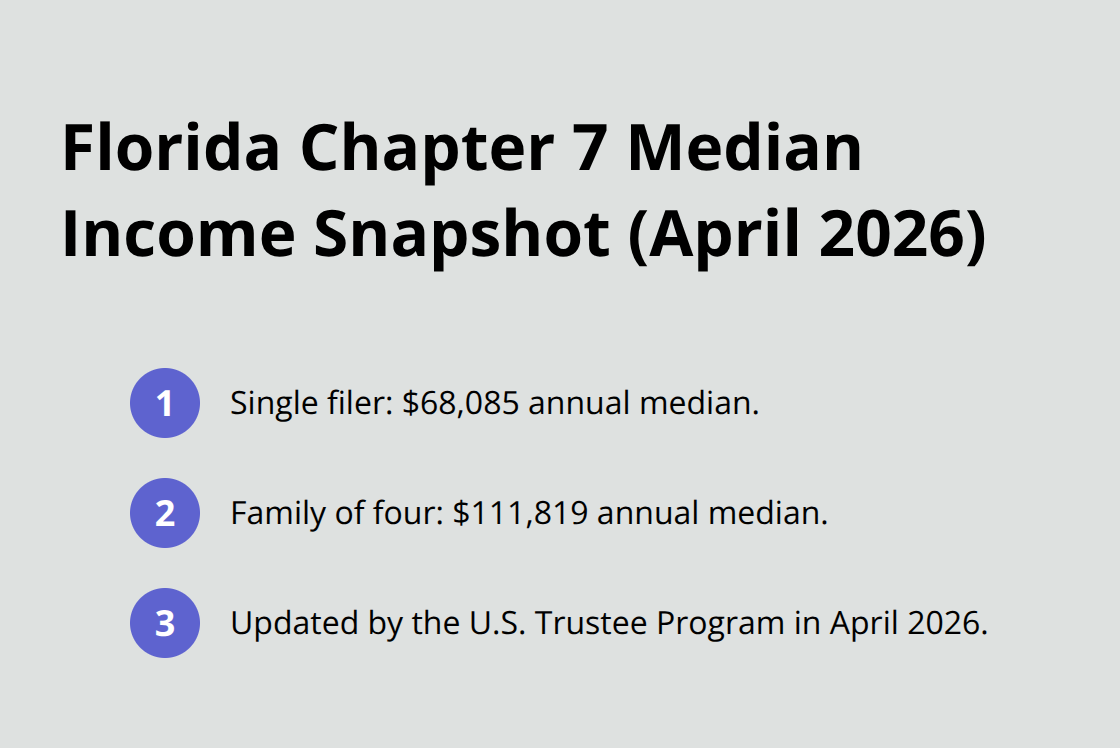
The means test compares your average income over the six months before filing to Florida’s median income for your household size, then analyzes your expenses if you exceed that threshold. As of April 2026, the U.S. Trustee Program updated Florida’s median income limits, making more filers eligible for Chapter 7. For a single person, the limit is now $68,085 annually; for a family of four, it’s $111,819. These thresholds determine whether you move to the second phase of the analysis.
If your six-month average income falls below the median for your household size, you pass automatically and can pursue Chapter 7 without further scrutiny. If you’re above the median, the test examines your actual expenses to calculate disposable income-and that’s where most filers either qualify or face obstacles.
Income That Actually Counts
The means test includes wages, bonuses, self-employment income, rental income, and regular contributions from household members, but it excludes Social Security benefits. The six-month lookback period reflects your recent reality, not a single paycheck or a year-long average. If your income dropped recently due to job loss or reduced hours, that recent decline helps your eligibility.
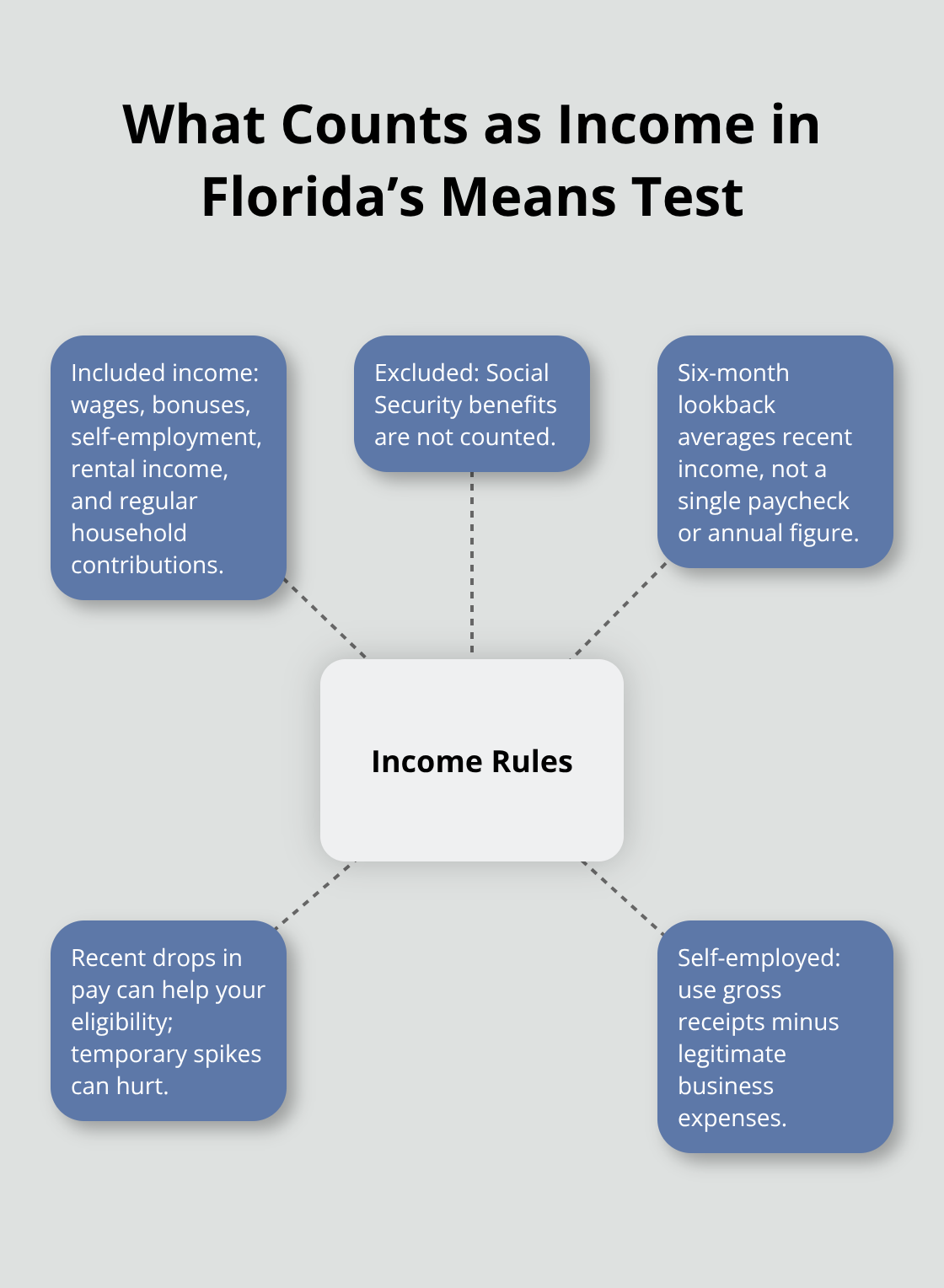
Conversely, if you received a bonus or temporary income spike six months ago, it inflates your current monthly income calculation even if that income no longer exists. The timing of your filing matters significantly; filing when your income is genuinely lower improves your chances of passing the first phase. Self-employed filers should understand that the means test uses gross receipts minus legitimate business expenses, not take-home pay, so proper documentation of business deductions is essential.
Expenses Reduce Your Disposable Income
If you exceed the median, the second phase subtracts allowable deductions from your current monthly income to calculate disposable income. These deductions include mortgage or rent, vehicle loans and insurance, property taxes, health insurance premiums, childcare, and court-ordered support obligations. The allowable amounts come from IRS National Standards and Local Standards, not your actual spending (a family spending $800 monthly on groceries might only deduct $400 based on the IRS standard for their household size). This disconnect frustrates many filers, but it’s the legal framework. A $200 monthly miscalculation in expenses translates to $12,000 over the 60-month projection period used to assess whether abuse exists. Precise categorization and documentation of expenses directly shift your eligibility outcome, making accurate record-keeping your strongest tool for qualifying.
What Happens When Numbers Don’t Add Up
The disposable income calculation determines your fate in the means test. If your projected 60-month disposable income falls below $10,275, no presumption of abuse exists and you likely qualify for Chapter 7. If it exceeds $17,150, a presumption of abuse arises and the trustee may move to dismiss or convert your case to Chapter 13. The middle ground ($10,275 to $17,150) requires comparing your disposable income to 25 percent of your non-priority unsecured debt. Small errors in expense categorization can push you across these thresholds, which is why working with someone familiar with Florida bankruptcy law matters when you file.
Calculating Your Household Income and Expenses
Determining Your Average Monthly Income
Your average monthly income for the means test comes from adding all income sources across the six months before you file, then dividing by six. This includes wages, bonuses, self-employment income, rental income, and regular contributions from household members who live with you and share expenses. Social Security benefits do not count in this calculation, nor do disability payments and certain veterans’ benefits. The six-month lookback period reflects your actual financial situation at filing time, not a theoretical annual average. If you received a one-time bonus or had temporary income six months ago that no longer exists, that spike still counts and increases your current monthly income. If you lost your job three months ago, that recent income loss helps your case. The U.S. Trustee Program’s April 2026 update means the median thresholds now account for inflation and rising costs, but timing your filing when your income is genuinely lower can make the difference between passing and failing the test.
Self-employed filers must submit detailed business records showing gross receipts minus legitimate operating expenses, not just what you take home. Documentation is non-negotiable here-pay stubs, tax returns, and bank statements form the foundation of your income calculation, and vague estimates will undermine your case.
Understanding Allowable Expense Deductions
Allowable expenses are the second half of the equation, and they directly determine whether you qualify for Chapter 7 or face a presumption of abuse. The IRS National Standards provide fixed amounts for food, utilities, and personal care based on household size, while Local Standards cover housing, vehicle ownership, and transportation costs specific to your Florida county. A family of four in Miami may have different housing allowances than a family of four in rural North Florida, reflecting actual regional cost differences.
These standardized amounts often fall below what you actually spend. The IRS food allowance for a family of four is roughly $1,400 monthly, but you may spend $1,800. The test does not care; you deduct the IRS standard, not your actual grocery bill. Mortgage or rent, vehicle loans and insurance, property taxes, health insurance premiums, childcare, and court-ordered support obligations all reduce your disposable income.
How Miscalculations Impact Your Outcome
A $200 monthly miscalculation in any expense category compounds to $12,000 over the 60-month projection period used to assess abuse. Precise expense documentation and correct categorization of costs directly shift your eligibility outcome, making meticulous record-keeping your strongest tool for qualifying. Small errors in how you classify or calculate housing costs, vehicle expenses, or insurance premiums can push you across the thresholds that determine your fate in the means test. The difference between passing and facing a presumption of abuse often comes down to accuracy in these deductions (not guesswork or rounded figures). When you move forward with your Chapter 7 case, the trustee will scrutinize these numbers, so the work you do now to document and categorize expenses correctly pays off later.
Where Florida Filers Go Wrong With the Means Test
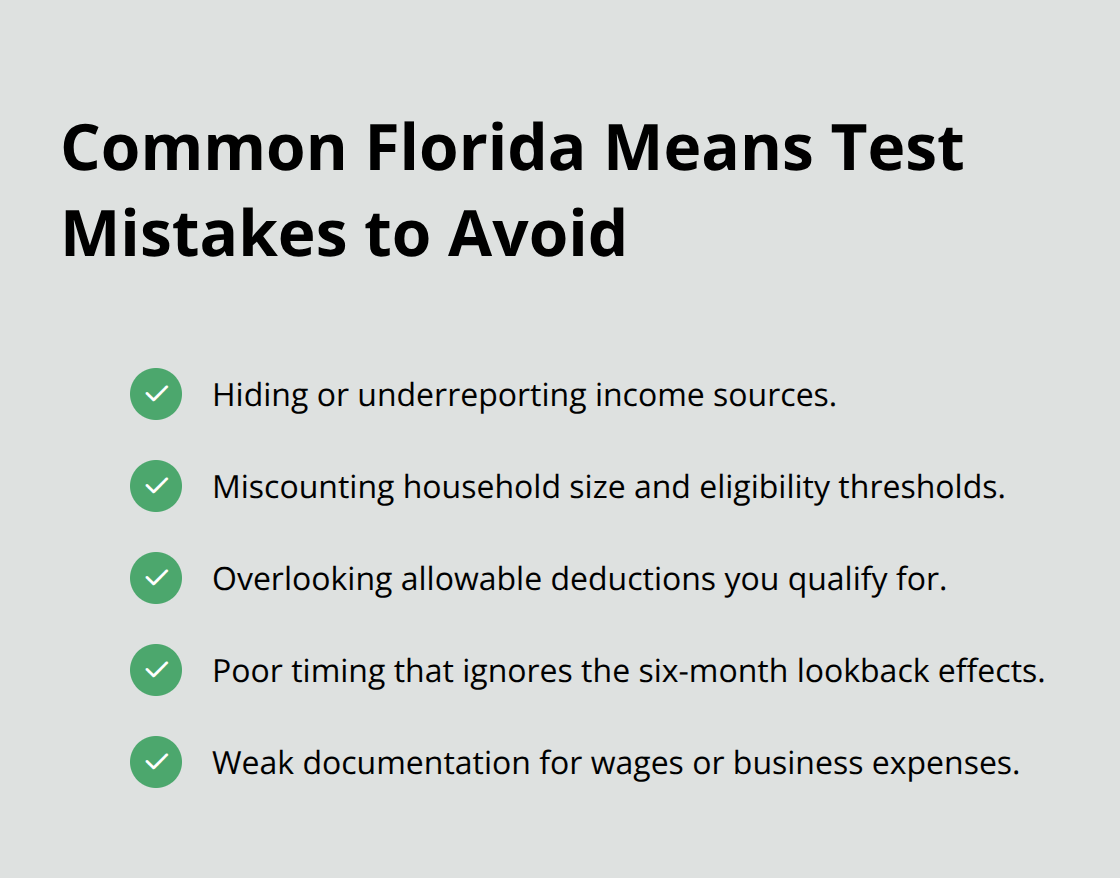
Florida filers routinely sabotage their own Chapter 7 eligibility through preventable errors in income and expense calculations. The U.S. Trustee Program processes thousands of bankruptcy filings annually, and a significant portion face dismissal or conversion to Chapter 13 because the initial means test calculation was incorrect. The most damaging mistakes occur when filers hide income sources to appear poorer than they are, miscount household members, or fail to claim legitimate deductions they qualify for. Each error compounds during the 60-month projection period, potentially shifting you from passing to facing a presumption of abuse.
The median income thresholds updated in April 2026 now make more filers eligible, but only if they calculate their numbers correctly from the start.
Hiding Income Sources Backfires Quickly
Some filers underreport income because they believe fewer numbers on the means test form improves their eligibility odds. This strategy fails immediately when the trustee cross-references your pay stubs, tax returns, and bank statements against what you reported. The means test requires six months of documented income, and discrepancies between your forms and actual records trigger trustee investigations that delay your case and damage credibility in court. Rental income, side gig earnings, and contributions from household members appear clearly in bank deposits and tax filings, making them particularly risky to omit. If you receive regular contributions from an adult child or spouse who lives with you and shares household expenses, that money counts toward your current monthly income even if it feels informal. One South Florida filer reported only wage income and omitted $800 monthly in rental income from a property. The trustee discovered the discrepancy during the 341 meeting and moved to dismiss the case, forcing her to refile and delaying her debt discharge by months. Bonuses, commissions, and overtime that fluctuate month to month still count; use the six-month average even if some months were higher or lower.
Household Size Errors Derail Median Income Comparisons
Miscounting who lives in your household directly determines which median income threshold applies to you. A single person faces a $68,085 annual threshold, while a family of four faces $111,819 as of April 2026. Miscounting by even one person shifts your comparison point and can move you from below the median to above it, triggering the second phase of the means test and requiring full expense analysis. Some filers exclude adult children who live at home but contribute income to household expenses, thinking only spouses and minor dependents count. Others include roommates or extended family who do not share household expenses or contribute income. The means test defines household size as people living with you who share expenses and income, not merely occupants of the same address. If your adult daughter lives with you, receives income, and contributes to rent and utilities, she counts as a household member. If your elderly parent lives with you but receives only Social Security and you cover all household costs without their contribution, they still count because they live there and depend on your income for support. Applying the wrong median threshold to your situation undermines the entire first phase comparison.
Overlooking Deductions You Actually Qualify For
Failing to claim deductions you deserve proves equally destructive and more common than underreporting income. Many filers calculate disposable income using only their largest expenses like mortgage and car payments, then overlook healthcare costs, childcare, transportation allowances, and court-ordered support obligations that reduce their disposable income significantly. The IRS National Standards and Local Standards provide generous allowances for these categories, and you must claim them to accurately reflect your financial reality. A family spending $400 monthly on unreimbursed medical expenses can deduct that amount; a parent paying $1,200 monthly for childcare can deduct it; someone with two car loans can deduct both vehicle expenses. These deductions matter enormously because they directly reduce the disposable income figure used to assess abuse. A Tampa filer with $120,000 household income appeared to exceed the median and face abuse presumption until she properly documented $2,400 monthly in childcare costs and $600 in medical expenses. Those deductions alone reduced her projected 60-month disposable income by $180,000, moving her comfortably below the abuse threshold. Property taxes, homeowners insurance, vehicle insurance, health insurance premiums, and legitimate business expenses for self-employed filers are all claimable deductions that filers frequently omit. The trustee does not volunteer these deductions; you must identify and document them correctly on Form 122A-2 to benefit from them.
Final Thoughts
Passing the means test is not the finish line; it’s the gateway to your Chapter 7 discharge. Once you clear the income and expense analysis, the bankruptcy process moves into the filing stage, where documentation accuracy and timing become equally important. You’ll file your petition along with schedules detailing all assets, liabilities, income, and expenses, then attend the 341 meeting of creditors within 30 to 40 days of filing. Bring your government-issued ID, Social Security card, and any documents the trustee requests to avoid dismissal.
The trustee reviews your case to identify non-exempt assets that could be liquidated to pay creditors, though Florida exemptions often protect significant property like your home equity and personal belongings. Most Chapter 7 cases proceed smoothly after the 341 meeting, and you receive your discharge order within three to six months, eliminating qualifying unsecured debts like credit cards, medical bills, and personal loans. Income timing, expense categorization, household composition, and filing strategy all influence your outcome, and small decisions made now ripple through your entire case.
Our means test Florida guidance covers the technical requirements, but your individual situation demands personalized attention. We at Harnage Law, PLLC help clients navigate each stage of the bankruptcy process, from calculating your means test numbers accurately to representing you at the 341 meeting and beyond. Contact us for a free consultation to discuss your Chapter 7 eligibility and next steps.