Filing for Chapter 7 bankruptcy in Florida involves a series of specific steps that can feel overwhelming without clear guidance. We at Harnage Law, PLLC understand the process and want to walk you through each stage from petition to discharge.
This guide breaks down the chapter 7 petition steps so you know exactly what to expect at every turn.
Step 1: Filing Your Chapter 7 Petition in Florida
Gather specific financial documents before completing any court forms. You need your most recent federal tax return, pay stubs from the last six months, bank statements, mortgage or lease agreements, car loan documents, and a complete list of all creditors with balances. The U.S. Courts require these documents to complete the official bankruptcy forms accurately. Missing even one document delays your filing and pushes back your path to discharge. Start collecting these materials at least two weeks before you plan to file.
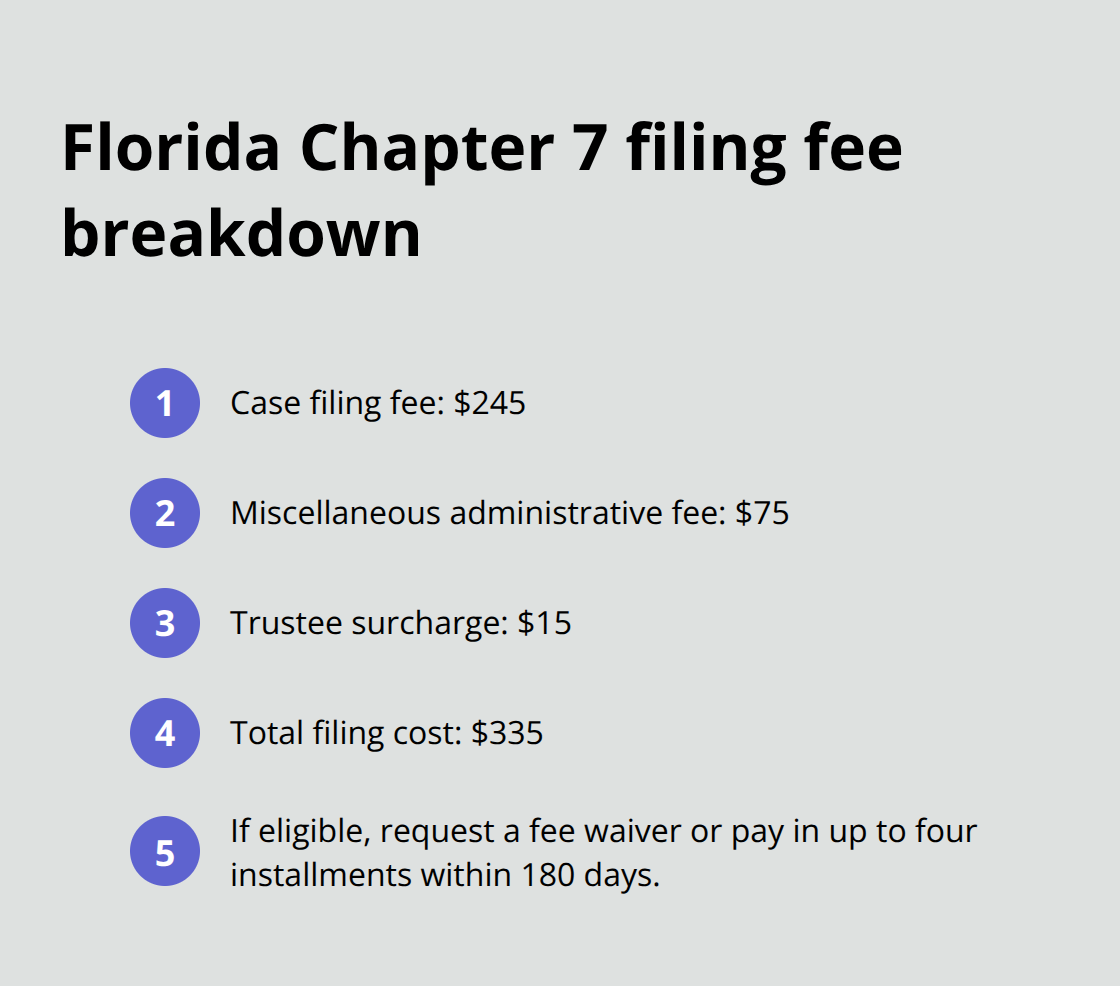
Once your documents are organized, complete the Official Bankruptcy Forms required by federal law. The petition itself is Form 106-Sum, but you also need Schedules A through J listing your assets, liabilities, income, and expenses. These forms demand precision because the bankruptcy trustee uses them to determine what property you can keep under Florida exemptions and whether you pass the means test. The filing fee totals $335 (split into a $245 case filing fee, a $75 miscellaneous administrative fee, and a $15 trustee surcharge). If your income falls below 150% of the poverty line for Florida, you can request a fee waiver or payment plan allowing four installments within 180 days.
Submit your completed petition and all schedules to the U.S. Bankruptcy Court for your Florida district-either the Middle, Northern, or Southern District depending on your residence. Once the court receives your petition, the automatic stay takes effect immediately, stopping most creditors from pursuing collection actions against you.
Step 2: Credit Counseling and the Automatic Stay
You must complete credit counseling before filing your Chapter 7 petition-this is a federal requirement, not optional. The U.S. Department of Justice maintains a list of approved agencies in Florida that offer these courses. Most counseling sessions run 60 to 90 minutes and cover budgeting basics, debt management alternatives, and your financial obligations. You need to finish this course within 180 days before you file, then obtain your Certificate of Credit Counseling and file it within 14 days after submitting your petition. Skipping this step delays your case and pushes back your discharge date.
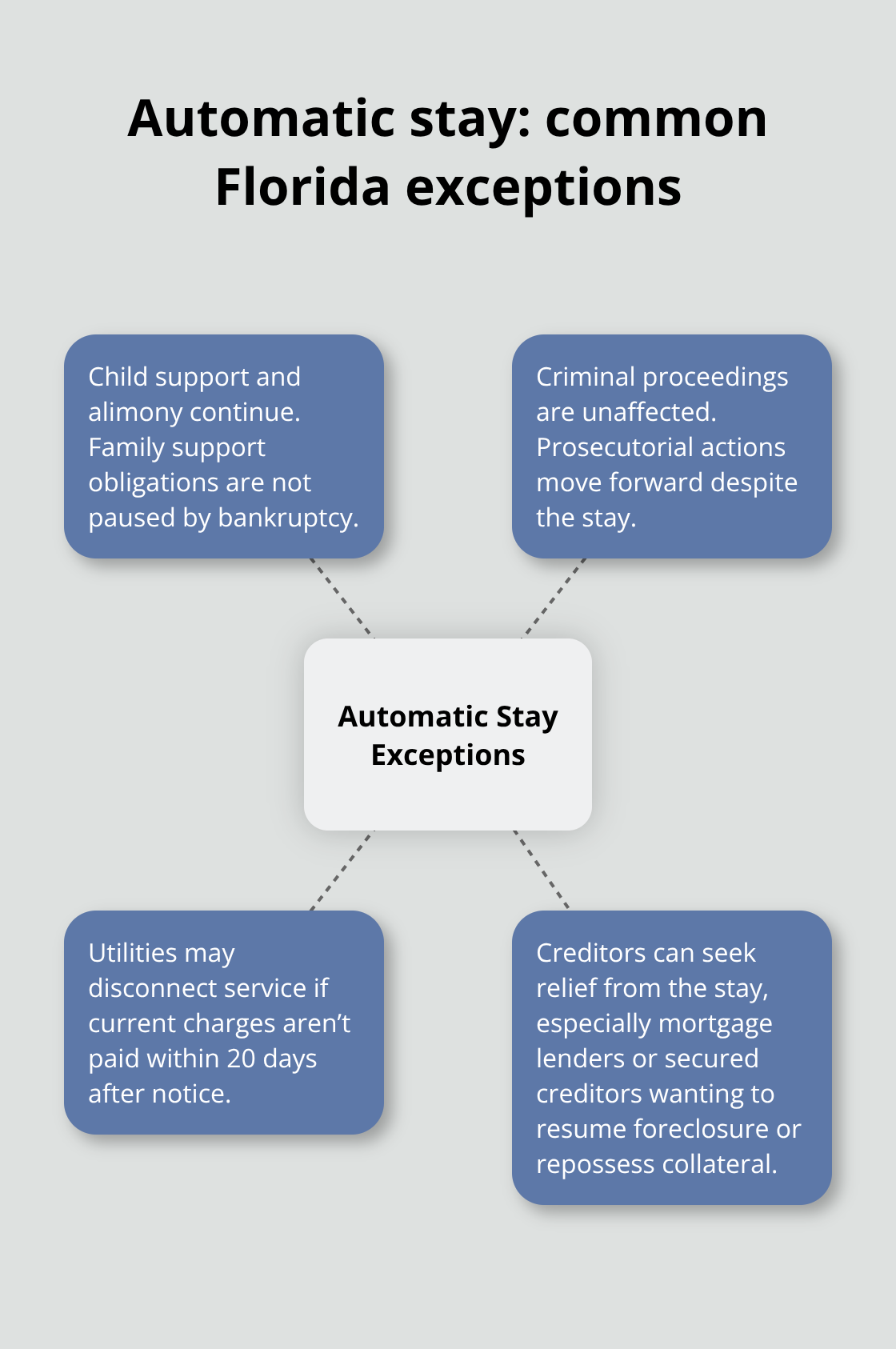
The automatic stay takes effect the moment the court receives your petition, and it stops most collection activity immediately. Collection calls halt, wage garnishments stop, and foreclosure proceedings pause for most creditors. However, Florida law recognizes important exceptions to this protection. Child support and alimony collection continue without interruption, and criminal proceedings move forward unaffected. Utility companies can shut off service under certain conditions if you don’t pay current charges within 20 days of notice, and some creditors can petition the court for relief from the stay-particularly mortgage lenders seeking to resume foreclosure or secured creditors wanting to repossess collateral.
The automatic stay remains in place until your discharge or case dismissal, giving you the breathing room to reorganize your finances. With collection pressure lifted, you can focus on the next critical step: preparing for your meeting with the bankruptcy trustee.
Step 3: The 341 Meeting with Your Trustee
The 341 meeting of creditors occurs 21 to 40 days after you file your petition, and it’s far less intimidating than the name suggests. Bring your photo ID and your most recent federal tax return-the trustee needs the tax return at least 7 days before the meeting, so deliver it early to the trustee’s address listed in your court notice. The meeting typically lasts only 10 to 20 minutes, and most creditors never show up despite the official name. The trustee’s main job involves verifying your financial information matches what you submitted on your schedules and assessing whether you have nonexempt assets to liquidate. Florida courts schedule these meetings within about 60 days of filing, so you’ll have time to prepare without rushing.
The trustee will ask straightforward questions under oath: How did you accumulate your debts? Have you sold any property in the last two years? Do you have any income sources beyond your job? Is your spouse’s information included because you live together? These questions help the trustee determine if you pass the means test and whether you have assets worth pursuing. Answer honestly and directly-evasion or false statements create serious legal problems. The meeting room has no recording devices allowed, and the atmosphere is professional but routine. After the trustee files a report to the court within 10 days, you’ll move forward to complete your financial management course and wait for discharge, which brings you to the next critical requirement in your Chapter 7 journey.
Step 4: Asset Review and Exemption Claims
After your 341 meeting, the trustee evaluates your property to determine what the bankruptcy estate includes and what you keep under Florida law. The trustee reviews your schedules to identify nonexempt assets-property that belongs to creditors and will be sold to pay them. Florida exemptions are generous compared to federal exemptions, protecting the assets most filers actually need. If you own a home, your primary residence receives homestead exemption protection regardless of value, but only if you lived in Florida continuously for at least 24 months before filing. Your motor vehicle gets $1,000 protection, personal property starts at $1,000 (rising to $4,000 if you don’t claim homestead), and retirement accounts like 401(k)s, 403(b)s, and IRAs remain fully exempt under Florida law.
Most filers keep everything they own because Florida exemptions cover essential assets. Retirement savings, disability benefits, Social Security, pensions, life insurance cash surrender value, and annuities all stay with you-the trustee cannot touch these. If you have nonexempt assets, the trustee liquidates them and distributes proceeds to creditors, but this happens in fewer than 10% of Florida Chapter 7 cases. The key involves claiming your exemptions correctly on your schedules; failing to list an exemption creates administrative headaches but doesn’t strip the protection away. Once the trustee completes the asset evaluation and you understand what property the estate includes, you move to the next requirement: completing your financial management course within the court-imposed deadline.
Step 5: Complete Your Financial Management Course
After your 341 meeting concludes, you must complete a post-petition financial management course within 60 days of the first meeting date set by the court. This requirement differs from your pre-filing credit counseling and focuses specifically on personal financial management, budgeting strategies, and long-term money habits. The U.S. Department of Justice maintains an approved provider list for Florida that includes nonprofit organizations and educational institutions offering these courses. Most courses run between 90 minutes and two hours, and many providers offer online options so you can complete the requirement from home without scheduling conflicts. You cannot skip this step-failure to finish the course delays your discharge indefinitely.
Once you complete the course, the provider files Form B423 directly with the court or provides you with a completion certificate that you must file yourself within the 60-day deadline. Check with your course provider beforehand about their filing procedures because some agencies handle court notification automatically while others require you to submit the paperwork. The filing fee is zero, and most approved providers charge between $20 and $50 for the entire course. Try to complete this course at least one week before your deadline to avoid last-minute complications or technical issues with online filing systems. Once the court receives your completion certification, you’ve satisfied all major requirements and move toward your discharge order, which brings you to the next critical phase: understanding what happens during the objections period and how creditors can challenge your case.
Step 6: Objections Period and Creditor Actions
After your 341 meeting, creditors and the trustee have a limited window to object to your discharge or challenge your case. The objection period typically runs 60 days from your 341 meeting date, though Florida courts may extend this deadline if circumstances warrant additional time. Most Chapter 7 cases proceed without objections because filers meet the means test requirements and have properly listed their debts and assets. Creditors rarely object unless they suspect fraud, hidden assets, or income concealment on your schedules. The trustee files a report within 10 days after your meeting and will flag any concerns about your eligibility at that point, so you’ll have advance notice if problems exist.
Creditors challenge discharges primarily when they believe you committed fraud, concealed property, or failed to disclose income sources on your petition. If a creditor objects, you’ll receive written notice and can respond directly to their concerns without requiring a court appearance in most cases. The trustee may also object if nonexempt assets exist or if your income suggests you should file Chapter 13 instead of Chapter 7. Florida law gives you the right to address any objection in writing. Once the objection period expires without challenges, the court issues your discharge order, typically within 60 to 90 days after your 341 meeting concludes-marking the transition to your final step where you receive the discharge order that eliminates your qualifying debts.
Step 7: Your Discharge Order Arrives
Your discharge order typically arrives 60 to 90 days after your 341 meeting concludes, assuming no creditors or the trustee filed objections during the challenge period. The court mails your discharge papers directly to you and your attorney if you have one, officially releasing you from personal liability for most debts listed in your petition. This order eliminates credit card balances, medical bills, personal loans, and unsecured debts that creditors cannot pursue further. The discharge is permanent and binding-creditors cannot restart collection actions, file lawsuits, or garnish wages for discharged debts. Once you hold this document, your financial fresh start legally begins.
However, certain debts survive Chapter 7 discharge and remain your responsibility. Child support and alimony obligations continue indefinitely because Florida law protects family support obligations above all other debts. Most federal, state, and local tax debts cannot be discharged unless they meet specific age and payment requirements established by the IRS. Government-guaranteed student loans typically cannot be discharged unless you prove undue hardship through a separate adversary proceeding, which is extremely difficult to win. Criminal restitution orders, debts incurred through fraud or willful injury, and recent income tax returns all stay with you after discharge.
Your discharge papers specify exactly which debts are eliminated and which remain, so review them carefully to understand your post-bankruptcy obligations. Rebuilding your credit score begins immediately after discharge, and most filers see measurable improvement within 12 to 24 months as negative bankruptcy information ages and on-time payments accumulate on your credit report. This fresh financial foundation sets the stage for the final section of your Chapter 7 journey, where you’ll learn concrete steps to restore your credit and move forward with confidence.
Moving Forward After Your Florida Chapter 7 Bankruptcy
Your discharge order marks the beginning of your financial recovery, not the end of your journey. With qualifying debts eliminated, you now control your financial future without the weight of creditor harassment or wage garnishments. The Chapter 7 petition steps you completed have given you a genuine fresh start, and the next phase involves rebuilding your credit and establishing healthy financial habits that prevent future debt accumulation.
Your credit score will improve significantly over time as negative bankruptcy information ages on your report. Most filers see measurable gains within 12 to 24 months after discharge, particularly when they make on-time payments on any remaining obligations and keep credit card balances low. Start small with a secured credit card that requires a cash deposit, which demonstrates responsible credit use to lenders without excessive risk. Payment history accounts for 35% of your credit score calculation, so you must pay your bills on time every single month.

You can apply for new credit immediately after discharge, though lenders will see your bankruptcy on your credit report for seven to ten years depending on the chapter you filed. Some creditors specifically target recent bankruptcy filers because they know you cannot file Chapter 7 again for eight years, making you a lower-risk borrower. Avoid payday loans and predatory lenders that charge excessive interest rates and trap you in debt cycles similar to what you just escaped. Instead, work with mainstream financial institutions that offer reasonable terms and transparent fee structures.
If you navigated the Chapter 7 petition steps without legal representation, consider consulting with a bankruptcy attorney now to address any remaining questions about your discharge or post-bankruptcy obligations. We at Harnage Law, PLLC assist individuals and families in overcoming financial challenges by providing legal guidance through every step of the bankruptcy process. Contact us at https://chapter7florida.com to discuss your situation and ensure you’re maximizing your fresh financial start.