Filing Chapter 7 bankruptcy in Florida comes with a significant advantage: state law protects far more of your assets than most other states allow. Chapter 7 Florida exemptions can shield your home, vehicle, retirement accounts, and personal belongings from creditors.
We at Harnage Law, PLLC help clients understand exactly what they can keep during bankruptcy. This guide walks you through Florida’s most generous protections so you know where you stand.
What Exemptions Actually Do in Chapter 7
How Exemptions Protect Your Assets
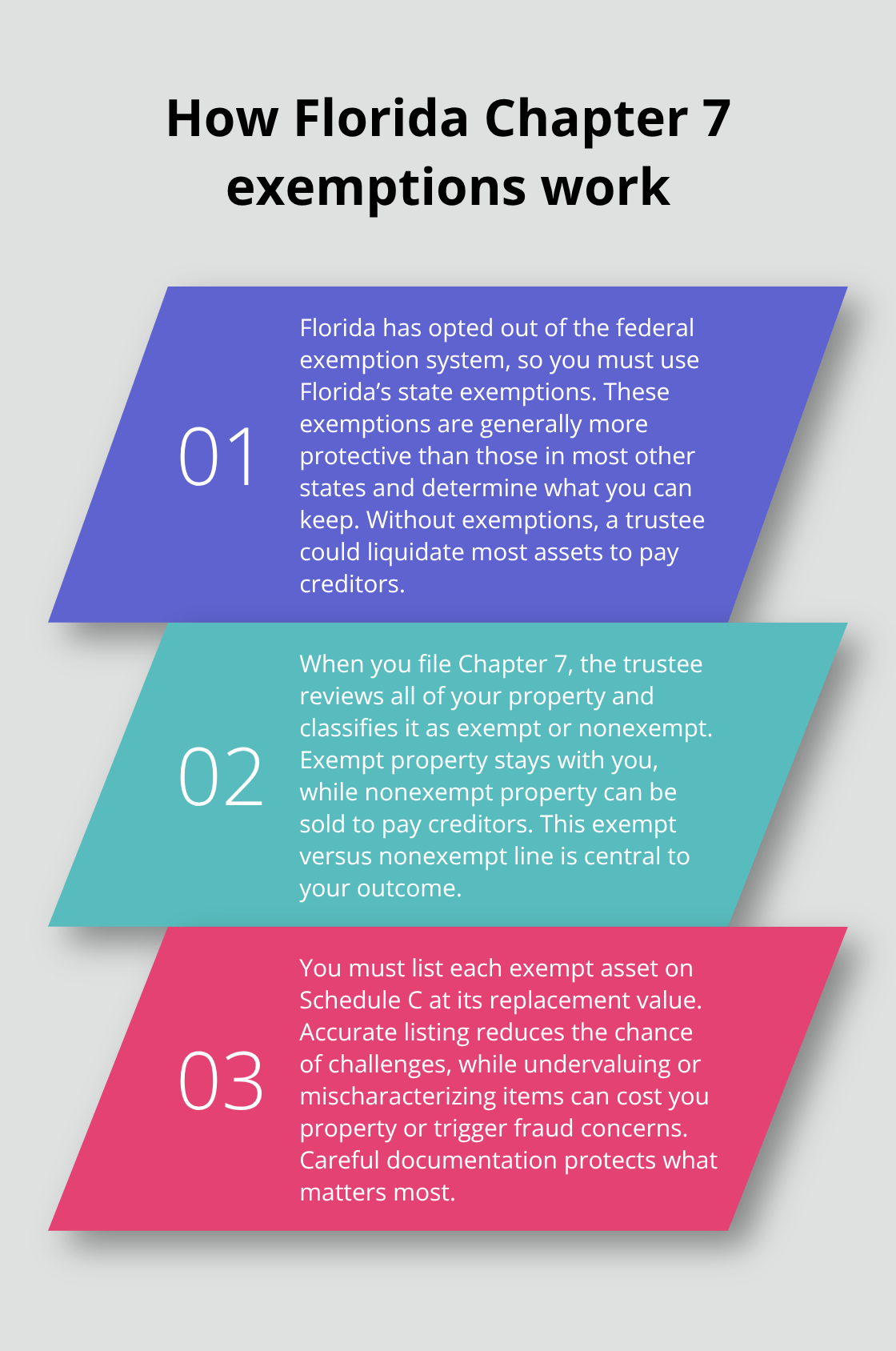
Exemptions in Chapter 7 bankruptcy are the legal tools that let you keep specific assets when you file. Without exemptions, a bankruptcy trustee could liquidate nearly everything you own to pay creditors. Florida exemptions work differently than federal ones because Florida has opted out of the federal system entirely. This means you must use Florida state exemptions, and they’re substantially more protective than what most other states offer.
The law recognizes that debtors need certain property to survive and rebuild after bankruptcy, so it shields homes, vehicles, retirement savings, and essential household items from the trustee’s reach. When you file Chapter 7, the trustee will review all your property and determine what’s exempt versus nonexempt. Nonexempt property gets sold to pay creditors, while exempt property stays with you.
Why Understanding Your Exemptions Matters
You could lose tens of thousands of dollars in assets simply because you didn’t know how to properly claim exemptions on your bankruptcy forms. When you file, you’ll list each exempt asset on Schedule C of your bankruptcy petition with its replacement value. The trustee rarely challenges accurately listed items, but if you undervalue or mischaracterize property, you risk losing it or facing fraud allegations.
Florida’s Strongest Protections
Florida’s exemption laws rank among the strongest in America, particularly for homestead protection. If you’ve owned your primary residence for at least 1,215 days before filing, you can exempt unlimited equity in your home within the acreage limits of half an acre inside a municipality or 160 acres outside one. That protection doesn’t exist in most states.
Beyond real estate, Florida shields up to $5,000 in motor vehicle equity, all retirement account balances, Social Security benefits, workers compensation payments, and veteran’s benefits. The state also protects life insurance proceeds, disability income, and prepaid college savings accounts. Florida’s approach is clear: it prioritizes letting people keep their homes and the income streams they depend on.
What This Means for Your Chapter 7 Case
Many Chapter 7 filers in Florida end up keeping all or nearly all their property because these exemptions cover what matters most. The specific assets you protect depend on your situation, your income sources, and the property you own. Understanding which exemptions apply to your circumstances sets the foundation for protecting what you need most-which is why the next section walks through Florida’s primary exemptions in detail.
Chapter 7 Florida Exemptions: What Property Stays With You
Your Home Receives Unlimited Protection
Your home stands as the crown jewel of Florida’s bankruptcy protections, and the numbers justify the reputation. If you own your primary residence for at least 1,215 days before filing, Florida law shields unlimited equity in that property-no matter how much it’s worth. The only limitation is acreage: half an acre within city limits or 160 acres outside municipalities. This unlimited protection does not exist in most states; California caps homestead exemptions at $713,050, Texas at $683,500, and New York offers no homestead exemption at all.
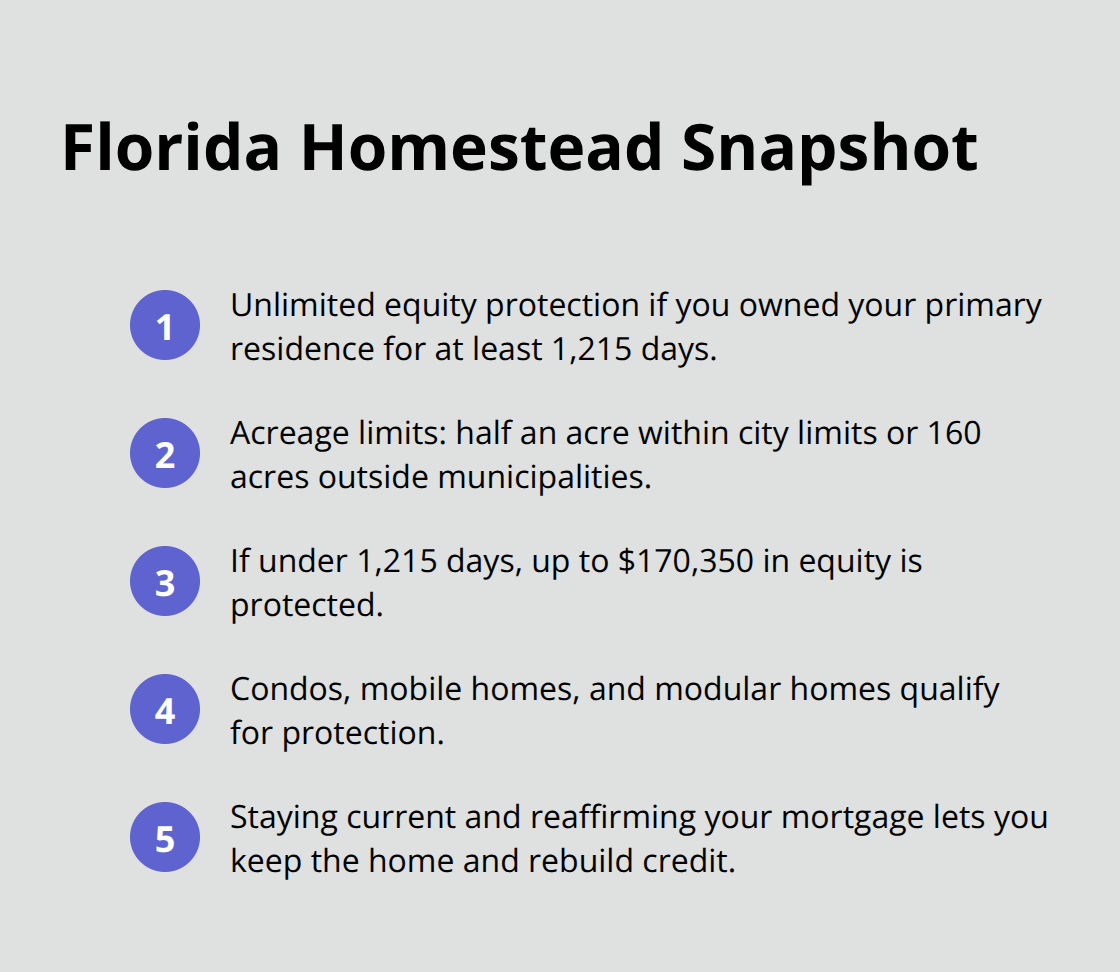
Even if you have not owned your home for the full 1,215 days, Florida still protects up to $170,350 in equity, which covers most primary residences in the state. The protection extends to condos, mobile homes, and modular homes-not just traditional houses. If you stay current on your mortgage payments and reaffirm the debt in your Chapter 7 filing, you keep the home and those on-time payments help rebuild your credit score after discharge.
Catching Up on Missed Mortgage Payments
If you have fallen behind on payments, Chapter 13 becomes the better option because it lets you catch up missed payments over a three- to five-year repayment plan, potentially saving the home from foreclosure. This strategy works when you want to preserve your residence but cannot immediately pay the full arrearage.
Motor Vehicles and Personal Property Protection
Your vehicle receives substantial protection through Florida’s $5,000 motor vehicle exemption per person, which means a married couple filing jointly can protect up to $10,000 in combined vehicle equity. Most people benefit from this because new and slightly used vehicles depreciate rapidly after purchase and carry financed balances that eliminate equity. A car financed for $25,000 that is now worth $18,000 has no exempt equity-the lender’s lien consumes it entirely.
Personal property exemptions cover household goods, furniture, clothing, electronics, jewelry, and artwork up to $1,000 per person (or $4,000 if you decline the homestead exemption). The key to protecting these items is accurate valuation on Schedule C of your bankruptcy petition. List a used couch at its replacement value, not its original purchase price. Trustees rarely challenge accurately listed household items because they are time-consuming to sell and generate minimal proceeds.
Retirement Accounts and Income Streams
Retirement accounts receive 100 percent protection under Florida law, including 401(k) plans, 403(b) accounts, IRAs, and pension payments. Federal law caps retirement account protection at $1,711,975 per person for cases filed between April 2025 and March 2028, but most people fall well below that threshold. Life insurance proceeds paid to a beneficiary are fully exempt, as is the cash surrender value of whole life policies.
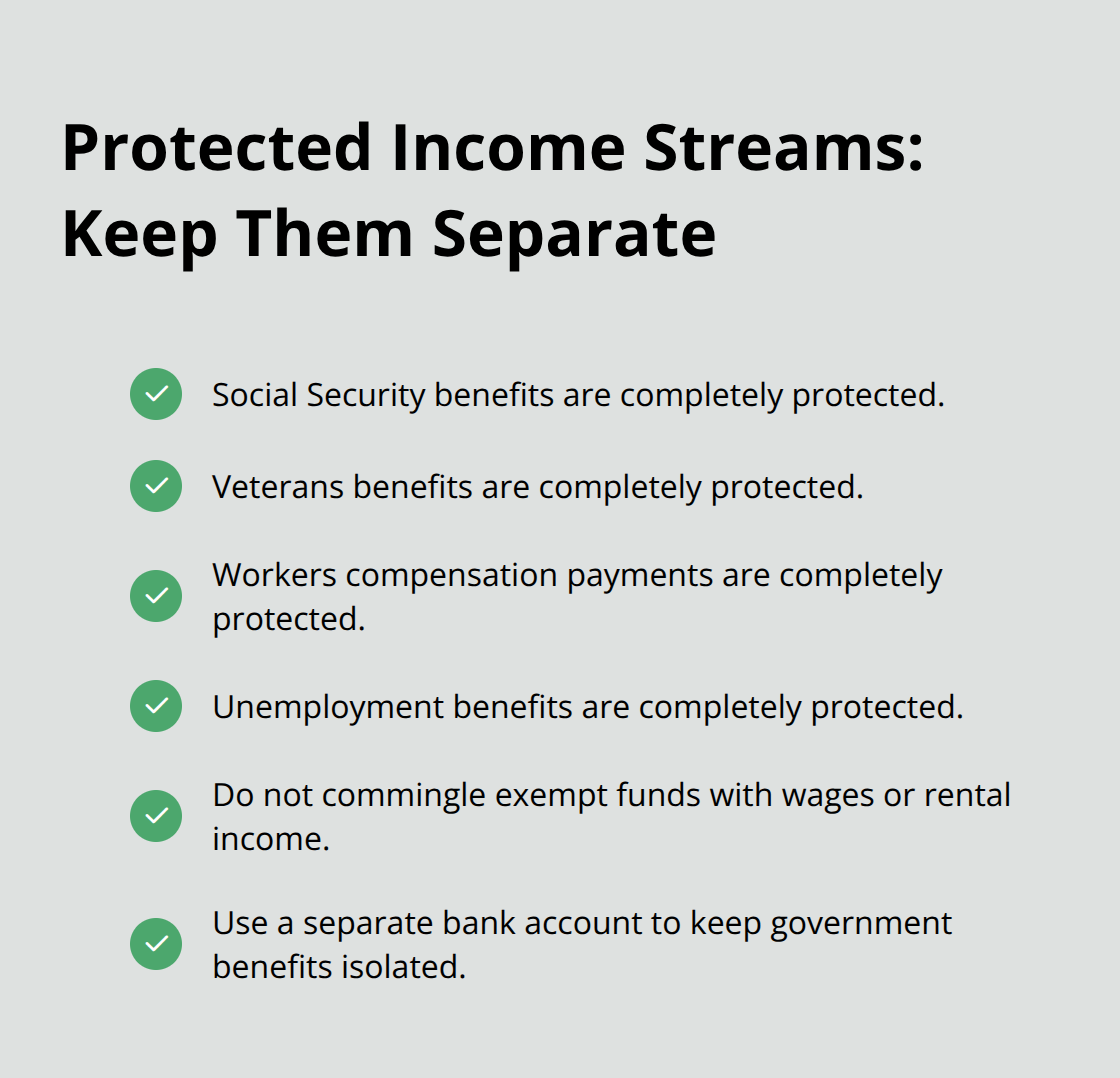
Social Security benefits, veterans benefits, workers compensation payments, and unemployment benefits remain completely protected from creditors-never commingle these funds with wages or rental income, or you risk losing the exempt status. Certain items may be exempt from liquidation under Florida law, allowing you to retain essentials while eligible debts are typically discharged at the end of your case. These income protections form the backbone of financial stability for many filers, which is why the next section addresses how to properly claim and preserve these exemptions throughout your Chapter 7 case.
Assets That Stay Protected Beyond Your Home and Car
Retirement Accounts Shield Your Long-Term Savings
Retirement accounts represent the most valuable protected assets for most Chapter 7 filers in Florida, and the law treats them with near-absolute protection. Your 401(k), 403(b), traditional IRA, Roth IRA, and pension payments stay completely shielded from liquidation under Florida Statute 222.21. Federal law caps this protection at $1,711,975 per person for cases filed between April 2025 and March 2028, but this ceiling rarely affects working people or retirees. The protection applies to the full account balance regardless of size, which means a 55-year-old with $800,000 in retirement savings keeps every dollar. This matters enormously because retirement accounts represent decades of compound growth that creditors cannot touch. If you have ERISA-qualified retirement benefits through an employer, those receive even stronger protections under federal nonbankruptcy exemptions that layer on top of Florida’s state protections.
Life Insurance and Annuity Proceeds
Life insurance proceeds paid to a named beneficiary stay completely exempt, and the cash surrender value of whole life policies receives full protection as well. This distinction matters: term life insurance has no cash value, so there is nothing to protect, but a whole life policy with $50,000 in accumulated cash value stays entirely yours. Annuity proceeds follow similar rules, though lottery-related annuities may not qualify for exemption in Florida. Verify your beneficiary designations are current and accurate because bankruptcy does not change who receives life insurance proceeds-only the bankruptcy trustee cannot claim those funds.
Government and Employer Income Streams
Social Security benefits, veterans benefits, workers compensation payments, and unemployment benefits stay completely exempt from creditors under Florida law. The catch is simple but critical: never commingle these funds with non-exempt income like wages or rental income, or you lose the exempt status on the entire account. If you deposit $3,000 in Social Security and $2,000 in wages into the same checking account, a trustee can argue the entire $5,000 became non-exempt property. Open a separate bank account for government benefits and keep it isolated from other deposits.
Business Equipment and Professional Tools
Tools of the trade and business equipment receive limited protection under Florida exemptions, with only $1,000 in exemption available for items necessary to your profession. A carpenter’s tools worth $2,500 would have $1,500 exposed to liquidation, which is why many self-employed filers choose Chapter 13 instead to keep their equipment and income-producing assets.
Education and Health Savings Accounts
Prepaid college education savings accounts and health savings accounts stay fully exempt under Florida law, making these vehicles valuable for protecting money set aside for education or medical expenses. These protections exist because debtors need access to retirement income, life insurance protection, and the tools required to maintain employment after bankruptcy concludes.
Final Thoughts
Florida’s Chapter 7 exemptions protect the assets that matter most in your financial life. Your home receives unlimited equity protection if you’ve owned it for 1,215 days, your vehicle stays shielded up to $5,000, and your retirement accounts remain completely off-limits to creditors. Social Security, veterans benefits, workers compensation, and life insurance proceeds stay protected, while personal property like household goods and clothing receive exemption coverage as well.
Properly claiming these exemptions on your bankruptcy forms determines whether you keep the property you need most. Misvaluing assets or failing to list them correctly can result in losing property you could have protected, and commingling exempt funds like Social Security with non-exempt income can jeopardize your protections. These details matter enormously when your financial future is at stake.
We at Harnage Law, PLLC help clients navigate Chapter 7 bankruptcy by identifying every available exemption and ensuring your assets receive maximum protection. Contact us to discuss your Chapter 7 options and learn exactly what you can keep under Florida exemption laws.