
Filing Chapter 7 bankruptcy in Florida gives you powerful legal protections. Florida Chapter 7 exemptions let you shield your home, vehicles, retirement accounts, and other assets from creditors.
At Harnage Law, PLLC, we’ve helped countless Floridians navigate these protections and keep what matters most. This guide walks you through exactly what you can protect and how to do it right.
1. Your Home Protection Starts With Meeting Two Hard Deadlines
Florida’s homestead exemption shields unlimited equity in your primary residence, but only if you satisfy two specific ownership requirements. You must have lived in Florida for at least 730 days before filing Chapter 7, and you must have owned and occupied the home as your permanent residence for at least 1,215 days prior to filing. Your property also cannot exceed half an acre within a municipality or 160 acres outside city limits. If you meet all three conditions, the trustee cannot force a sale of your home to pay creditors, regardless of how much equity you hold. Missing even one deadline means federal law caps your protection at approximately $214,000, leaving substantial equity vulnerable.
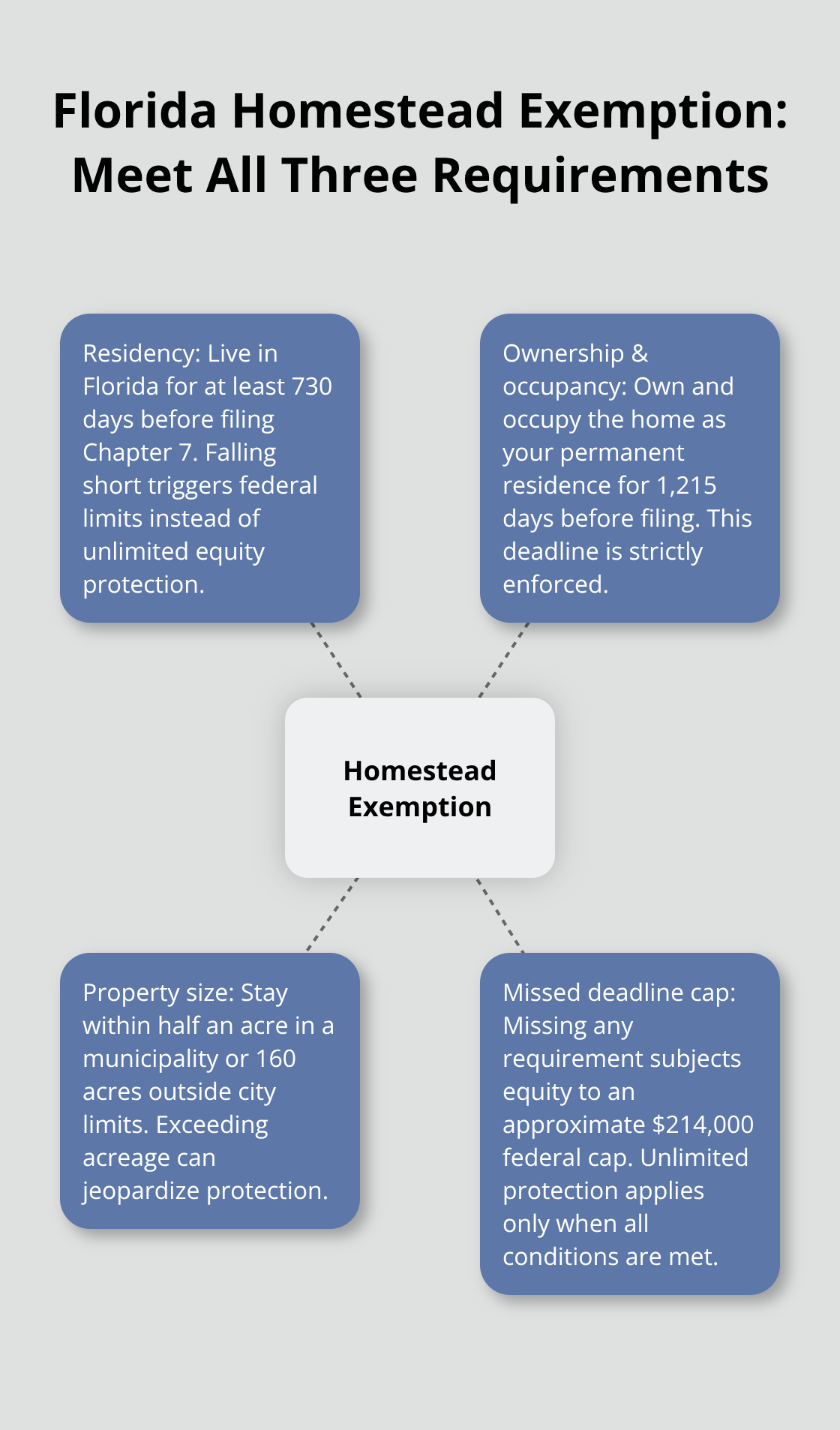
The 1,215-day ownership requirement creates real problems for people who purchased homes recently. If you bought your house 900 days before filing, you fall short by 315 days and lose unlimited protection entirely. Document your ownership with your deed and your residency with utility bills, lease agreements, or tax returns showing your Florida address. Clients often assume they qualify when they do not, then file and discover their home faces liquidation. Verify these dates before you file-once your case opens, amending your exemptions becomes complicated and invites trustee challenges.
Accurate documentation prevents costly surprises and keeps your home genuinely protected. Your next step involves understanding what other household assets Florida law shields from creditors.
2. Protecting Everyday Items Within the $1,000 Limit
Florida law shields $1,000 of personal property from creditors in Chapter 7, covering everyday household items like furniture, electronics, clothing, and books. This protection applies to tangible goods you own outright, not debts secured by those items. The trustee values these assets at fair market value, meaning your five-year-old television worth $200 counts toward the limit, not its original purchase price. Married couples filing jointly can protect $2,000 of personal property combined, doubling the individual exemption. If you own items worth $1,200, the trustee could liquidate $200 worth of assets to pay creditors, though many trustees abandon property that costs more to sell than it generates in proceeds.
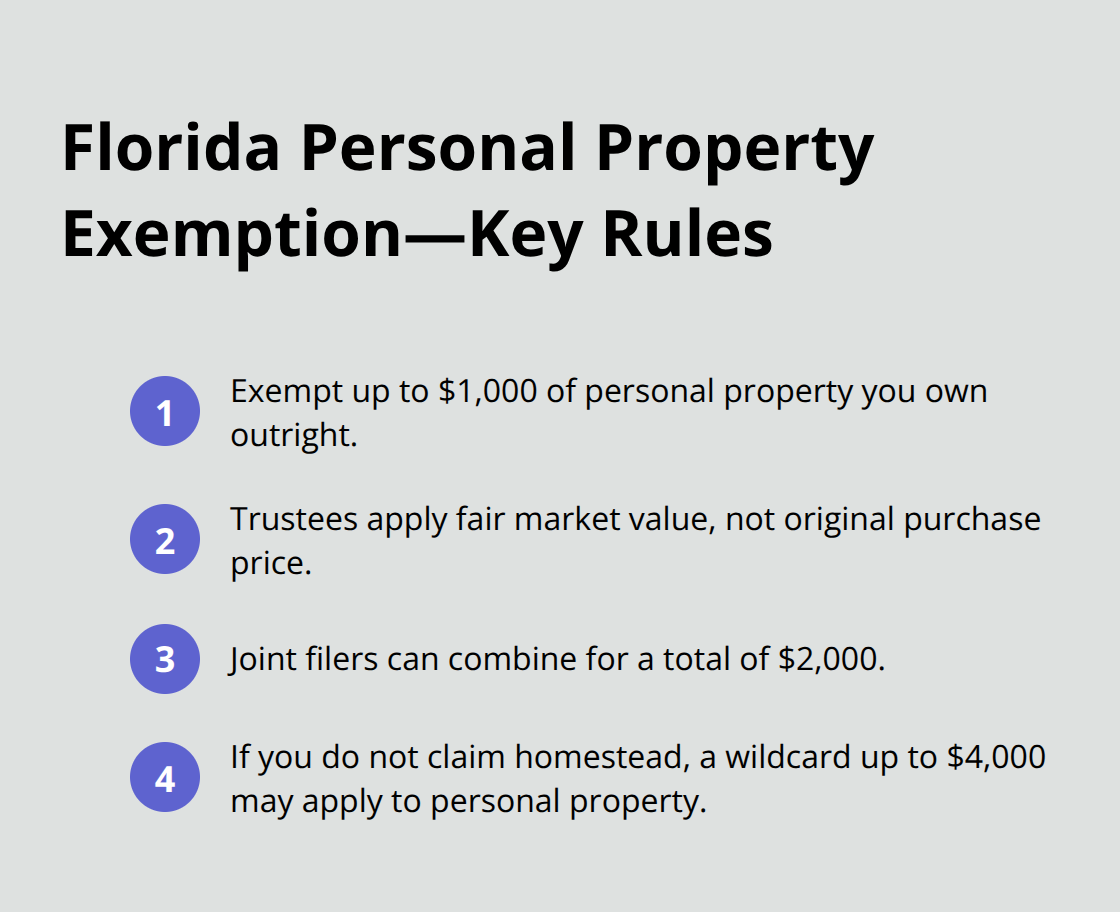
Strategic planning matters when you have valuable family heirlooms or high-end electronics. If you do not claim the homestead exemption because you rent or own investment property, Florida allows you to use a wildcard exemption of up to $4,000 for personal property instead of the standard $1,000, significantly increasing protection for valuable items. Certain items receive separate protection outside the $1,000 cap:
- Prescription health aids
- Education savings accounts
- Health savings accounts
These do not reduce your available exemption space. Keep detailed records of what you own and its condition before filing. Understanding which assets fall under the personal property exemption and which qualify for additional protections helps you maximize what you can safely keep through Chapter 7. Your vehicle represents another major asset that Florida law protects separately from personal property.
3. Your Vehicle Protection and When It Falls Short
Florida’s motor vehicle exemption protects $5,000 of equity in a single vehicle during Chapter 7. If you own a car worth $8,000 and owe $4,000, your $4,000 equity falls safely within the exemption, and the trustee cannot liquidate it. Married couples filing jointly can protect $10,000 of combined vehicle equity, effectively doubling protection for jointly owned vehicles. The trustee uses Kelley Blue Book Private Party value to determine your vehicle’s worth, not dealer pricing or what you paid for it. A vehicle worth less than your loan balance creates zero equity to protect, and most Chapter 7 filers keep their vehicles without issues because equity rarely exceeds exemption limits.
Vehicles worth significantly more than the exemption create a genuine problem that demands a different strategy. If you own a paid-off vehicle worth $12,000, the trustee could sell it and give you $5,000 in cash, pocketing $7,000 for creditors. Chapter 13 bankruptcy offers a better solution because you can keep the vehicle while repaying the nonexempt equity through a three to five year plan instead of losing it immediately. Redemption under federal bankruptcy law allows you to pay the vehicle’s fair market value to the secured creditor rather than the full loan balance, though this applies primarily to financed vehicles. Work vehicles and mobility aids face the same $5,000 exemption limit as any other vehicle under Florida law.
Documenting your vehicle’s current condition and mileage establishes its fair market value if the trustee questions your valuation. Understanding how wage protections interact with vehicle ownership helps you plan your overall asset strategy during Chapter 7.
4. Protecting Your Paycheck and Bank Deposits
Chapter 7 bankruptcy stops wage garnishment immediately through the automatic stay, which prevents creditors from taking money directly from your paychecks the moment you file. Florida law provides additional protection for wages deposited into your bank account, though the rules differ depending on your household status. If you qualify as head of household, Florida exemptions shield a larger portion of your deposited wages from creditor claims compared to single filers. Once the court receives your petition, creditors face contempt charges if they continue collection efforts, giving you genuine breathing room to stabilize your finances.
Bank accounts holding recently deposited wages receive varying levels of protection depending on timing and account ownership. Wages deposited within a specific period before filing retain stronger protection under Florida law, though commingling those wages with other funds can complicate protection claims. If your account contains only wage deposits from recent paychecks, the trustee faces obstacles in accessing those funds because they qualify as exempt income. Accounts mixing wages with savings, gifts, or other money sources become vulnerable because the trustee can argue that nonexempt funds are present. Maintaining a separate account for wage deposits and keeping documentation of deposit dates and amounts establishes which funds qualify for protection and prevents disputes about what money actually belongs to you during your Chapter 7 case.
Retirement accounts represent another category of assets that Florida law shields from creditors, offering protection that extends far beyond what most debtors realize.
5. Retirement Savings That Stay Completely Off Limits
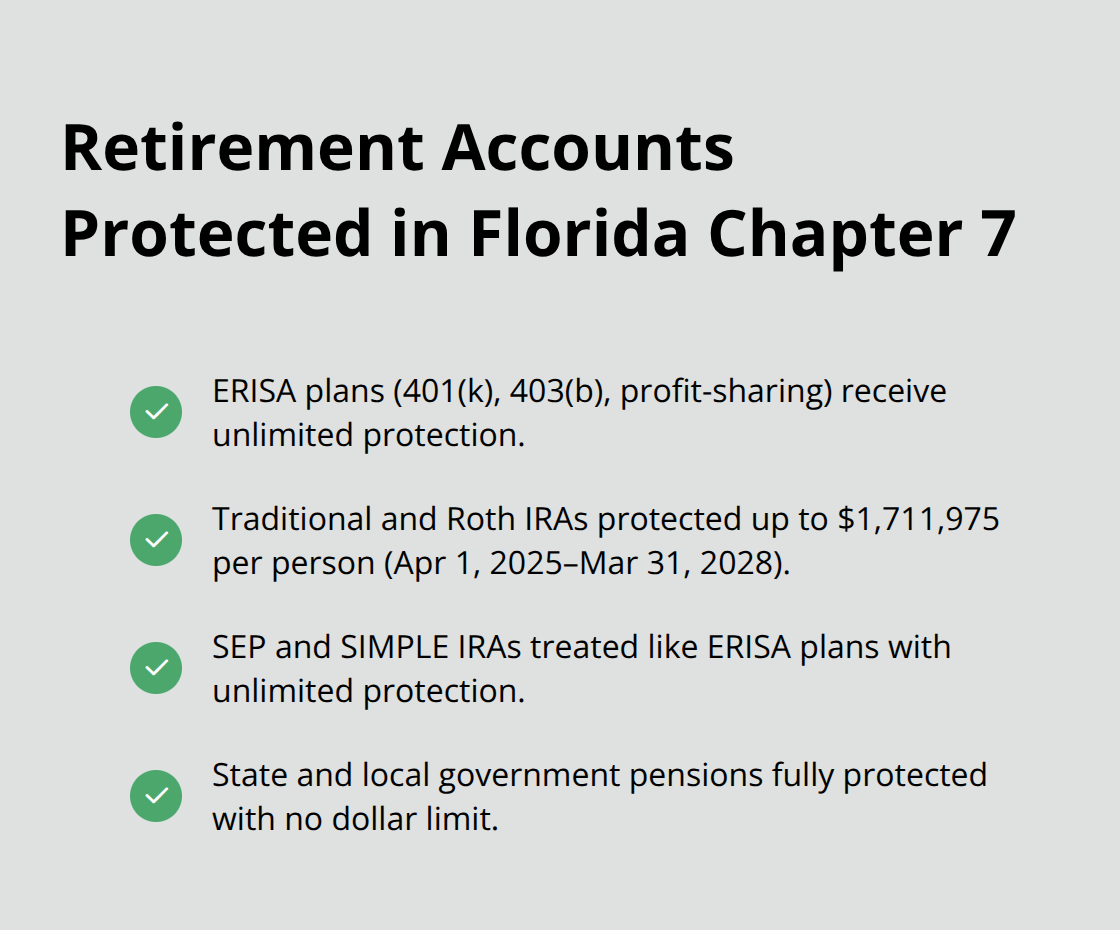
Florida law shields retirement accounts from creditors with remarkable breadth during Chapter 7, protecting far more than most debtors expect. ERISA-qualified plans including 401(k)s, 403(b)s, and profit-sharing accounts receive unlimited protection regardless of balance size, meaning a $500,000 401(k) stays entirely safe from the trustee. Traditional and Roth IRAs receive protection up to $1,711,975 per person for cases filed between April 1, 2025 and March 31, 2028, according to federal bankruptcy law adjustments. SEP and SIMPLE IRAs qualify for the same unlimited protection as other ERISA plans, not the IRA cap, making them exceptionally valuable for self-employed filers. State and local government pensions including teacher and law enforcement retirement systems receive full protection without any dollar limit, a critical advantage for public employees carrying substantial debt.
Non-ERISA retirement accounts and annuities face different treatment that demands careful attention before filing. Annuity proceeds from lottery winnings specifically lose exemption protection, while annuity contracts and death benefits payable to a named beneficiary retain exemption status in most situations. The distinction matters because the trustee cannot liquidate qualified retirement accounts to pay creditors, but non-qualified annuities may face closer scrutiny depending on structure and funding source. Health savings accounts and education savings accounts receive separate exemption protection outside retirement account limits, preserving these vehicles entirely. Documenting your account type and ERISA status before filing prevents disputes with the trustee and ensures these substantial assets remain protected throughout your Chapter 7 case, setting the stage for understanding how life insurance and annuities interact with your overall asset protection strategy.
6. Life Insurance and Annuities During Chapter 7
Life insurance death benefits payable to a named beneficiary stay completely protected from creditors during Florida Chapter 7 bankruptcy, with proceeds passing directly to your family without entering the bankruptcy estate. The cash surrender value of your policy-the amount the insurance company would pay if you canceled it today-also receives exemption protection, preventing the trustee from forcing you to liquidate coverage you rely on for family security. Annuity contracts structured as retirement vehicles receive the same protection as life insurance under Florida law, though annuity proceeds from lottery winnings specifically lose exemption status and become available to creditors. Most annuities purchased through legitimate financial planning retain full protection because they function as deferred income vehicles rather than gambling proceeds. The trustee cannot compel you to surrender a policy to access its cash value, even if that value reaches substantial amounts.
Policy ownership structure directly determines whether exemption protection applies during your Chapter 7 case. Policies titled in your individual name receive full protection as long as you maintain them as personal property without pledging them as collateral to a creditor. If your policy is owned by an irrevocable trust or a business entity like a corporation or LLC, the exemption protection may not apply because natural persons receive the exemption under Florida law, not entities. Verify your policy ownership documents before filing and disclose them accurately on your bankruptcy forms to avoid trustee challenges that could delay your discharge or jeopardize coverage you intend to keep. Understanding how these protections work positions you to make informed decisions about which assets require additional strategic planning through other exemption categories.
7. Using the Wildcard Exemption Strategically
Florida’s wildcard exemption provides up to $4,000 of additional personal property protection when you do not claim the homestead exemption, giving renters and investment property owners a powerful tool that homestead filers cannot access. This exemption applies to any type of property valued at fair market value, meaning you can protect high-end electronics, jewelry, collectibles, or cash without restriction on what category of items qualifies. Married couples filing jointly can combine wildcard exemptions to protect $8,000 of personal property, effectively doubling protection for any assets not covered by other exemptions. The wildcard amount increases to $4,000 per person specifically because you surrendered homestead protection, making it a genuine trade-off worth calculating before you file. If you own investment property or rent your residence, this exemption becomes your primary tool for shielding valuable personal items from liquidation.
Strategic layering combines the wildcard exemption with vehicle protection to create substantial asset preservation even without homestead status. If you do not claim homestead and have a vehicle worth $8,000 with $3,000 equity, you can apply $1,000 toward the vehicle under the standard motor vehicle exemption, then use $2,000 of your wildcard exemption to reach $3,000 total protection, leaving $2,000 wildcard space for other property. This approach works only if you calculate your exemptions carefully before filing and list them correctly on Schedule C of your bankruptcy forms. The trustee will review your wildcard claims against fair market values you provide, so accurate appraisals prevent challenges that could cost you assets during your Chapter 7 case. Proper exemption planning now positions you to understand how common mistakes leave assets vulnerable and what steps you must take before filing your petition.
Final Thoughts
Protecting your assets during Florida Chapter 7 bankruptcy requires careful planning before you file your petition. The exemptions available to you depend on residency length, property ownership duration, and accurate documentation of what you own. Many filers lose assets they could have protected through proper planning because they file without verifying homestead eligibility, miscalculating vehicle equity, or listing retirement accounts incorrectly on their bankruptcy forms.
Start your asset protection strategy by gathering documentation of your home purchase date, Florida residency timeline, vehicle valuations, and retirement account statements. List every asset you own with its fair market value, then cross-reference each item against the Florida Chapter 7 exemptions covered in this guide to identify which assets fall within exemption limits and which ones create vulnerability. If nonexempt equity exists in vehicles or personal property, Chapter 13 bankruptcy might better serve your situation by allowing you to keep assets while repaying nonexempt value through a plan.
Contact Harnage Law, PLLC to discuss your situation and learn how we can help you protect your assets while achieving a fresh financial start. We evaluate your complete financial picture and develop a strategy that maximizes protection for what matters most. We guide you through every step of the bankruptcy process, from initial asset assessment through discharge.