Debt consolidation sounds appealing, but it often traps you in years of payments while Chapter 7 bankruptcy can eliminate qualifying debts in months. At Harnage Law, PLLC, we see clients who chose consolidation only to realize they’re paying more interest and getting nowhere financially.
The right chapter guidance depends on your specific situation. If you’re facing wage garnishment or have no realistic way to repay your debts, Chapter 7 may offer the fresh start consolidation simply cannot provide.
How Chapter 7 Works Faster Than Debt Consolidation in Florida
Timeline: Months Versus Years
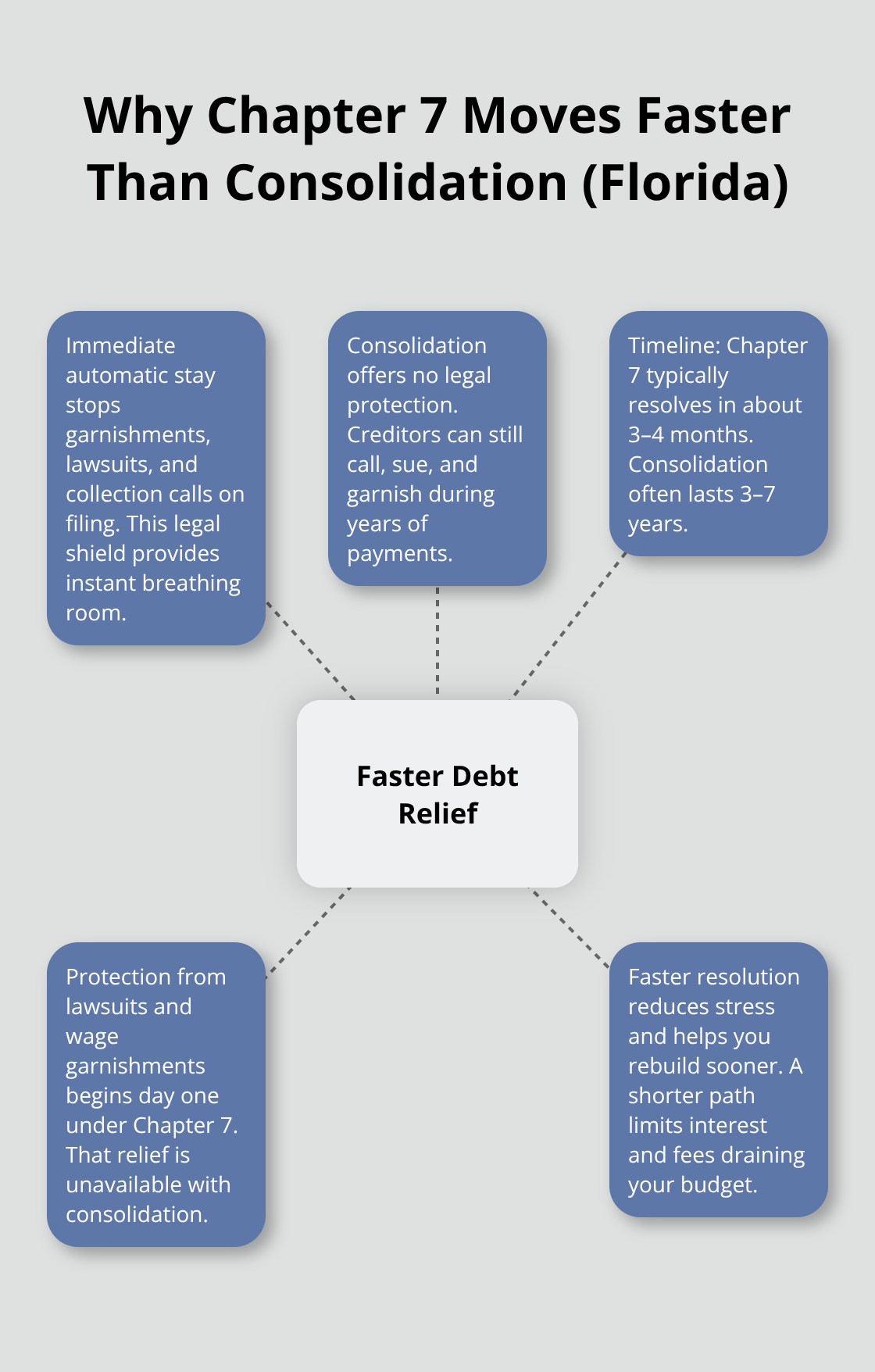
Chapter 7 bankruptcy moves through Florida courts in roughly three to four months from filing to discharge, while debt consolidation typically stretches across three to seven years. That timeline difference matters enormously when creditors call daily or your wages face garnishment. The moment you file Chapter 7, an automatic stay takes effect immediately, stopping wage garnishments, foreclosure proceedings, and creditor lawsuits. Consolidation offers no such protection-creditors keep calling, keep suing, and keep garnishing while you remain locked into years of payments.
The Cost of Consolidation Interest
Most people consolidating debt spend between $1,500 and $5,000 annually just on interest alone, money that vanishes while your principal barely moves. Chapter 7 discharges qualifying unsecured debts like credit cards, medical bills, and personal loans completely. You pay nothing more on those debts once the discharge is granted.
When Your Debt-to-Income Ratio Tells the Story
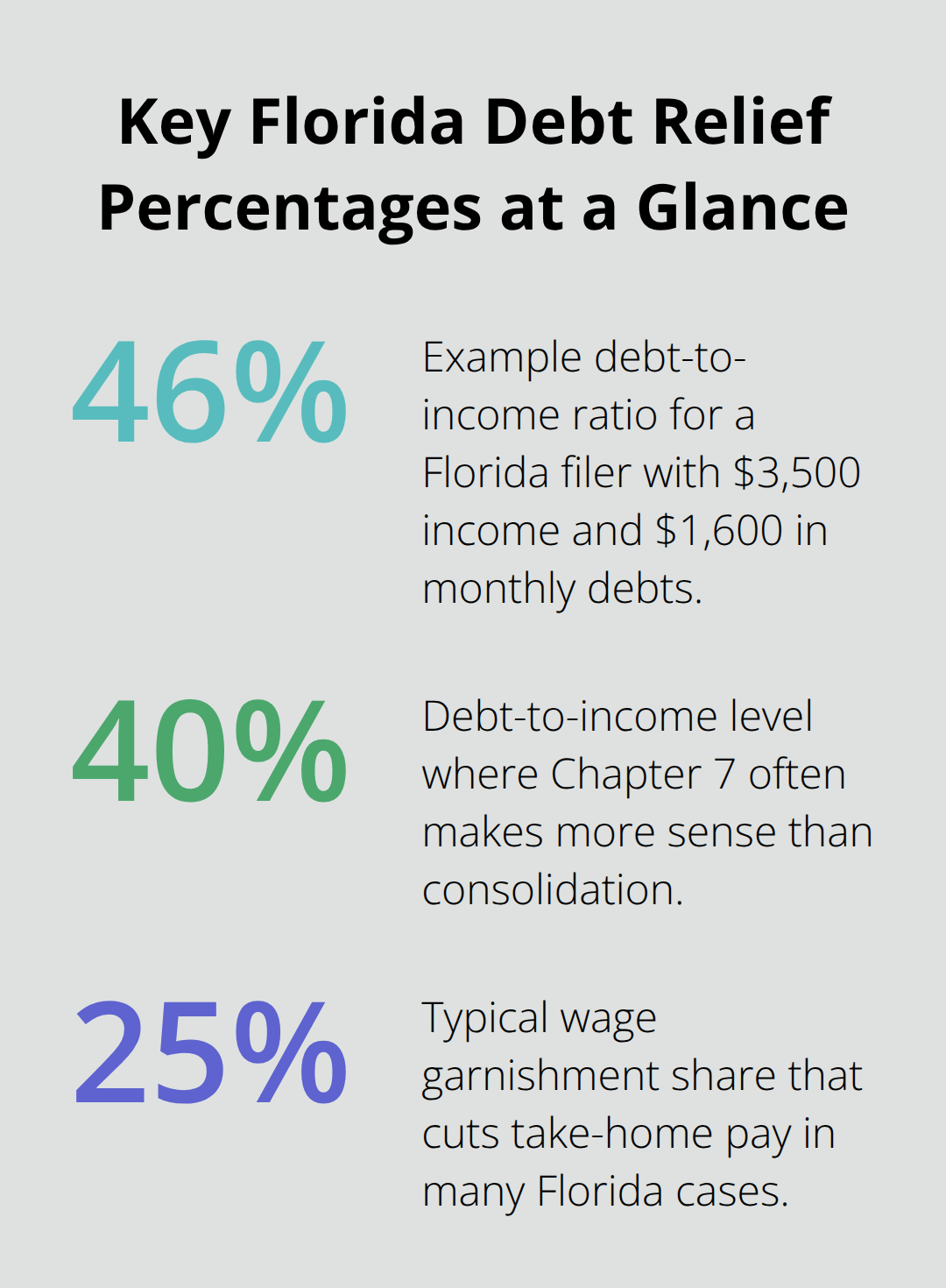
The financial math favors Chapter 7 decisively when your debt-to-income ratio exceeds 40 percent of your gross monthly income. If you earn $3,000 monthly and carry $1,200 or more in monthly debt payments, consolidation means you spend years stretching your budget thinner. Chapter 7 eliminates that burden in months, giving you immediate breathing room to rebuild.
Asset Protection Under Florida Law
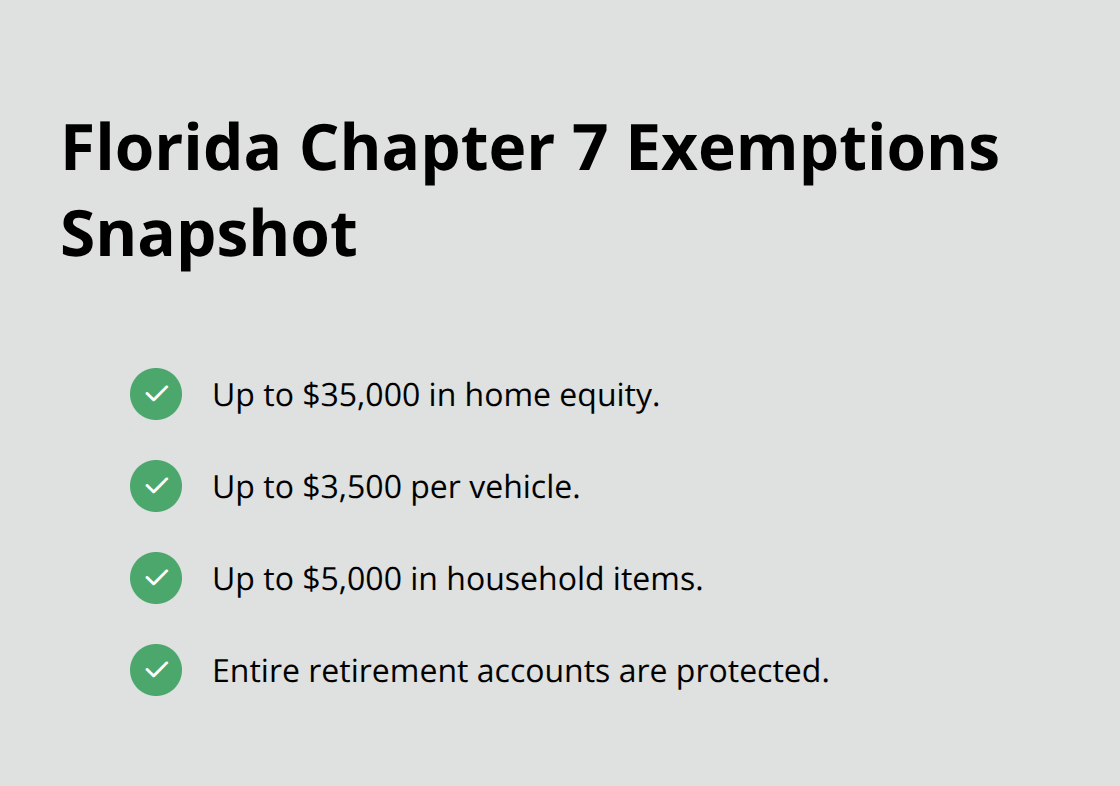
Florida exemptions protect substantial assets during the process-you can keep up to $35,000 in home equity, $3,500 per vehicle, $5,000 in household items, and your entire retirement account. A trustee may liquidate non-exempt assets, but most people filing in Florida retain the property they need for daily life.
Credit Recovery After Chapter 7
The credit impact is real but recoverable: your score typically drops 130 to 200 points initially, yet many people qualify for FHA loans within two years of discharge. Consolidation causes smaller initial damage but leaves you paying interest for years while your debt burden remains fundamentally unchanged. If you cannot realistically afford monthly consolidation payments or face immediate collection action, Chapter 7 provides the faster, cleaner path forward. Understanding whether you qualify for Chapter 7 requires examining your income against Florida’s means test thresholds.
What Chapter 7 Actually Eliminates That Consolidation Cannot
Chapter 7 erases unsecured debts completely, meaning credit cards, medical bills, and personal loans vanish permanently upon discharge. Consolidation, by contrast, simply repackages these same debts into a new loan structure-you still owe every dollar plus interest. The distinction matters financially and psychologically. When you consolidate a $25,000 credit card balance at 18 percent interest into a five-year consolidation loan at 10 percent, you pay roughly $3,000 more in interest alone compared to what you already owed. That money flows to the lender, not toward your financial recovery. Chapter 7 eliminates the debt entirely, which means no interest accumulates, no payments extend into the future, and no creditor retains leverage over your finances.
Unsecured Debts Vanish Completely in Florida Chapter 7
The Internal Revenue Service reports that medical debt remains the leading cause of personal bankruptcy filings. Consolidating medical bills simply prolongs financial strain without addressing the underlying problem. If your debts stem from illness, job loss, or other circumstances beyond your control, consolidation forces you to keep paying for problems you did not create while Chapter 7 offers genuine relief. The discharge order eliminates these obligations permanently, freeing you from future liability.
Creditor Harassment Stops Immediately With Chapter 7
The automatic stay triggered by Chapter 7 filing halts wage garnishments, collection lawsuits, and creditor calls on day one. Consolidation provides zero such protection. Creditors continue calling, continue suing, and continue garnishing wages while you navigate years of consolidation payments. Many Florida residents filing Chapter 7 report that stopping the constant phone calls and legal threats alone justifies the filing, regardless of other financial considerations. Consolidation leaves you vulnerable throughout the entire repayment period, meaning creditors can still pursue collection actions, obtain judgments, and garnish your wages even as you make consolidation payments on time.
Income Thresholds Determine Your Chapter 7 Eligibility in Florida
A person earning $3,500 monthly with $1,600 in monthly debt obligations faces a 46 percent debt-to-income ratio. Consolidating that debt into a five-year loan still requires roughly $300 monthly payments plus new interest charges. Chapter 7 discharge eliminates those debts in four months, freeing that $1,600 for rent, food, and rebuilding.
The means test determines Chapter 7 eligibility based on income thresholds-for a single-person household in Florida, the median income sits at $41,334 annually according to current bankruptcy standards. If your income falls below that figure, you qualify presumptively for Chapter 7 without further calculations. Even if your income exceeds the median, the means test calculates whether you have sufficient disposable income to repay debts; most Florida residents with high debt loads still qualify. Consolidation requires good credit and stable income to secure favorable terms, making it inaccessible to many people drowning in debt. Chapter 7 becomes available precisely when you need it most-when consolidation is no longer realistic. Understanding which path fits your financial situation requires examining your specific income, debts, and assets against Florida’s legal standards.
Who Should Choose Chapter 7 Instead of Consolidation in Florida
Wage Garnishment Makes Consolidation Impossible
Wage garnishment reduces your take-home pay by 25 percent or more in many Florida cases, making it impossible to afford consolidation payments that already stretch your budget. If creditors have obtained judgments against you and your wages face active garnishment, Chapter 7’s automatic stay stops that garnishment immediately, whereas consolidation leaves garnishments in place throughout the entire repayment period. A person earning $2,500 monthly with $625 already garnished has only $1,875 to cover rent, food, utilities, and debt payments-consolidation becomes mathematically impossible. Chapter 7 eliminates the underlying debts in months, restoring full access to your paycheck.
Asset Seizure Risk Favors Chapter 7
If you own a vehicle worth $8,000 but owe $12,000 on the loan plus $18,000 in credit card debt, your asset seizure risk is genuine. Florida’s vehicle exemption protects $3,500 per person, meaning consolidation leaves you vulnerable to repossession while you struggle through years of payments. Chapter 7 discharges the credit card debt completely and allows you to keep the vehicle if you reaffirm the auto loan, protecting your transportation while eliminating unsecured obligations.
Income Thresholds Determine Your Real Options
If your monthly income is $2,200 and you carry $1,100 in monthly debt obligations, consolidation lenders will either deny you outright or offer predatory terms with rates exceeding 15 percent because your debt-to-income ratio signals high default risk. Chapter 7’s means test, by contrast, prioritizes those with insufficient income to repay debts-the very population that consolidation ignores. A single-person household in Florida with annual income under $41,334 qualifies presumptively for Chapter 7 without extensive calculations. Even those exceeding the median income threshold often qualify because the means test accounts for actual living expenses, not just gross income.
Medical Debt and Job Loss Scenarios
If you work full-time but earn $28,000 annually and carry $15,000 in credit card debt from medical emergencies or job loss, consolidation requires either excellent credit you do not possess or predatory lending terms that worsen your situation. Chapter 7 offers genuine relief because it targets your specific financial crisis rather than rewarding borrowers with pristine credit histories. The discharge eliminates $15,000 in debt completely, whereas consolidation would stretch payments across five years while charging thousands in additional interest. Medical debt remains the leading cause of personal bankruptcy filings according to the Internal Revenue Service, and consolidation simply prolongs financial strain without addressing the underlying problem.
Final Thoughts
Chapter 7 bankruptcy eliminates qualifying debts in months while consolidation stretches payments across years, making the choice clear for Florida residents facing overwhelming financial pressure. If wage garnishment threatens your paycheck, creditors pursue collection lawsuits, or your debt-to-income ratio exceeds 40 percent, Chapter 7 offers the fresh start consolidation cannot provide. The automatic stay stops creditor harassment immediately, protecting your income and assets while debts are discharged permanently.
Florida’s generous exemptions protect substantial home equity, vehicles, and retirement accounts during the process, meaning most people retain the property they need for daily life. Your credit recovers within two years for many borrowers, and FHA loan eligibility returns relatively quickly after discharge. Consolidation causes smaller initial credit damage but leaves your fundamental financial problem unresolved while interest accumulates.
We at Harnage Law, PLLC understand that financial hardship creates stress and uncertainty about which path forward makes sense. If you are uncertain whether Chapter 7 or consolidation fits your situation, contact us for a free consultation to explore your options and receive chapter guidance tailored to your specific circumstances.