Credit counseling in Chapter 7 bankruptcy isn’t optional-it’s a federal requirement that directly affects whether your case gets approved or dismissed. We at Harnage Law, PLLC see clients lose their bankruptcy protection every year because they skip this step or use the wrong agency.
This guide walks you through exactly what Florida courts require, how to find approved counselors, and the mistakes that derail cases.
Why Federal Law Mandates Credit Counseling Before You File Chapter 7 in Florida
Federal bankruptcy law under 11 U.S.C. § 111 requires every individual filing Chapter 7 in Florida to complete credit counseling from a U.S. Trustee-approved agency before submitting the petition to the court. This is not a suggestion or a best practice-it is a mandatory prerequisite. Courts automatically dismiss cases filed without proof of completed counseling, meaning your bankruptcy protection vanishes and creditors resume collection efforts immediately. The U.S. Trustee Program maintains the official list of approved agencies by state and judicial district, and only certificates from these vetted providers count toward your filing eligibility. If you complete counseling through an unapproved agency, the certificate is worthless, and you cannot file. The 180-day window matters too: counseling must be completed within 180 days before you file your petition, so timing coordination with your attorney is essential to avoid missing the deadline and starting over.
The Two-Part Counseling Requirement You Cannot Skip
Bankruptcy law actually requires two separate counseling courses, not one. The first is pre-filing credit counseling, which you complete before submitting your petition and must attach as a certificate to your filing documents. The second is debtor education, a personal financial management course completed after your 341 meeting of creditors, typically within 30 days. Both certificates are mandatory for discharge eligibility. Many people focus only on the pre-filing requirement and overlook post-filing education, then face delays when they discover the second course is missing weeks after their 341 meeting. Approved agencies typically charge between $20 and $50 for each course, though households at or below 150 percent of the poverty level can request fee waivers or reductions.
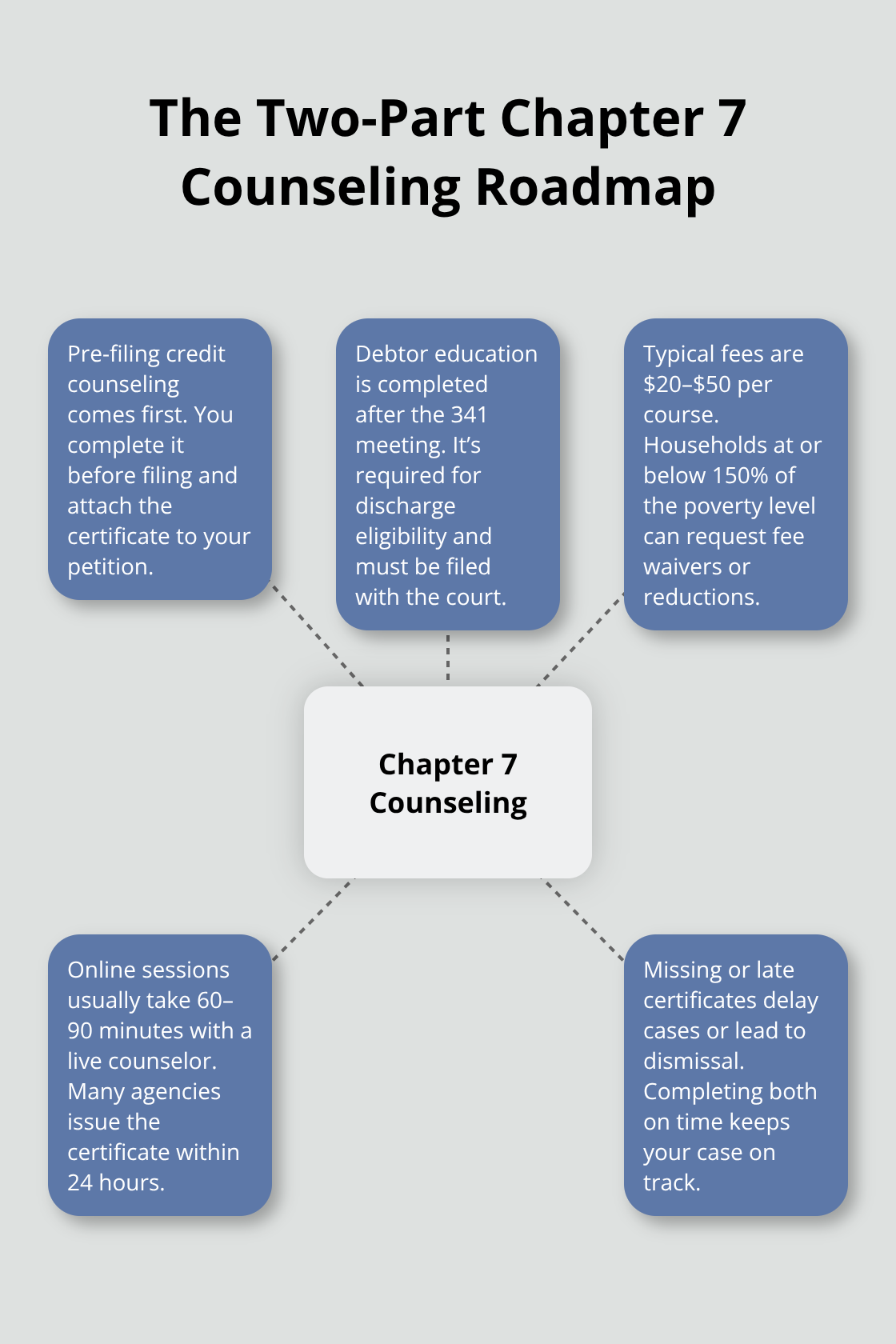
Online sessions dominate because they offer flexibility-most last 60 to 90 minutes with a live counselor reviewing your financial situation in real time, and you receive your completion certificate within 24 hours. This speed prevents filing delays that could otherwise push your case timeline back by weeks.
How Counseling Protects Your Case From Dismissal
The counseling requirement exists because federal law assumes that debtors who understand budgeting, debt alternatives, and post-bankruptcy financial management make better decisions and avoid repeat bankruptcy filings. The counselor reviews your income, expenses, debts, and assets during the session, then discusses whether alternatives like debt management plans or settlement negotiations might work before bankruptcy. This conversation creates a documented record showing you considered other options, which strengthens your case credibility with the trustee at your 341 meeting. Courts and trustees view counseling completion as evidence of good faith-you took the legal requirement seriously and prepared properly before filing. Conversely, missing this step signals carelessness or ignorance of federal rules, and judges view dismissals for missing counseling certificates as entirely avoidable.
Certificate Accuracy Determines Your Filing Success
The certificate itself must contain your full name, the exact completion date, the agency name and U.S. Trustee approval number, and the counselor’s signature. Any errors or mismatches between the certificate and your petition trigger rejection, forcing you to request a replacement and refile, adding weeks to your case. Bringing accurate financial documentation to your counseling session (two recent pay stubs, last year’s tax returns, current debt statements, and 30 days of expense records) ensures the counselor can provide meaningful guidance and generate a complete certificate without corrections. The counselor generates the certificate at the end of your session-online completions produce immediate certificates, in-person completions take about one business day, and many agencies send certificates directly to your attorney to streamline the filing process.
What Happens Next in Your Chapter 7 Timeline
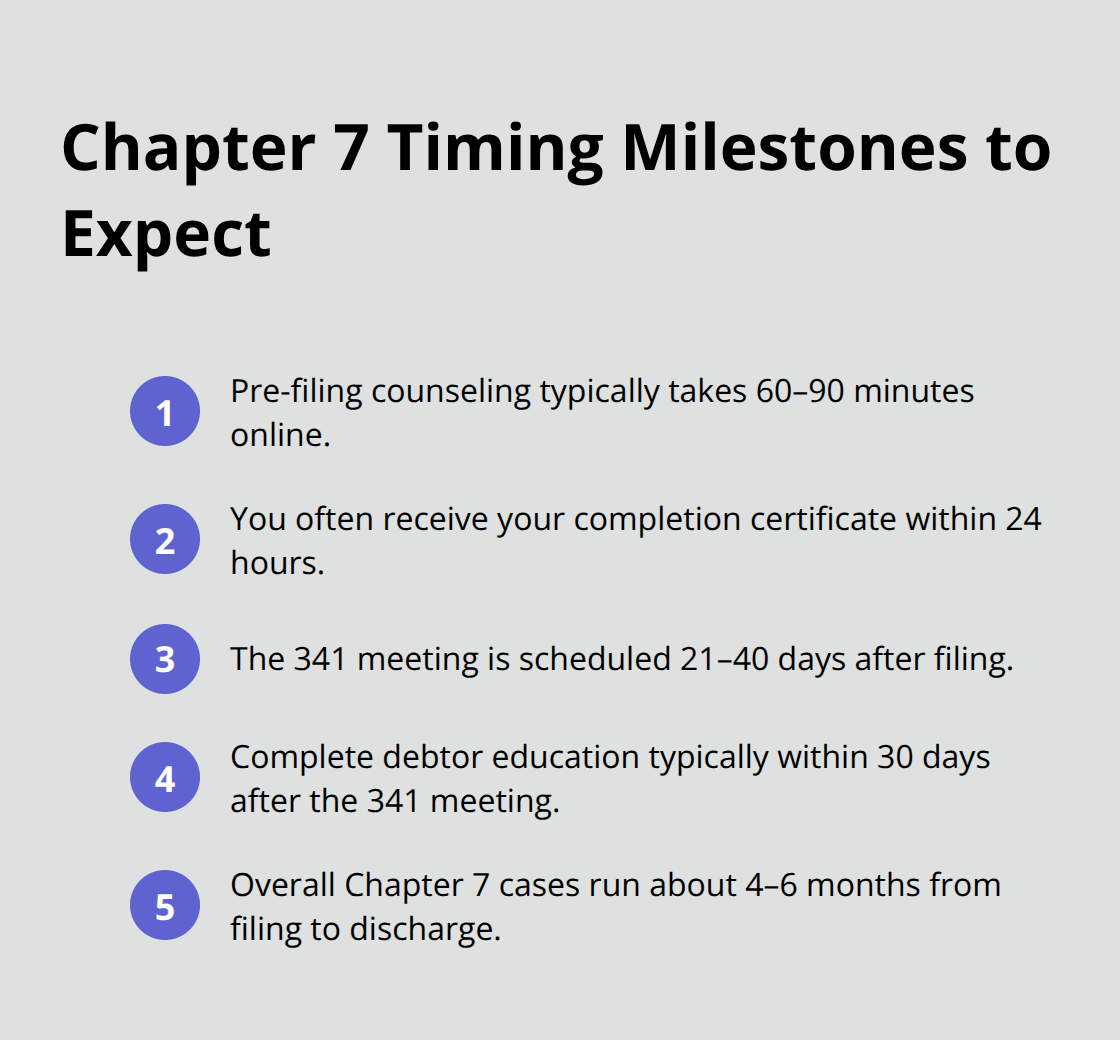
After you file your petition with the completed counseling certificate attached, the court schedules your 341 meeting of creditors within 21 to 40 days. At this meeting, the trustee reviews your finances and asks about your assets, debts, and income. Following the 341 meeting, you must complete the second required course-debtor education from a U.S. Trustee-approved provider-typically within 30 days. This second certificate must also be filed with the court to maintain your discharge eligibility. The overall Chapter 7 timeline runs 4 to 6 months from filing to discharge, and completing both counseling requirements on schedule keeps your case moving forward without interruption.
Selecting and Working With Approved Agencies in Florida
Finding the Right Approved Agency for Your Situation
The U.S. Trustee Program maintains a state- and district-specific list of approved credit counseling agencies, and Florida has dozens of options across multiple judicial districts. Start at the official U.S. Trustee website and filter by your county or judicial district to locate providers serving your area. Well-known providers on the Florida approved list include Cambridge Credit Counseling Corp., GreenPath, Inc., Money Management International (MMI), InCharge Debt Solutions, and CredAbility. Some agencies operate only online or by phone, while others offer in-person sessions; check each agency’s entry for the delivery format that fits your schedule. Pricing typically ranges from $20 to $50 per course, though agencies must cap fees at $50 unless justified, and households at or below 150 percent of the poverty level qualify for waivers or reductions. Verify the agency’s current approval status before enrolling-approvals can change-and confirm that the certificate it issues will be recognized by your court. Your attorney can verify approved agencies and often maintains established relationships with providers who send certificates directly to the law office, eliminating a step you would otherwise handle yourself.
Preparing Your Financial Documentation
Bring comprehensive financial documentation to your counseling session: two recent pay stubs, last year’s tax returns, current statements for all debts (credit cards, medical bills, loans), documentation of assets (home value, vehicle titles, bank accounts, retirement accounts), and 30 days of actual expense records covering utilities, rent or mortgage, insurance, groceries, and medical costs. The counselor will review your income versus expenses, identify your monthly deficit or surplus, discuss your specific debts and any collection or garnishment actions, and explain alternatives like debt management plans or settlements-all without giving legal advice about whether you should file bankruptcy. This session creates a documented record showing you explored options before filing, which strengthens your credibility with the trustee at your 341 meeting.
Understanding the Counseling Session Format and Timeline
Online sessions typically last 60 to 90 minutes with a live counselor, and you receive your completion certificate immediately after the session ends. In-person completions take about one business day, and phone counseling offers real-time interaction though with less scheduling flexibility. The certificate must contain your full name, exact completion date, agency name and U.S. Trustee approval number, and the counselor’s signature-any errors force you to request a replacement and refile, delaying your case by weeks. Many agencies send certificates directly to your attorney, but if yours does not, bring the original certificate to your attorney at least three business days before your planned filing date to allow time for corrections if needed. This preparation step ensures your petition moves forward without interruption and positions you to meet the next critical deadline in your Chapter 7 process.
What Goes Wrong When You Skip or Mess Up Credit Counseling in Florida
Filing Without the Required Pre-Filing Certificate
Filing Chapter 7 without completing pre-filing credit counseling destroys your bankruptcy protection instantly. The court does not issue warnings or grace periods-it automatically dismisses your case the moment it discovers the missing certificate. Once dismissed, your creditors resume collection calls, wage garnishments restart if they were paused, and foreclosure timelines restart from zero. Clients have filed without counseling certificates, thinking they could complete the course after filing, only to have their petitions rejected within days. Federal law under 11 U.S.C. § 111 is absolute: the certificate must accompany your petition at the time of filing, not arrive later. The U.S. Trustee Program enforces this rule uniformly across all Florida districts and nationwide because the statute leaves no room for exceptions.
Selecting an Unapproved Agency and Losing Your Case
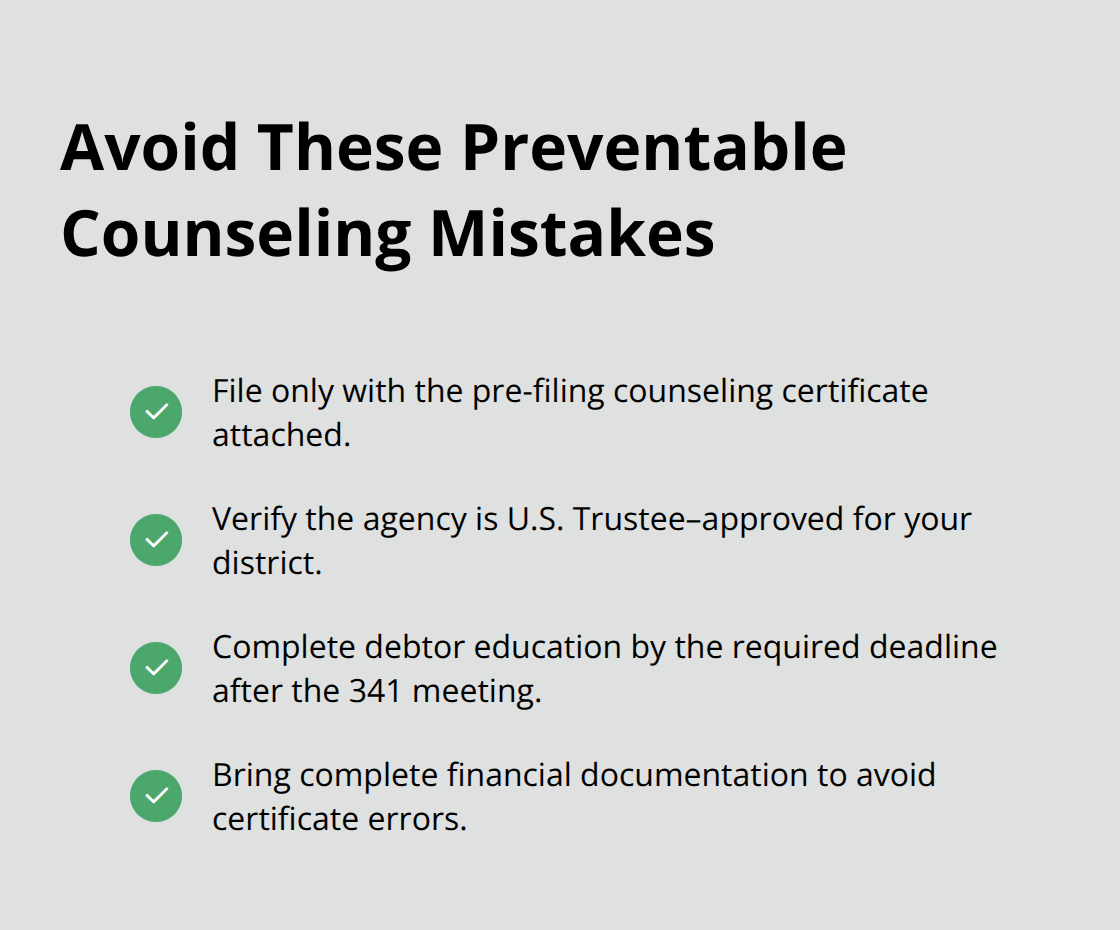
Choosing an unapproved agency is equally destructive. You might spend $30 or $50 on counseling, receive a certificate, and believe you have satisfied the requirement-then discover at filing that the agency was never approved by the U.S. Trustee for your judicial district. The certificate becomes worthless, your petition cannot proceed, and you start the entire process over, costing weeks and potentially thousands in additional legal fees. Many people find agencies through Google searches or recommendations without verifying approval status on the official U.S. Trustee list. This mistake is completely preventable: your attorney will verify agency approval before you enroll, and established firms maintain relationships with approved providers in your district, eliminating guesswork entirely.
Missing the Post-Discharge Financial Management Course Deadline
The second critical mistake is overlooking the post-discharge financial management course required after your 341 meeting. This is not optional-it is a separate federal requirement under 11 U.S.C. § 111 that must be completed within 60 days after your 341 meeting to finalize your discharge. Many people complete pre-filing counseling, attend their 341 meeting, and assume they are finished, then receive a notice weeks later stating their discharge is on hold pending completion of debtor education. This delay frustrates clients who thought their case was closed and extends your timeline by 30 to 60 days. The second course costs another $20 to $50 from an approved provider and takes 60 to 90 minutes online, but the deadline is strict-missing it means your discharge does not become final.
Arriving Unprepared With Incomplete Financial Documentation
Some people fail to bring adequate financial documentation to their pre-filing counseling session, which forces the counselor to make assumptions about expenses or income. This incomplete session produces a weaker record and may result in a certificate that contains errors or missing details, triggering rejection at filing. Gathering two recent pay stubs, last year’s tax returns, current debt statements, and 30 days of expense records before your counseling appointment takes two hours and prevents certificate rejections that would delay your filing by weeks. The cost of prevention-two hours of your time-is infinitely smaller than the cost of correction. Bring comprehensive documentation (home value, vehicle titles, bank accounts, and retirement account statements) to ensure the counselor can provide meaningful guidance and generate a complete certificate without corrections.
Final Thoughts
Credit counseling in Chapter 7 bankruptcy protects your case from automatic dismissal and demonstrates good faith to the trustee. The two-part requirement-pre-filing counseling and post-discharge financial management-exists because courts recognize that debtors who understand budgeting and debt alternatives make better long-term decisions. Completing credit counseling Chapter 7 from an approved agency and attaching the certificate to your petition creates a documented record showing you explored all options before filing, which strengthens your credibility at your 341 meeting and keeps your case moving toward discharge.
The mistakes that derail cases are entirely preventable. Filing without a counseling certificate, selecting an unapproved agency, or missing the post-discharge financial management course deadline cost you weeks of delay, thousands in additional legal fees, and the loss of bankruptcy protection when creditors resume collection efforts. Bringing complete financial documentation to your counseling session, verifying agency approval status before enrolling, and marking both course deadlines on your calendar takes minimal effort and eliminates the most common reasons cases fail.
Contact Harnage Law, PLLC to verify approved counseling agencies in your district and coordinate your counseling timeline with your filing date. The firm guides you through every step of the bankruptcy process, stopping creditor harassment, preventing wage garnishments, and protecting your assets so you can rebuild your financial future.