Chapter 7 bankruptcy offers several distinct payment options, and choosing the right one depends entirely on your financial circumstances and what you want to keep.
We at Harnage Law, PLLC know that Florida residents often feel overwhelmed by the different paths available-from trustee arrangements to reaffirmation agreements to complete debt discharge. This guide walks you through each option so you can make an informed decision about your relief strategy.
What Chapter 7 Payment Plans Actually Cover
Chapter 7 bankruptcy works differently than Chapter 13, which locks you into a structured repayment plan for three to five years. In Chapter 7, you don’t make monthly payments to a trustee for years-instead, the trustee liquidates your nonexempt assets once, and most of your unsecured debts vanish completely. The court filing fee totals $335 ($245 filing plus $75 administrative plus $15 trustee surcharge), and you must pay this before your case is filed. Florida residents often assume Chapter 7 means setting up a payment arrangement, but the reality is much simpler: you surrender nonexempt property, the trustee sells it, and creditors receive distributions based on priority. If your case has no nonexempt assets-which the U.S. Courts data shows applies to most Chapter 7 cases involving individuals-you pay nothing to creditors after filing.
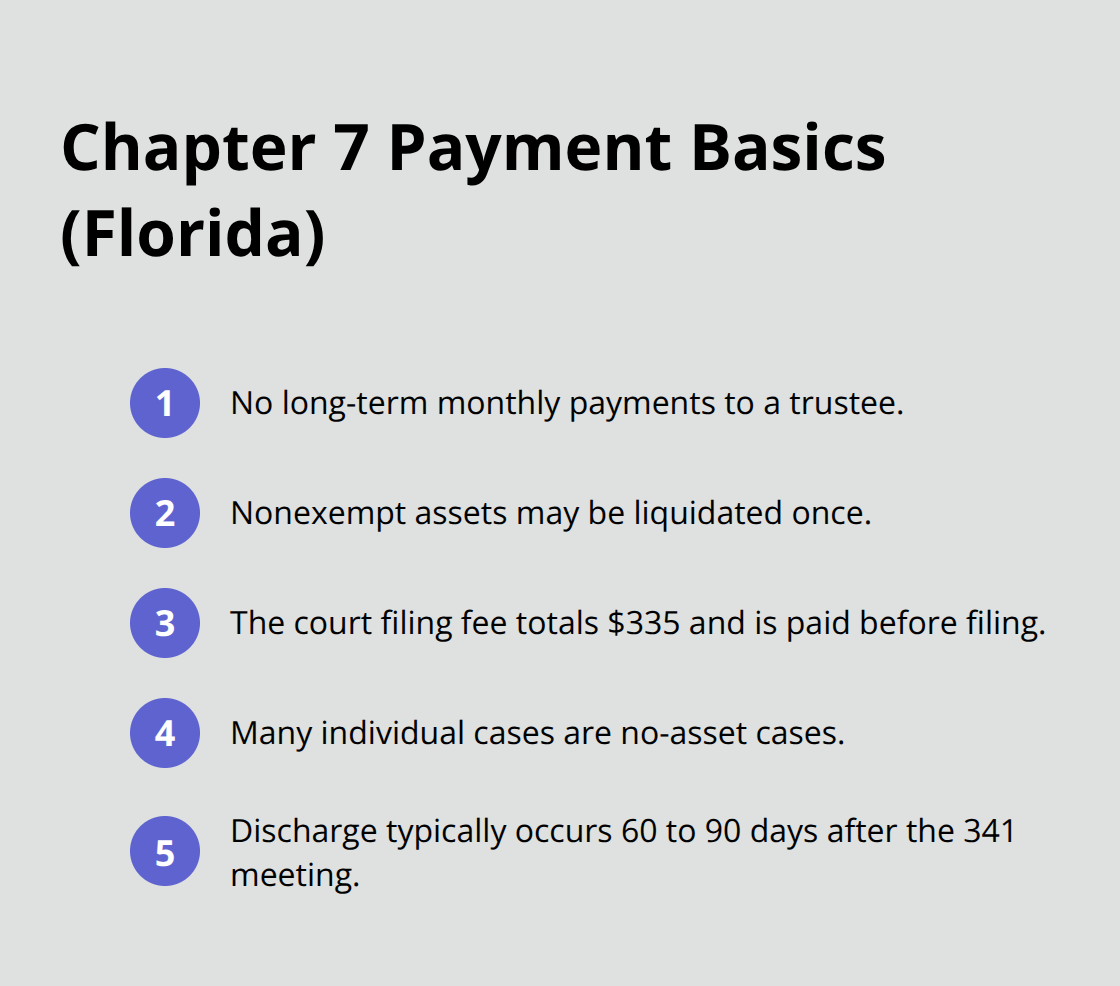
Your actual payment obligations depend entirely on what you own and whether you want to keep secured property like a car or home. If you reaffirm a car loan or mortgage, you continue making those payments directly to the lender, not to the trustee, and those payments aren’t part of a Chapter 7 plan-they represent your choice to keep the collateral. The means test, which assesses your monthly income and expenses under 11 U.S.C. § 707(b), determines whether you qualify for Chapter 7 at all, but passing it creates no payment obligations to the court. Unlike Chapter 13, where disposable income flows into a repayment plan, Chapter 7 frees you from most unsecured debts immediately after discharge, typically within 60 to 90 days following your 341 creditors’ meeting. Understanding what you’ll actually owe sets the stage for exploring the specific payment arrangements available to you.
Option 1: The 341 Meeting and Trustee Payment Arrangements
Your 341 creditors’ meeting takes place 21 to 40 days after you file and represents the single most important event in your Chapter 7 case. The trustee assigned to your case will question you under oath about your assets, income, debts, and financial transactions from the past six years. This meeting determines whether you have nonexempt property the trustee can liquidate and whether your case qualifies as a no-asset case, meaning creditors receive nothing. According to U.S. Courts data, most Chapter 7 cases are no-asset cases, so many filers attend this meeting only to learn they owe the trustee nothing. The trustee reports any concerns about abuse to the court within ten days after your meeting, and if no issues arise, your case moves toward discharge.
The trustee evaluates your payment capacity by examining your monthly income, necessary expenses, and any property you own that falls outside Florida’s exemption protections. If you have disposable income after covering essential costs, the trustee may propose a settlement payment or request you surrender specific assets like a second vehicle or valuable personal property. The trustee only takes nonexempt assets and must follow strict valuation rules under 11 U.S.C. § 704, so liquidation is not automatic. Many Florida residents discover during this meeting that their primary residence, one vehicle, and retirement accounts remain protected, meaning they keep far more than they feared. Arrive prepared with documentation of your income, debts, and property values so you can answer questions directly and demonstrate your actual financial position to the trustee, which sets the foundation for understanding what reaffirmation agreements might mean for property you want to keep.
Option 2: Keeping Secured Property Through Reaffirmation
Reaffirmation agreements let you keep a car, home, or other secured property by agreeing to continue paying the underlying loan after your Chapter 7 discharge. Under 11 U.S.C. § 524(k), any reaffirmation must be in writing with specific disclosures, and the creditor cannot force you into this arrangement. The critical decision point arrives when you realize that without reaffirmation, the lender can repossess collateral even though your personal debt obligation disappears through discharge. Many Florida residents choose reaffirmation for vehicles because losing a car directly impacts employment and daily functioning, making the ongoing payment obligation worth the cost. If you have equity in a home and want to keep it, reaffirmation of the mortgage is typically necessary, though this ties you to debt payments that Chapter 7 would otherwise eliminate.
The mechanics differ sharply from asset surrender: instead of the trustee liquidating your property, you keep it and make regular payments directly to the lender on the original loan terms. If your car loan shows a remaining balance of $12,000 and the vehicle is worth $10,000, reaffirmation locks you into paying the full $12,000 rather than allowing the trustee to sell it and satisfy the debt for $10,000. This trade-off makes sense only when the property’s value to your life exceeds the financial burden of continued payments.
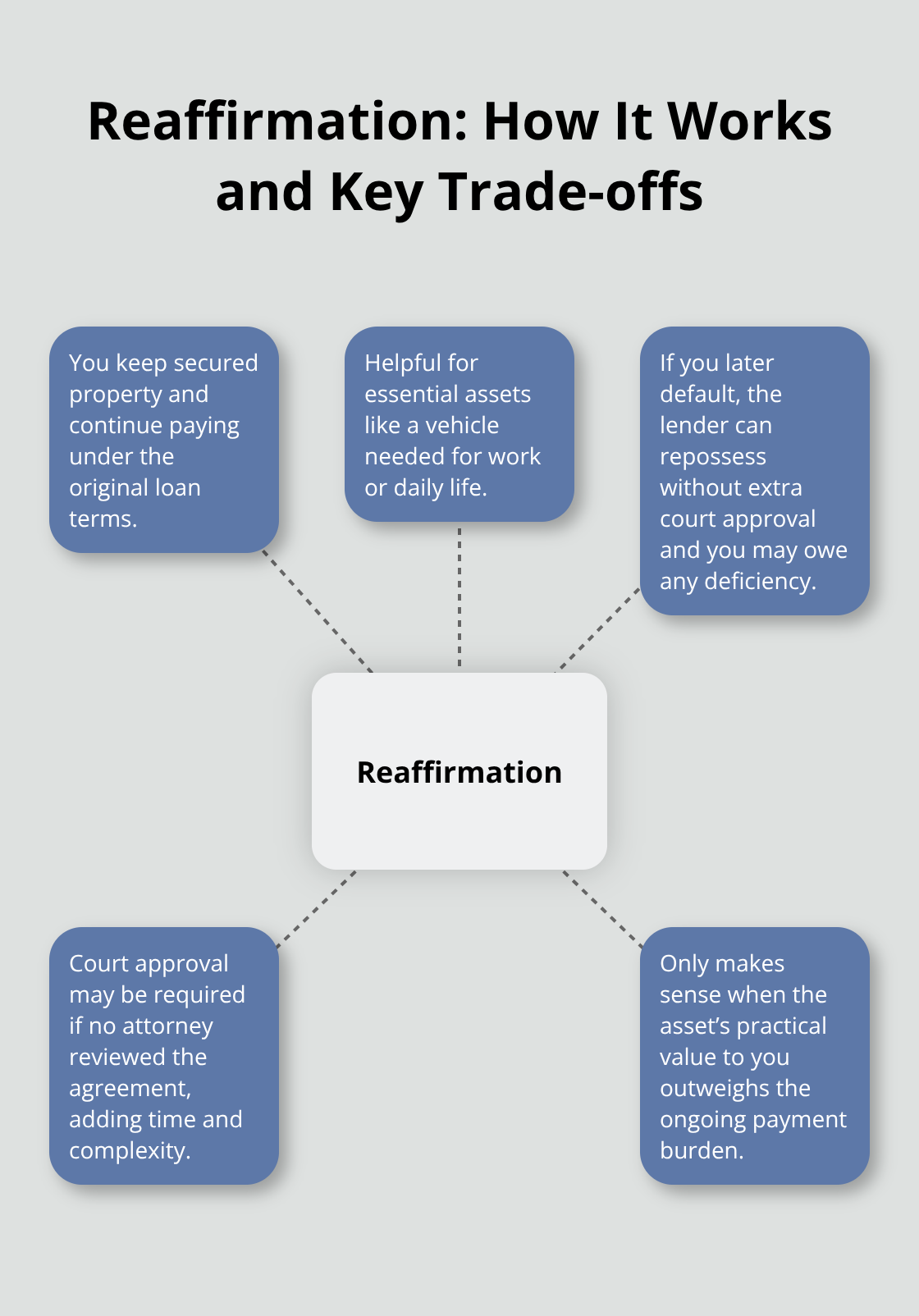
The risks are substantial-if you later cannot afford reaffirmation payments, the creditor can repossess without additional court approval, and you remain liable for any deficiency between the sale price and outstanding balance. Court approval is required if you did not have an attorney review the reaffirmation agreement, adding time and complexity to the process.
Evaluate whether each piece of secured property justifies the ongoing obligation, because Chapter 7’s core benefit is eliminating debt, and reaffirmation deliberately reverses that benefit for specific assets. Understanding how reaffirmation affects your financial picture prepares you to consider whether other options-such as cramdown arrangements for vehicle loans-might better serve your situation.
Option 3: Reducing Vehicle Loan Balances
Chapter 7 does not technically allow cramdowns in the traditional sense that Chapter 13 does, and this distinction matters enormously for Florida residents considering their options. A cramdown under Chapter 13 lets you reduce a vehicle loan to the collateral’s actual value, but Chapter 7 operates under different rules governed by 11 U.S.C. § 506. In Chapter 7, you cannot unilaterally reduce what you owe on a car loan through court action the way Chapter 13 permits. Instead, your realistic options narrow to either reaffirming the full loan amount, surrendering the vehicle and walking away from the debt, or negotiating a settlement directly with the lender outside the bankruptcy process. Many Florida filers mistakenly believe Chapter 7 offers cramdown protection, then discover too late that their only path forward requires accepting reaffirmation at the original loan balance or losing the vehicle entirely.
If your vehicle loan balance significantly exceeds the car’s market value, Chapter 7 creates a genuine problem that reaffirmation cannot solve favorably. Some lenders will negotiate informal settlements during bankruptcy, allowing you to pay a reduced lump sum to keep the vehicle, though this remains entirely voluntary on the creditor’s side and carries no legal guarantee. The trustee cannot force this negotiation or compel the lender to accept less than owed, making it purely a business decision by the creditor. Your practical path involves requesting a settlement offer from the lender before or immediately after filing, presenting your financial circumstances, and proposing a one-time payment that satisfies their interests better than repossession and resale. This negotiation happens outside the formal bankruptcy framework and requires direct communication with the lender’s loss mitigation department rather than through court procedures, which then leads to exploring whether lump sum settlements might work across your entire debt portfolio.
Option 4: Debts That Vanish Completely
Chapter 7 eliminates most unsecured debts the moment your discharge is granted, typically 60 to 90 days after your 341 meeting. Credit card balances, medical bills, personal loans, and payday loans disappear entirely under 11 U.S.C. § 727, meaning creditors cannot pursue collection efforts once the court issues your discharge order. If you carry $35,000 in credit card debt and $18,000 in medical bills from a hospital stay, both amounts vanish without any repayment obligation. This complete elimination applies regardless of whether you had income to pay these debts or whether creditors object, making Chapter 7 fundamentally different from Chapter 13, where you repay a portion through a structured plan. Most Chapter 7 cases involving individuals are no-asset cases according to U.S. Courts data, meaning creditors receive zero distribution and you discharge your debts while keeping all exempt property.
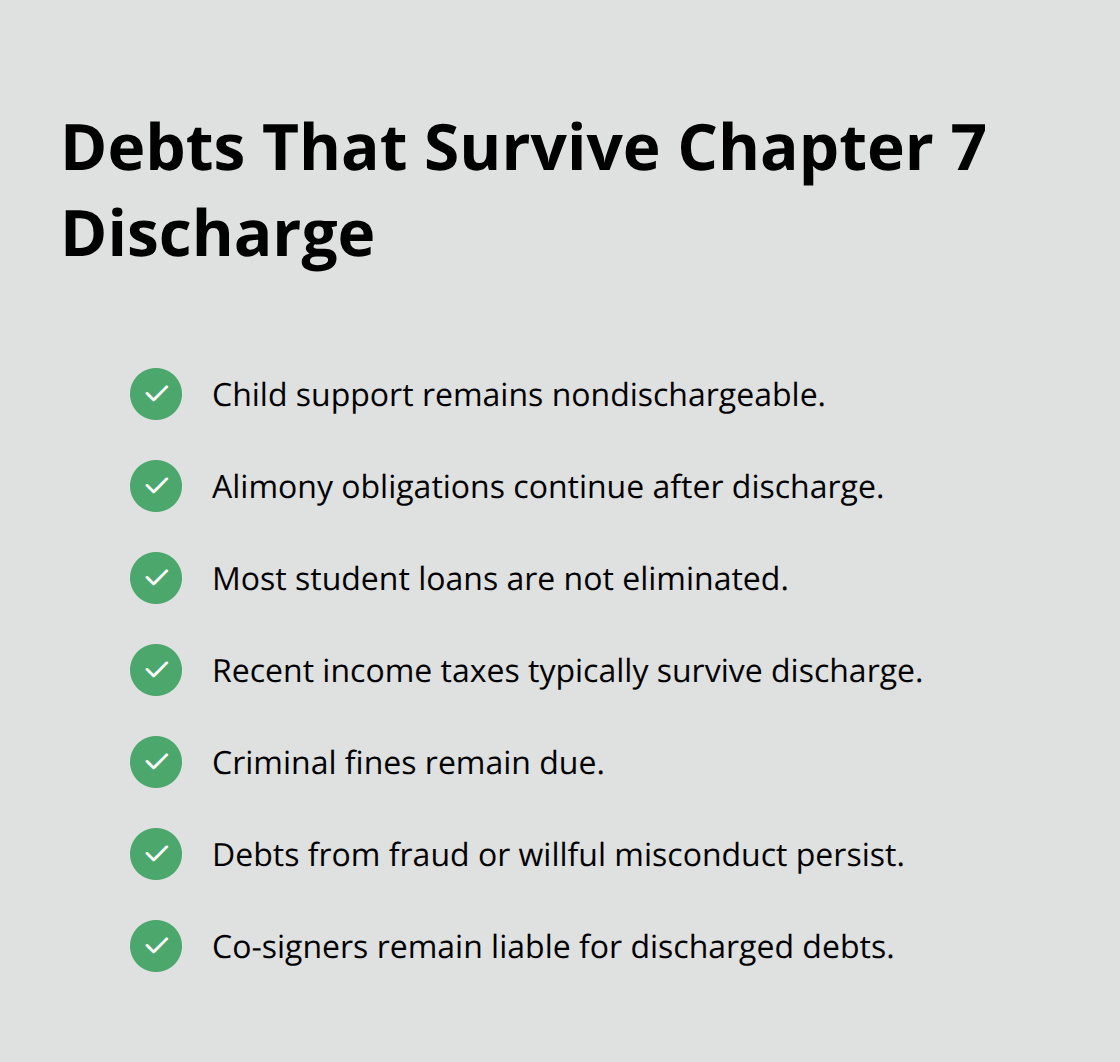
The critical limitation is knowing which debts survive discharge because some obligations persist even after your case closes. Child support, alimony, most student loans, recent taxes, criminal fines, and debts arising from fraud or willful misconduct remain nondischargeable under 11 U.S.C. § 523. Co-signers on your discharged debts remain liable for the full balance, so your discharge does not protect anyone who signed alongside you on a credit card or personal loan. Map out your debts before filing to identify which ones disappear completely and which ones require ongoing attention after discharge.
This clarity positions you to structure your case around protecting assets you want to keep while letting unsecured obligations vanish, then move forward to evaluate lump sum settlement options that might accelerate your fresh start.
Option 5: One-Time Payments to Settle Faster
Most Chapter 7 cases involve no asset distribution to creditors, but when your case contains liquidatable property, the trustee may accept a lump sum settlement instead of waiting months for asset sales to complete. This approach works best when you have nonexempt equity in property but prefer to keep it rather than surrender it for liquidation. You negotiate directly with the trustee to pay a fixed amount upfront that satisfies their interest in recovering value from your estate, allowing you to retain the property and move toward discharge faster. The trustee holds no obligation to accept this arrangement, so the negotiation must present genuine financial benefit compared to the liquidation timeline and sale costs. Settlement amounts typically range from 30 to 70 percent of the property’s market value depending on the trustee’s assessment of liquidation expenses and recovery likelihood.
Creditors outside the bankruptcy process may also negotiate lump sum settlements on unsecured debts before or during your case, though this avenue requires direct communication and occurs entirely outside trustee involvement. Some creditors prefer receiving 40 to 60 percent of an owed balance immediately rather than waiting through a bankruptcy discharge that yields nothing, making settlement particularly attractive when you have access to funds from family, savings, or a settlement of your own. The financial advantage lies in closure: you eliminate specific debts faster, reduce your total obligation, and avoid the uncertainty of creditor objections or disputes. You should document any settlement agreement in writing before transferring funds, and you must confirm the creditor will report the debt as settled to credit bureaus rather than charged-off, which protects your credit recovery trajectory after discharge. Understanding how settlement payments accelerate your path to discharge positions you to evaluate income-based calculations that determine whether you face any payment obligations at all.
Option 6: Disposable Income and Your Payment Obligations
The means test under 11 U.S.C. § 707(b) calculates your disposable income by taking your average monthly income over the six months before filing and subtracting allowed expenses for housing, food, transportation, and other necessities. If your income falls below the median for a family of your size in Florida, you pass the means test automatically and face no abuse concerns. If your income exceeds the median, the calculation becomes more detailed: the trustee applies standardized expense amounts from IRS guidelines rather than your actual spending, which often results in a disposable income figure that differs significantly from your real financial situation. The Official Form B22A determines not whether you must pay, but whether Chapter 7 remains available to you versus forcing conversion to Chapter 13. Florida residents with recent job loss, medical emergencies, or significant child support obligations can reduce their calculated income, lowering disposable income figures that might otherwise appear problematic.
Your income includes wages, self-employment earnings, rental income, Social Security benefits, pension payments, and regular support received from family members, according to bankruptcy code Section 101. Some income sources do not count: workers compensation, certain disability payments, and assistance programs like TANF or SSI remain excluded from the calculation. Many Florida filers discover they have zero disposable income after the means test applies IRS expense standards, meaning they owe nothing to creditors through a repayment plan and qualify for Chapter 7 discharge without any payment obligation beyond the court filing fee paid upfront. This zero-disposable-income result happens frequently because the IRS standards allow substantial deductions for vehicle payments, insurance, and other regular costs that reduce your theoretical surplus to zero or below. Knowing where your income and expenses fall within this framework prevents surprises at your 341 meeting and clarifies whether your path forward involves asset liquidation, reaffirmation agreements, or straightforward debt discharge without ongoing payments-which then shapes how you approach the final decision about which payment option aligns with your specific financial circumstances.
Final Thoughts
Selecting the right Chapter Seven payment option requires honest assessment of what you own, what you want to keep, and what you can afford after discharge. List your assets and identify which ones fall outside Florida’s exemption protections-your primary residence, one vehicle, and retirement accounts typically remain safe, but second properties and significant vehicle equity may face liquidation. Calculate your actual monthly disposable income by reviewing your paystubs, expenses, and any irregular income sources over the past six months, which mirrors what the means test will show.
During your consultation, ask whether your case qualifies as a no-asset case, which determines whether you’ll face any trustee liquidation at all. Request a clear explanation of which debts will vanish completely and which obligations survive discharge, since this distinction directly impacts your financial planning after your case closes. Inquire about reaffirmation timing and whether negotiating a settlement with your vehicle lender makes sense before filing, because this decision affects whether you keep secured property and what payments continue afterward.
Gather documentation including recent paystubs, tax returns, a complete list of debts from your credit report, property valuations, and statements showing any nonexempt assets. We at Harnage Law, PLLC help individuals and families overcome financial challenges by providing legal guidance through every step of the bankruptcy process, stopping creditor harassment and preventing wage garnishments while protecting assets you want to keep. Contact Harnage Law, PLLC to discuss your Chapter Seven payment options and determine which path aligns with your financial circumstances and goals.